
Grade 2 vs Grade 5 Titanium Forgings
Grade 2 and Grade 5 titanium forgings are not interchangeable. Grade 2 (commercially pure titanium) is commonly selected for corrosion resistance and ductility, while Grade 5 (Ti-6Al-4V) is selected for substantially higher strength-to-weight performance. Final selection follows the design, environment, forging specification, condition and heat treatment.
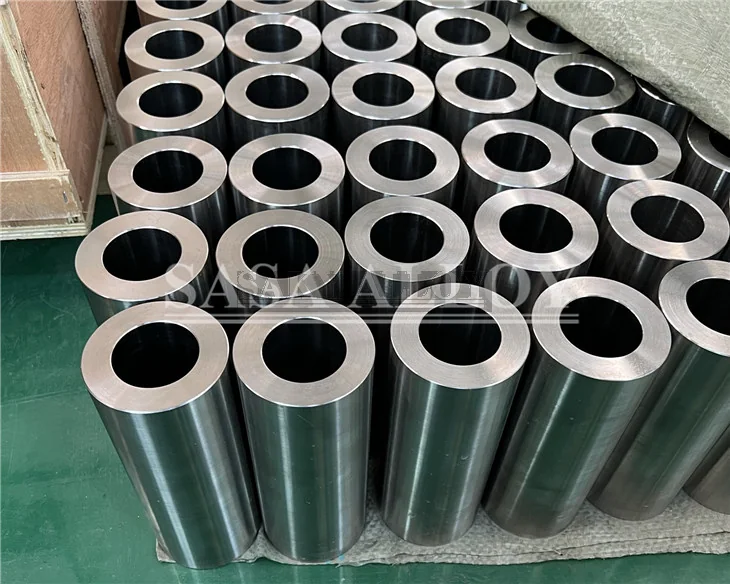
Grade 2 vs Grade 5 Forgings
| Item | Grade 2 family | Grade 5 family |
|---|---|---|
| Alloy type | Commercially pure titanium, UNS R50400 | Ti-6Al-4V alpha-beta alloy, UNS R56400 |
| Selection emphasis | Corrosion resistance, ductility and industrial fabrication | Higher strength and strength-to-weight performance |
| Heat-treatment sensitivity | Order-defined condition within the applicable specification | Heat treatment strongly influences final properties and acceptance |
| Critical review | Strength, environment, crevices and section | Environment, toughness/fatigue, heat treatment and inspection |
Use the Correct Forging Specification
State the applicable forging specification, revision and grade designation. Do not transfer chemistry, properties or acceptance criteria from plate or bar automatically. Finished requirements depend on forging section, condition, heat treatment and test coupon location.
Corrosion and Strength Are Separate Decisions
Grade 2 is often evaluated for chemical and marine corrosion service; Grade 5 is commonly evaluated for higher-load aerospace, mechanical and industrial components. Higher strength does not prove better corrosion performance. Review medium, temperature, stress, crevices, galvanic interfaces and design code.
Heat Treatment, Section and Test Orientation
Define delivery condition, permitted heat-treatment route, section size and required mechanical tests. State coupon location and orientation relative to grain flow and critical load direction. Large sections may require additional property, microstructure or hardenability-related review under the project specification.
Machining and NDT
Provide finished drawing, stock envelope and machining allowance. Specify ultrasonic and penetrant examination, acceptance class, surface condition and dimensional reporting. Require continuous heat and forging-lot traceability through heat treatment, testing and rough machining.
Request a Grade-Controlled Forging
Browse Titanium Forgings, Grade 5 Titanium Forged Disc and Custom Titanium Forging.
RFQ Checklist
- Grade, forging specification, revision and condition
- Finished drawing, stock dimensions and quantity
- Heat treatment, section and test orientation
- Machining allowance and delivery state
- UT/PT, acceptance criteria, certificate and traceability
FAQ
Is Grade 5 always better because it is stronger?
No. Strength, corrosion, ductility, fabrication, cost and code requirements must all suit the component.
Can Grade 5 replace Grade 2 without redesign?
No. Substitution requires engineering review of properties, environment, dimensions, joining and specification.
Can forging properties be taken from a plate data sheet?
No. Use the applicable forging specification, condition, section and certified test results.
Related Reading
Ring, Disc and Sleeve Selection · Bar, Shaft and Block RFQ · Machining Allowance