
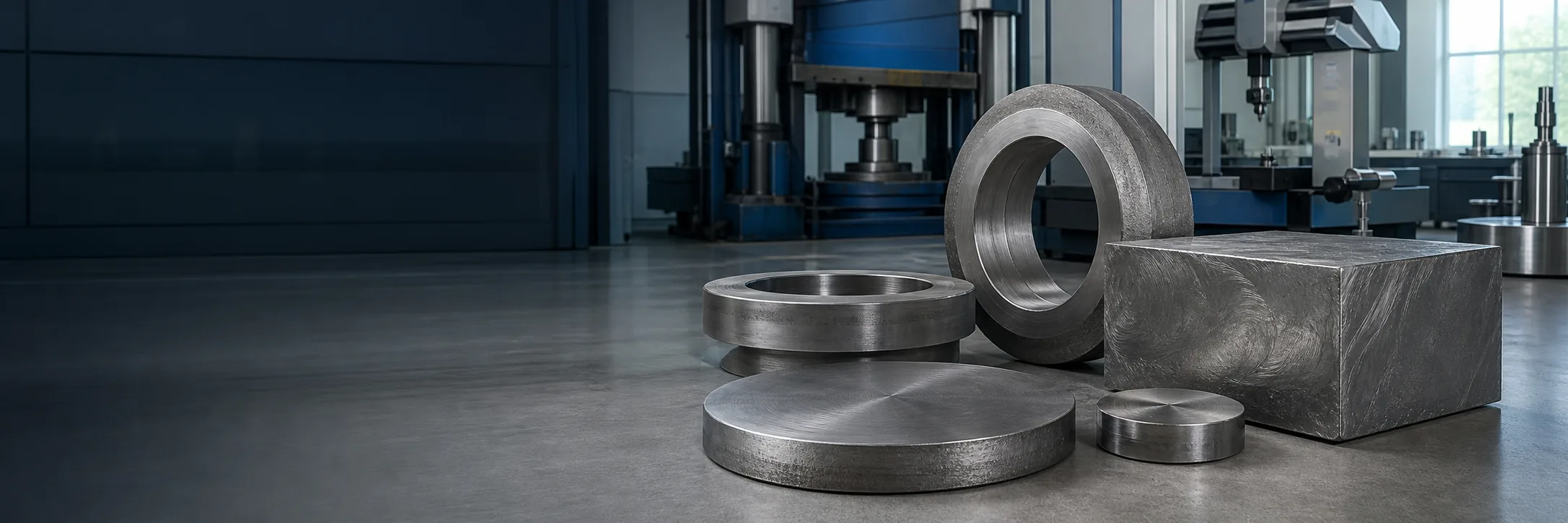
Titanium Circular Blank vs Forged Disc
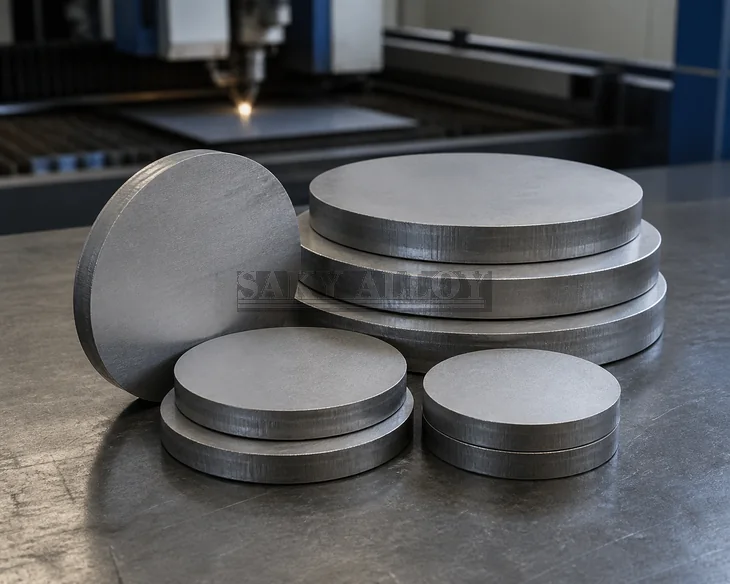
A plate-cut titanium circular blank and a forged disc are different product forms and should not be substituted without design approval. The component specification determines whether rolled plate direction or forging reduction and grain flow are required.
Product-Form Comparison
| Item | Plate-cut blank | Forged disc |
|---|---|---|
| Source | Rolled plate | Forging billet or stock |
| Definition | Plate standard plus cut drawing | Forging standard plus component drawing |
| Key controls | Thickness, rolling direction, edge and flatness | Reduction, grain flow, heat treatment and NDE |
| Typical decision | Plate-qualified geometry and stock removal | Design requiring forged product form |
Design and Qualification Boundary
Pressure, rotating, aerospace and fatigue-sensitive components may mandate a product form and manufacturing route. Mechanical-property similarity alone does not prove interchangeability. Obtain written engineering approval before substitution.
Machining, Testing and Records
Define grade, standard, dimensions, machining allowance, heat treatment, mechanical tests, ultrasonic or penetrant examination, MTC and heat traceability. Finished-part acceptance remains governed by the controlled drawing and quality plan.
Review Plate-Cut Options
Grade 2 Circular Blank, Grade 5 Circular Blank and Titanium Forgings.
RFQ Checklist
- Approved product form and drawing
- Grade, source standard and condition
- OD, thickness and machining allowance
- Heat treatment, properties and NDE
- Certificates, traceability and quantity
FAQ
Can plate replace a forged disc if dimensions match?
Not without design and qualification approval.
Does every circular component require forging?
No. Follow the applicable design, product-form and service requirements.
Related Reading
Grade 2 vs Grade 5 · Specify Circular Blanks · Cutting Route Comparison
Direct Answer: Plate-Cut Circular Blank or Forged Disc?
Use a plate-cut circular blank when certified rolled plate provides the required thickness, properties, orientation and inspection and when cutting plus machining is economical. Use a forged disc when section size, through-thickness quality, grain-flow expectations, forging qualification or heavy-duty service requires a forged route. They are not interchangeable starting products.
| Decision factor | Plate-cut blank | Forged disc |
|---|---|---|
| Starting product | ASTM B265 or approved rolled plate | ASTM B381 or approved forging stock |
| Geometry | Diameter/profile cut from plate thickness | Forged circular envelope with face/radial allowance |
| Material flow | Retains rolled-plate direction | Forging route can be designed for reduction and grain flow |
| Inspection | Parent-plate MTC, blank dimensions, edge and optional UT | Forging traceability, heat treatment, mechanical tests and specified UT/PT |
| Typical fit | Moderate thickness, covers and general machined parts | Heavy section, pressure, fatigue or qualification-driven parts |
RFQ Information
Provide the finished drawing, titanium grade, required material or forging standard, diameter and thickness, machining allowance, rolling or grain direction, condition, quantity, cutting or forging route restrictions, surface, tolerances, test location, NDE and certification. The supplier should not choose a lower-cost starting form when the drawing or design qualification requires the other route.
FAQ
Can a forged disc be replaced with cut plate?
Only with engineering approval after reviewing product specification, grain direction, properties, thickness, NDE and qualification.
Which route has less machining waste?
It depends on finished geometry and available stock. Plate cutting may be efficient for thinner discs; near-net forging may reduce waste for thicker or profiled parts.
Which standards are normally referenced?
ASTM B265 may govern source plate and ASTM B381 may govern forgings when expressly invoked; the drawing controls finished geometry.
Grade 2 Circular Blank | Grade 5 Circular Blank | Grade 5 Forged Disc | Request a quote