

Titanium Washers: Flat, Lock and Belleville Selection Guide
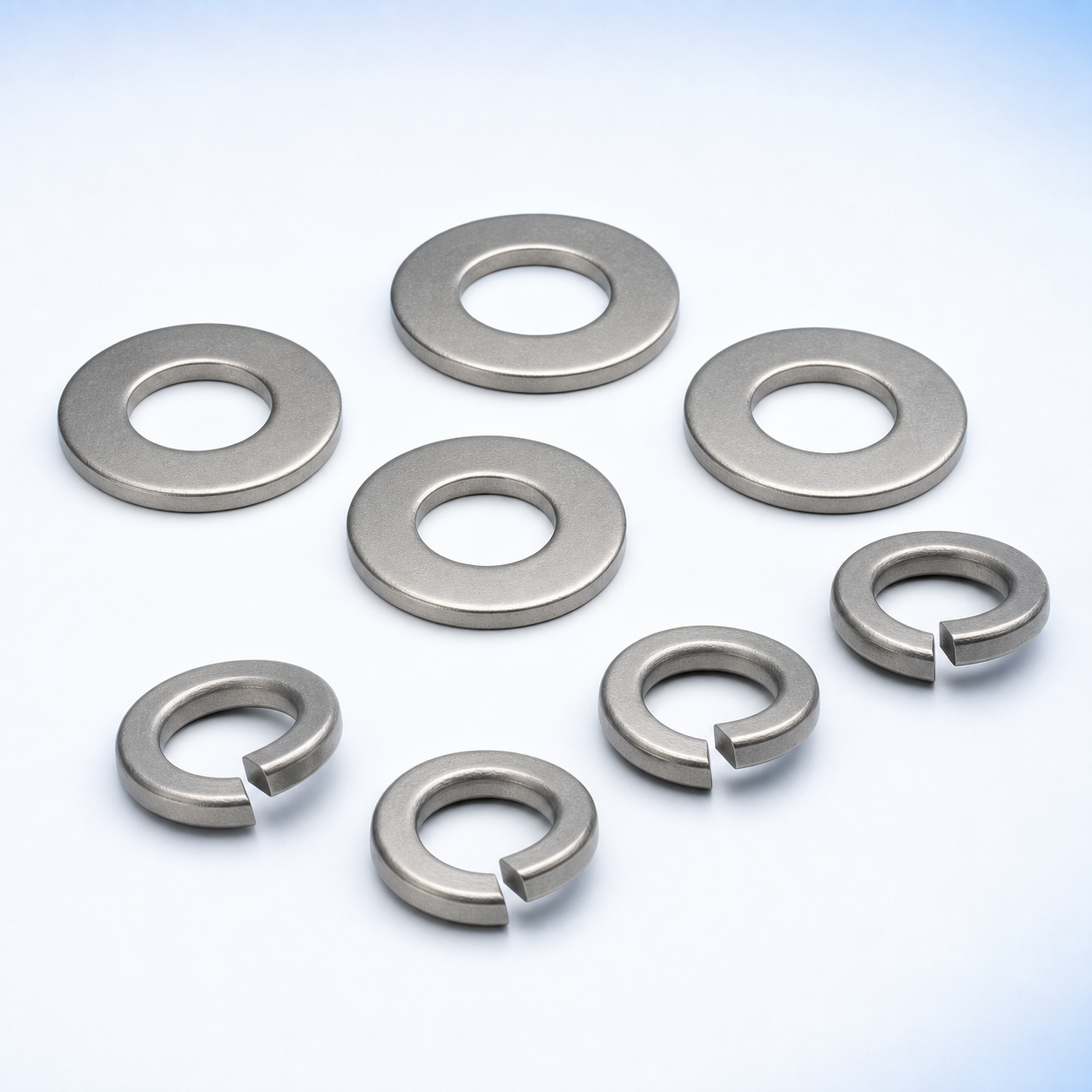
A titanium washer should be selected by joint function rather than appearance. Flat washers distribute bearing load, split lock washers provide a specified spring feature, and Belleville washers provide engineered axial load–deflection behavior.
Titanium Washer Selection Matrix
| Type | Primary function | Critical RFQ data |
|---|---|---|
| Flat washer | Distribute bearing load and protect surface | ID, OD, thickness, flatness, hardness and finish |
| Split lock washer | Spring feature in a validated joint | Standard, section, free height, direction and mating fastener |
| Belleville washer | Controlled axial spring force | ID, OD, thickness, free height, load–deflection curve and fatigue |
Flat Washer Bearing Design
Choose ID clearance, OD and thickness from bolt size, hole, clamped-material bearing strength and available space. A larger washer can reduce contact stress but may create edge or fit conflicts. Define burr, edge and flatness where sealing or soft surfaces are involved.
Locking Is a Joint-System Decision
A split lock washer does not guarantee resistance to loosening in every vibration or thermal cycle. Use the specified standard and validate the complete joint, including preload, friction, embedment, mating surfaces and service. Do not substitute washer types solely because dimensions are similar.
Belleville Load, Stacking and Fatigue
For Belleville washers, provide target force and deflection, working height, cycle range and environment. Series stacking increases deflection; parallel stacking increases force, subject to friction and manufacturing tolerances. Engineering must define stack orientation, guides, relaxation and fatigue acceptance.
Material, Testing and Traceability
State grade, condition, standard or drawing, dimensions and quantity. Spring washers may require hardness, load–deflection, set or fatigue testing. Require dimensional inspection, surface acceptance, MTC and lot traceability.
Choose the Washer by Joint Function
Grade 2 Flat Washers, Grade 5 Flat/Lock Washers, Grade 5 Belleville Washers and Grade 2 Split Lock Washers.
RFQ Checklist
- Joint function, washer type, grade and standard/drawing
- ID, OD, thickness, free height and quantity
- Mating bolt, nut, surface and environment
- Required load–deflection, set or fatigue tests
- Surface, MTC, traceability and packaging
FAQ
Can a flat washer replace a Belleville washer?
No. A flat washer distributes load; a Belleville washer supplies engineered spring behavior.
Does a split washer prevent all loosening?
No. Joint validation and preload control remain necessary.
Can Belleville washers be stacked?
Yes, but force, deflection, friction and fatigue must be engineered.
Related Reading
Fastener Matrix · Grade 2 vs Grade 5 Hex Fasteners · Prevent Galling