

How to Prevent Galling in Titanium Bolts and Nuts
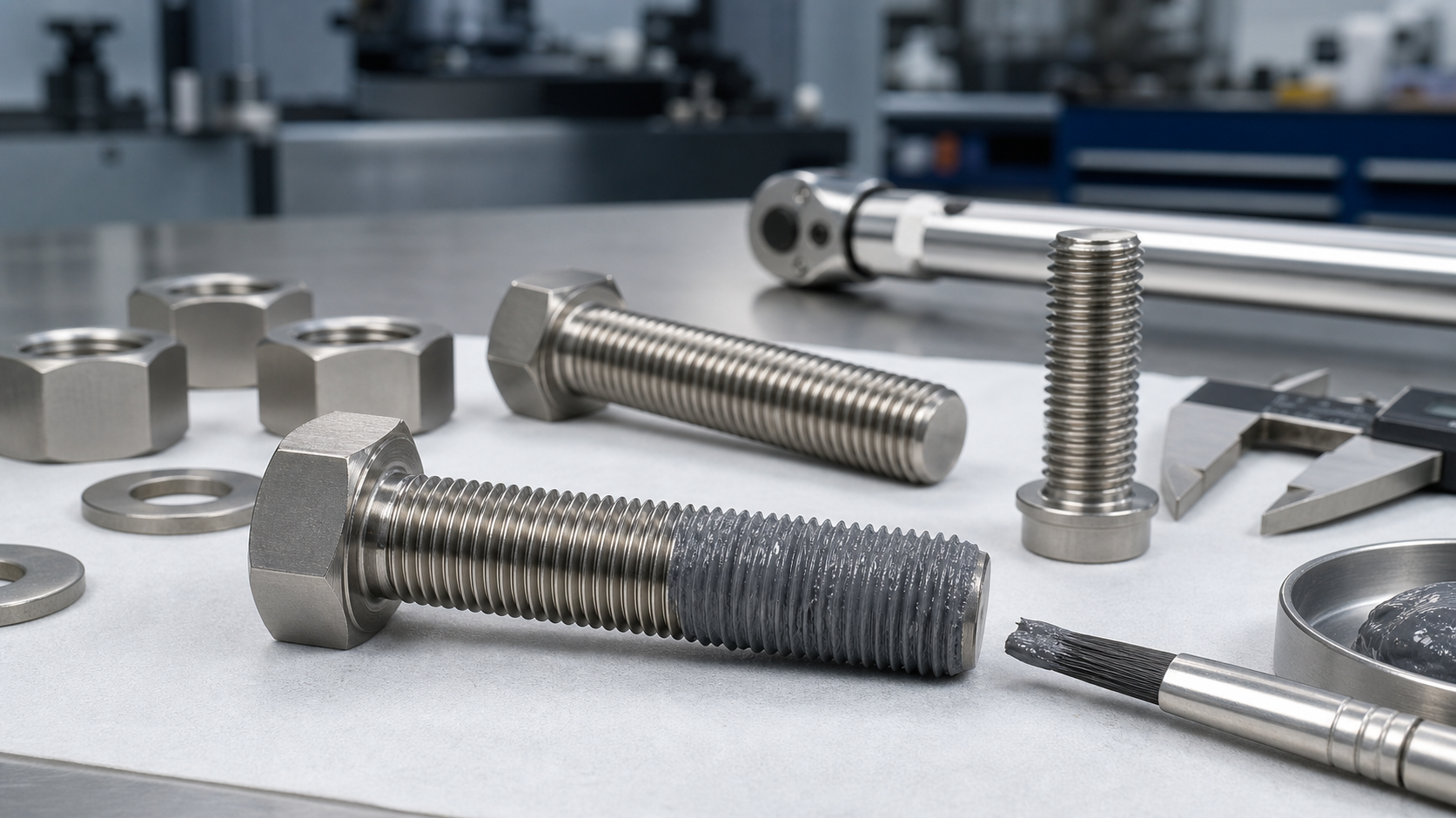
Titanium fastener galling can be reduced by combining clean, undamaged threads with a compatible lubricant or anti-seize compound, controlled installation speed, correct fit and a torque procedure developed for the actual joint. Grade 5 titanium bolts and nuts should never be tightened using an unverified dry torque value when the production assembly will be lubricated.
What Is Galling in Titanium Fasteners?
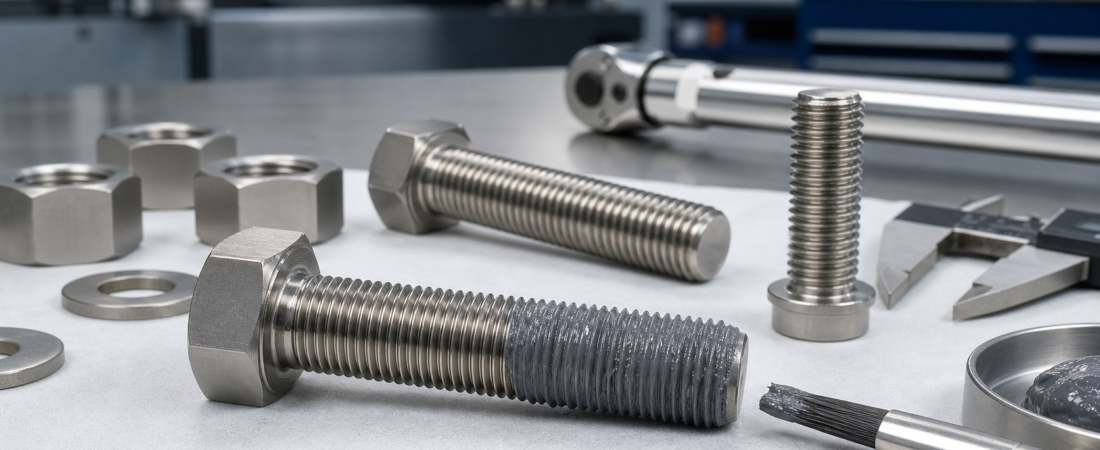
Galling is a severe form of adhesive wear. Under load, microscopic high points on mating thread surfaces can adhere to one another. Continued sliding may tear and transfer material, increasing friction rapidly. The nut can then lock before the intended clamp load is reached, or the threads may be damaged during disassembly.
Titanium is susceptible because it has a strong tendency toward metal-to-metal adhesion and does not dissipate frictional heat as readily as many common steels. Tight thread contact, high installation speed, surface damage, contamination and insufficient lubrication can increase the risk. Galling is an installation and joint-system issue rather than proof that the base material lacks strength.
Warning Signs During Installation
- Torque rises abruptly before the joint is fully seated.
- The nut advances unevenly or feels rough despite correct alignment.
- Metallic debris appears around the engaged threads.
- The fastener stops and cannot be reversed without excessive force.
- Disassembled threads show torn material, scoring or transferred metal.
When these symptoms appear, forcing the joint further can destroy the threads or produce an unknown preload. Stop, isolate the affected hardware and inspect both mating components.
Seven Practical Ways to Prevent Titanium Thread Galling
1. Start with the Correct Thread Fit
Specify the thread series, pitch, tolerance class and gauging requirements on the purchase order or drawing. Excessively tight fit increases contact stress, while poorly formed or damaged threads create local interference. Bolts and nuts should be checked with appropriate gauges and should run together smoothly before final loading.
2. Keep Threads Clean and Undamaged
Remove chips, abrasive particles, dirt and unsuitable residues before assembly. Protect threads during transport and storage, and do not use components with dents, burrs or flattened crests. Cleaning methods must be compatible with titanium and with any subsequently applied lubricant.
3. Use a Compatible Lubricant or Anti-Seize Compound
A suitable compound separates sliding surfaces and reduces friction variation. Selection depends on operating temperature, seawater or chemical exposure, vacuum or oxygen-service restrictions, cleanliness requirements, disassembly needs and compatibility with surrounding materials. Nickel-, copper-, graphite-, molybdenum-disulfide- and PTFE-containing products are not interchangeable in every system.
Apply a thin, controlled coating to the specified thread area. More compound is not automatically better: excess material can contaminate the assembly and may change friction more than expected. Record the product, application method and batch where installation control is important.
4. Tighten Slowly and Maintain Alignment
High-speed power tools generate heat quickly at the thread interface. Start the nut by hand, confirm free engagement and use a controlled tightening rate. Keep the bolt and nut aligned; side loading and cross-threading sharply increase local contact pressure.
5. Do Not Reuse an Unverified Dry Torque Value
Torque is consumed by friction under the head or nut and within the threads, with only part of it creating bolt tension. Lubrication normally lowers and stabilizes friction, so applying a dry torque value to lubricated hardware may produce excessive preload. The correct value should come from engineering analysis, fastener or lubricant guidance, or a representative torque-tension test.
6. Control Reuse
Previously tightened threads may contain transferred material or surface damage that is difficult to see. Safety-critical procedures should define whether reuse is permitted and what inspection is required. Replace any fastener with torn threads, pickup, necking, damaged flats or uncertain history.
7. Consider the Complete Material Pair
Titanium-on-titanium joints may require particular care, but changing one mating material can introduce galvanic, corrosion, strength or temperature concerns. Coatings and surface treatments may help in some systems, yet they must be specified with thickness, adhesion, service compatibility and inspection requirements rather than treated as a universal cure.
Installation Control Checklist
| Control point | What to specify or verify | Why it matters |
|---|---|---|
| Material | Titanium grade for bolt, nut and washer | Strength, corrosion and mating behavior |
| Fastener standard | Applicable dimensional and material specification | Defines geometry, properties and acceptance |
| Threads | Series, pitch, tolerance class and gauge inspection | Prevents interference and cross-threading |
| Surface condition | Cleanliness, burr control and any coating | Reduces local damage and friction scatter |
| Lubricant | Approved product and application quantity/method | Controls friction and service compatibility |
| Tightening | Tool, speed, sequence and calibrated target | Improves repeatability of clamp load |
| Verification | Torque-tension test or other preload method when required | Confirms the actual joint behavior |
Standards Buyers Should Reference
ASTM Subcommittee F16.04 maintains the principal ASTM standards for nonferrous fasteners. ASTM F468 covers nonferrous bolts, hex cap screws, socket head cap screws and studs for general use, while ASTM F467 covers nonferrous nuts. Metric counterparts may apply to metric hardware. Dimensional requirements can also come from ISO, DIN or ASME standards, depending on the product and market.
A standard designation alone does not establish a complete anti-galling procedure. The buyer should also state the titanium grade, dimensions, thread requirements, surface condition, lubricant or coating, mechanical-property requirements, inspection documents and any torque or preload validation required by the application.
Torque, Preload and Lubrication
There is no single safe torque value for every Grade 5 titanium bolt. Diameter, pitch, engaged length, proof or yield basis, nut factor, bearing surface, washer use, lubricant and repeated tightening all affect the result. Published charts may be useful starting points only when their assumptions match the actual joint.
What to Include in a Titanium Fastener RFQ
- Product type, head style and quantity.
- Grade, such as Grade 5 / Ti-6Al-4V / UNS R56400.
- Applicable bolt, nut and dimensional standards.
- Diameter, thread series and pitch, length and tolerance class.
- Surface condition, coating or approved lubricant requirements.
- Mechanical tests, dimensional inspection and lot traceability.
- MTC or other inspection-document requirements.
- Service temperature, environment and restrictions on compound chemistry.
For available forms and purchasing information, review our Grade 5 titanium hex bolts and nuts page or browse titanium standard parts and fasteners.
Request Grade 5 Titanium Fastener Information
Send the grade, standard, thread, dimensions, quantity and inspection requirements. SAKY ALLOY can review the requested fastener configuration and documentation needs.
Submit an RFQFAQ
Why do titanium bolts and nuts gall?
Galling occurs when loaded thread surfaces adhere during sliding, causing material transfer and rapidly increasing friction. Tight fits, dirty or damaged threads, high installation speed and inadequate lubrication can make seizure more likely.
Should titanium fasteners always be lubricated?
Lubrication is commonly used to reduce galling risk, but the compound must suit the temperature, environment and cleanliness restrictions of the application. The tightening value must be established for the lubricated condition.
Can I use the same torque for dry and lubricated titanium bolts?
No unverified substitution should be made. Lubrication changes friction and can substantially change the preload produced by a given torque, so use a validated torque-tension relationship for the actual joint.
Does anti-seize eliminate galling completely?
No. It reduces risk when correctly selected and applied, but thread fit, cleanliness, alignment, tightening speed and surface condition remain important. Installation controls should work as a system.
Can a galled titanium fastener be reused?
A fastener with torn, transferred or deformed thread material should not be returned to service. Reuse rules for apparently undamaged hardware should be established by the responsible engineer and application procedure.
Which ASTM standards apply to titanium bolts and nuts?
ASTM F468 covers applicable nonferrous bolts, cap screws and studs for general use, while ASTM F467 covers nonferrous nuts. Confirm the current applicable edition, metric or inch-pound version, dimensional standard and grade requirements on the purchase order.