

Titanium Fasteners for Marine and Offshore Applications
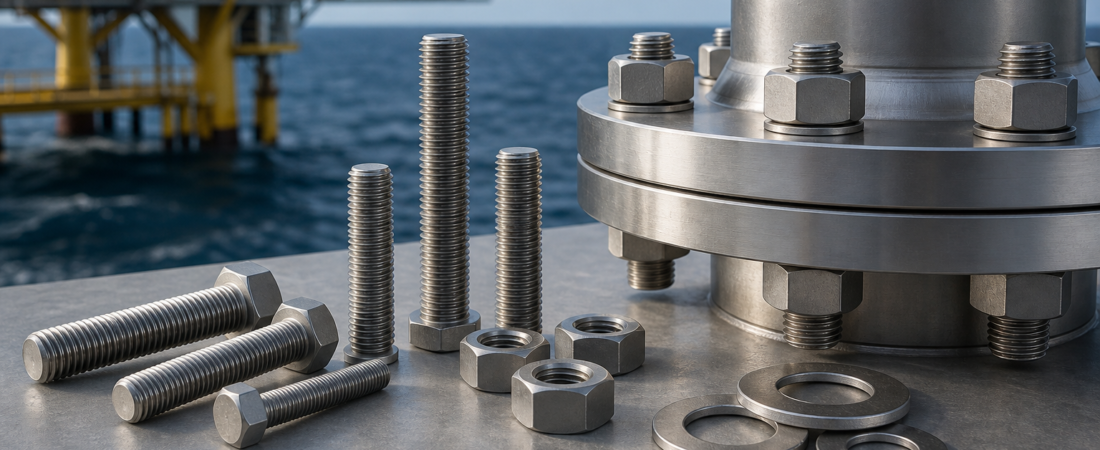
Titanium fasteners are used in marine and offshore systems when long-term resistance to seawater, low weight and dependable service life are more important than the lowest initial hardware cost. Correctly specified titanium bolts, nuts, studs and washers can reduce corrosion-driven maintenance in splash-zone, submerged and continuously wet assemblies.
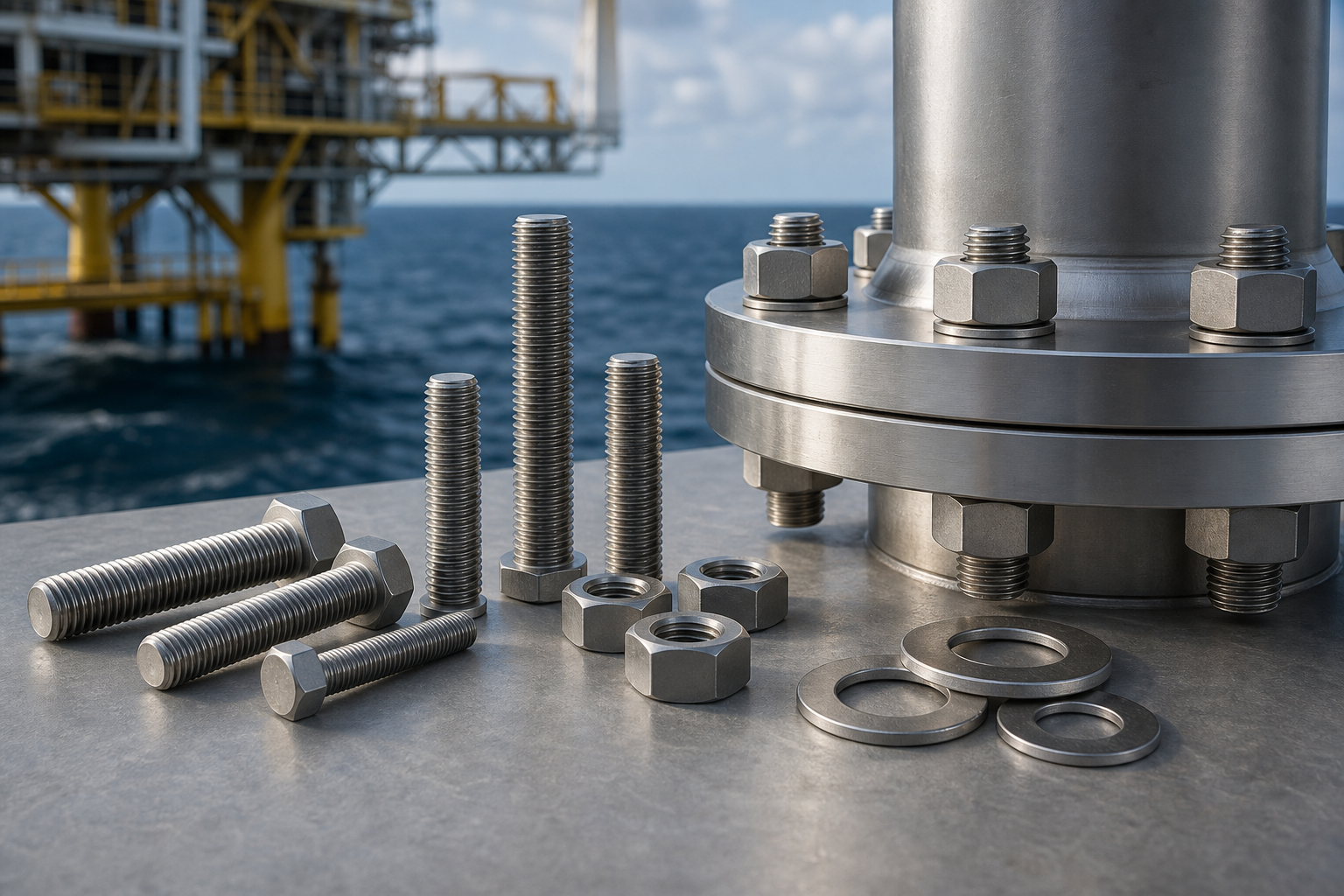
Why Use Titanium Fasteners in Seawater?
Titanium forms a stable, adherent oxide layer that protects the underlying metal in many natural and flowing seawater environments. If the surface is scratched and oxygen is available, the passive film can reform rapidly. This behaviour is fundamentally different from relying on a coating that may be damaged during installation.
For offshore operators, the business value is often fewer replacements, less unplanned access work and lower lifecycle maintenance. The low density of titanium—roughly 60% that of steel—also benefits weight-sensitive equipment, subsea assemblies and components that technicians must handle at height or in restricted spaces.
Grade 2 vs Grade 5 Titanium Fasteners
| Selection factor | Grade 2 titanium | Grade 5 titanium |
|---|---|---|
| Material type | Commercially pure titanium | Ti-6Al-4V alpha-beta alloy |
| Primary advantage | Excellent general corrosion resistance and ductility | Much higher strength-to-weight capability |
| Typical decision driver | Corrosion-dominated, moderate-load joints | Higher-load and weight-sensitive joints |
| Fabrication/forming | More ductile | Requires alloy-appropriate processing |
| Specification requirement | Never substitute by grade name alone; define the applicable fastener specification and mechanical-property class | |
Grade 5 is not automatically the better choice simply because it is stronger. The joint should be designed around required clamp load, fatigue, stiffness, mating material, installation method and inspection regime. For special corrosion environments, other titanium grades may also be evaluated.
Common Marine and Offshore Applications
- Seawater cooling and desalination equipment.
- Subsea instruments, sensor housings and remotely operated vehicle assemblies.
- Offshore platform piping supports, clamps and access equipment.
- Heat exchangers, pumps, valves and filtration systems.
- Marine exhaust and water-handling components.
- Yachts, high-performance vessels and lightweight deck hardware.
- Oceanographic, aquaculture and coastal infrastructure.
Fastener Types Available
Hex head, socket head, cap screws and application-specific geometries.
For flanged joints, equipment mounting and custom-length connections.
Hex nuts, locknut configurations and matched material combinations.
Flat washers, machined spacers and drawing-specific components.
Standards and Purchase Specifications
Depending on the market and application, titanium fasteners may be ordered to dimensional standards such as ISO, DIN, ASME/ANSI or a customer drawing. ASTM F468 covers nonferrous bolts, hex cap screws and studs for general use, while ASTM F467 addresses nonferrous nuts. Aerospace and safety-critical work may require separate material and fastener specifications.
A complete purchase order should not say only “titanium bolt.” It should define the material grade, fastener standard, diameter and pitch, length, thread tolerance, mechanical properties, head style, surface condition, testing, lot traceability and certification.
Galvanic Corrosion and Joint Design
Titanium is relatively noble in seawater. When it is electrically coupled to a less noble metal, the other metal may experience accelerated galvanic corrosion. The risk depends on electrode area ratio, electrolyte conductivity, geometry, coating condition and exposure.
Designers may use compatible mating materials, nonconductive sleeves or washers, suitable sealants and controlled coating systems where appropriate. A small anodic component connected to a large titanium surface deserves particular attention. Galvanic assessment should be part of system design rather than left to the installer.
Preventing Galling During Installation
Titanium threaded components can gall when mating surfaces slide under high contact pressure. Galling can damage threads or cause seizure before the intended preload is achieved.
- Use clean, accurately manufactured threads with the specified fit.
- Apply an engineering-approved lubricant or anti-seize compound compatible with the environment.
- Avoid uncontrolled high-speed tightening.
- Use validated torque or tension procedures rather than generic steel-bolt values.
- Consider material pairing, coatings or thread-form changes where the design permits.
Torque values must be developed for the actual fastener, lubricant, joint and required preload. A catalogue torque chart should not override the engineering specification.
Inspection and Documentation
For offshore projects, documentation can be as important as the physical fastener. Buyers commonly request chemical analysis, mechanical test results, heat or lot traceability, dimensional inspection and a mill test certificate. Critical projects may add positive material identification, independent inspection, surface inspection or application-specific testing.
SAKY ALLOY recommends agreeing all test methods and acceptance criteria before manufacture. Retrospective certification may be impossible once material identity or production-lot traceability has been broken.
Titanium Fastener RFQ Checklist
- Fastener type, drawing or dimensional standard.
- Titanium grade and material/fastener specification.
- Diameter, thread pitch, thread system, tolerance and length.
- Required mechanical properties and design load.
- Head style, drive style, nut and washer combination.
- Quantity, surface condition, lubrication or coating restrictions.
- Service environment, temperature and mating materials.
- Inspection, certification, marking, packaging and delivery date.
Frequently Asked Questions
Do titanium fasteners rust in seawater?
Titanium does not form red rust like carbon steel and has excellent resistance in many seawater conditions. Deposits, crevices, unusual chemistry and galvanic effects still require engineering review.
Are Grade 5 titanium bolts stronger than Grade 2 bolts?
Grade 5 titanium normally provides substantially higher strength, but the allowable capacity of a finished fastener depends on its governing specification, manufacture, heat treatment and test results.
Can titanium bolts be used with stainless steel?
They can be used in some designs, but galvanic behaviour, area ratio, exposure and crevice conditions must be assessed. Electrical isolation may be appropriate.
How can titanium bolt galling be reduced?
Use controlled thread quality, compatible lubrication, suitable material pairing and a validated low-speed installation procedure.
Request Titanium Fasteners for a Marine Project
Send SAKY ALLOY your drawing or fastener standard, titanium grade, dimensions, quantity, service conditions and certification requirements for a tailored quotation.
Request a Titanium Fastener QuoteTechnical note: This article is a procurement guide, not a joint-design specification. A qualified engineer must approve fastener grade, preload, torque, fatigue and corrosion controls for the actual application.