
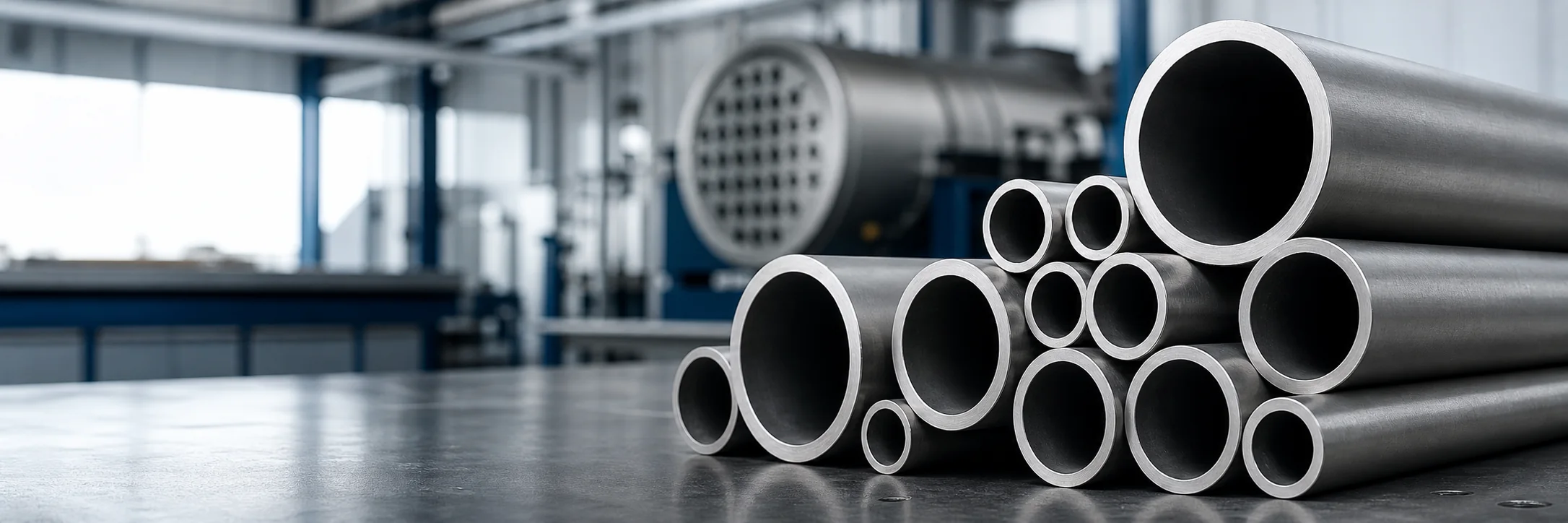
Titanium Seamless vs Welded Tube
Seamless and welded titanium tubes can use the same alloy grade, but they are produced by different routes and require different manufacturing controls. Neither route is automatically best for every project. Select from the governing product specification, dimensions, pressure and corrosion service, fabrication plan, required inspection and total project value.
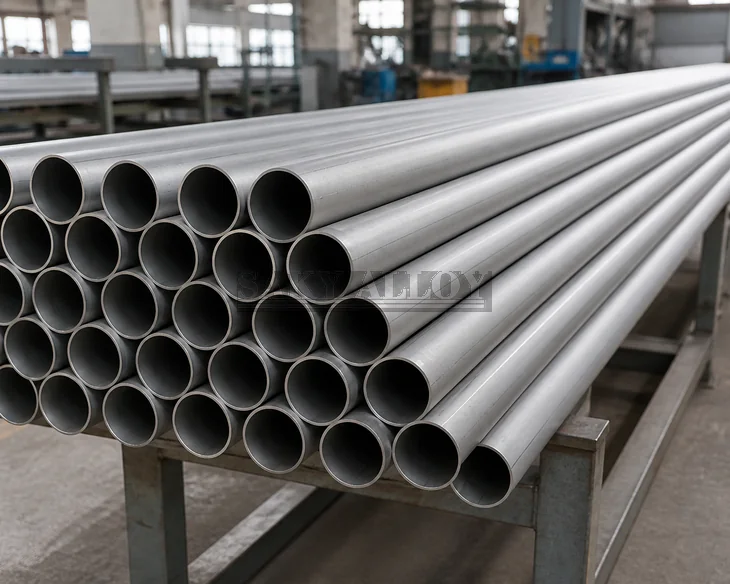
Seamless vs Welded Titanium Tube
| Item | Seamless tube | Welded tube |
|---|---|---|
| Starting material | Hollow billet or tubular hollow reduced and drawn to size | Flat-rolled strip or sheet formed and longitudinally welded |
| Defining feature | No longitudinal weld seam | Controlled longitudinal weld seam |
| Key production controls | Reduction route, wall uniformity, surface and dimensional control | Forming, weld procedure, seam condition, heat treatment where required and weld examination |
| Dimensional and commercial factors | Availability depends on tooling, starting hollow and reduction capacity | May offer efficient production in suitable sizes and quantities |
| Acceptance basis | Applicable standard, grade, condition, dimensions, tests, inspection and certified traceability | |
Performance Depends on the Finished Product
A weld seam is a feature to control, not proof of poor quality. Properly manufactured welded tube can satisfy demanding heat-transfer and corrosion applications when the specification permits it and the weld receives the required examination. Likewise, seamless construction does not remove the need to control wall variation, surface condition, defects, dimensions and heat treatment.
Do not select by appearance. A finished longitudinal seam may be difficult to see, while surface polishing can make different manufacturing routes look similar. Confirm the route from the purchase order, marking, material certificate and manufacturing or inspection records.
Standards and Ordering Context
ASTM B338 commonly covers both seamless and welded titanium tube for condensers and heat exchangers. ASTM B861 covers seamless titanium pipe, while ASTM B862 covers welded titanium pipe. The equipment or piping design must identify which specification applies. State the edition, alloy grade, manufacturing route, condition, dimensions and any supplementary requirements rather than ordering only “titanium tube.”
How Service Conditions Affect the Choice
- Heat exchangers and condensers: review heat-transfer design, tube-sheet joining, vibration, cleanliness, wall thickness and examination requirements.
- Chemical process systems: review fluid chemistry, temperature, pressure, crevices, cleaning cycles and fabrication.
- Marine and desalination service: review seawater conditions, deposits, flow velocity, galvanic interfaces and joining details.
- Formed or welded assemblies: confirm bend radii, expansion, orbital or manual welding procedures and dimensional allowances.
Inspection and Documentation
The governing specification and purchase order may require chemistry, tensile properties, dimensions, surface inspection, flattening or flaring, pressure testing, and eddy-current, ultrasonic or other nondestructive examination. For welded products, define weld-related acceptance requirements; for seamless products, define the relevant full-body examination where required. Require heat or lot traceability and a material test certificate matching the order.
Compare Grade 2 Tube Routes
Review Grade 2 Seamless Titanium Tube, Grade 2 Welded Titanium Tube and the complete Titanium Pipe & Tube family.
RFQ Checklist
- Application, fluid, temperature, pressure and design code
- Product standard and edition, alloy grade and UNS number
- Seamless or welded construction
- Outside diameter or NPS, wall or schedule, length and quantity
- Condition, tolerances, surface, ends and fabrication needs
- NDE, pressure test, certificate and third-party inspection requirements
FAQ
Is seamless titanium tube always stronger?
Not as a general rule. Strength acceptance follows grade, condition and product specification. Manufacturing route alone does not establish the certified mechanical properties.
Is welded tube suitable for corrosive service?
It can be when the grade, welding process, finished condition, examination and system design suit the environment. The project specification must permit the route.
Which route is less expensive?
Cost depends on size, wall, grade, quantity, testing, availability and delivery. Compare compliant quotations with the same inspection and documentation scope.
Related Reading
ASTM B338 vs B861 vs B862 · Grade 2 vs Grade 7 Tube · Titanium Tube Applications