

How to Specify Titanium Fluid Manifolds
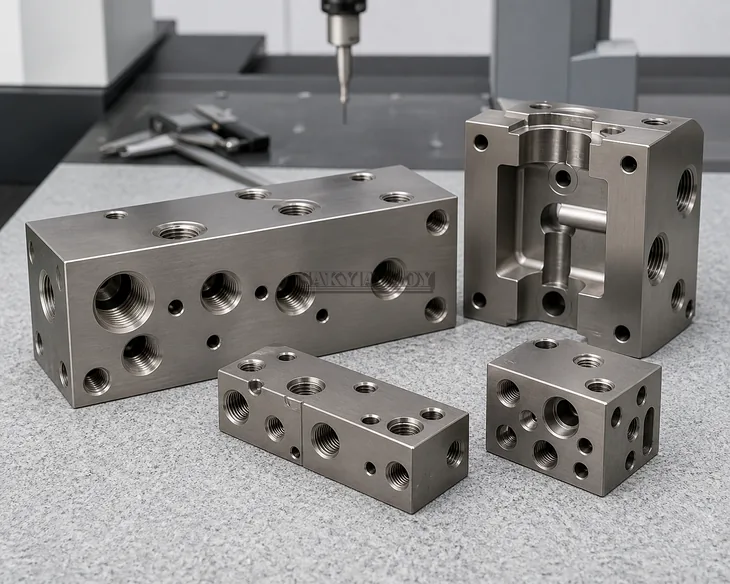
A titanium fluid-manifold RFQ should start with the flow diagram and service conditions, then translate them into a controlled machined-part drawing. Port names alone do not define passage walls, sealing interfaces, pressure integrity or cleanliness.
Functional Definition Matrix
| Area | Required data |
|---|---|
| Service | Media, concentration, temperature, compatibility and cleanliness |
| Hydraulics | Flow direction, passage size, pressure drop, drainability and dead volume |
| Ports | Standard, size, class/thread, orientation, engagement and sealing face |
| Integrity | Design/test pressure, wall between bores, plugs and leak criterion |
Passages, Intersections and Plugs
Control drill-point penetration, intersecting bores, minimum wall, burr removal, internal-surface acceptance and inspection access. Define plug type, material, seal, installation method and whether plugs are permanent or serviceable.
Material and Machined-Part Controls
Specify titanium grade, source form and standard, condition, drawing revision, datums, tolerances, surface finish and traceability. Corrosion suitability must include media, crevices, plugs, seals and all connected materials.
Pressure, Leak and Cleanliness Testing
Separate proof-pressure testing from leak-rate testing. Choose hydrostatic, pneumatic or helium methods from service requirements and an approved safe procedure. Define pressure, hold time, allowable leakage, test medium, drying, cleaning chemistry, particle/residue limits, caps and packaging.
Send the Flow and Port Drawing
Review Titanium Manifolds and the Titanium Machining Parts category.
RFQ Checklist
- Flow diagram, service media and operating range
- Drawing, grade, source form and condition
- Ports, passages, walls, plugs and seals
- Pressure/leak test and acceptance criteria
- Cleaning, inspection, reports and traceability
FAQ
Why are intersecting-passage burrs a risk?
They can obstruct flow, contaminate instruments or damage seals; removal and verification must be planned.
Is a pressure test the same as a leak test?
No. A proof test demonstrates pressure integrity under its criteria; a leak test measures leakage to a stated limit.
Related Reading
CNC Machining RFQ Guide · Tolerance and Inspection · Machined Component Applications