

Titanium technical buyer guide · 21 October 2026
Grade 12 vs Grade 2 Titanium Bar: Corrosion, Strength and ASTM B348 Guide
Compare material identity, corrosion-selection boundaries, bar specifications, price factors and the RFQ details needed for a technically comparable quotation.
Quick answer: Grade 12 titanium bar is a lean titanium alloy identified as UNS R53400, with nominal additions of 0.3% molybdenum and 0.8% nickel. Compared with commercially pure Grade 2, Grade 12 is generally selected when a project needs higher strength together with improved resistance to crevice corrosion in selected hot-chloride or brine service. The correct choice still depends on the actual medium, temperature, stress, geometry, fabrication route and governing specification.
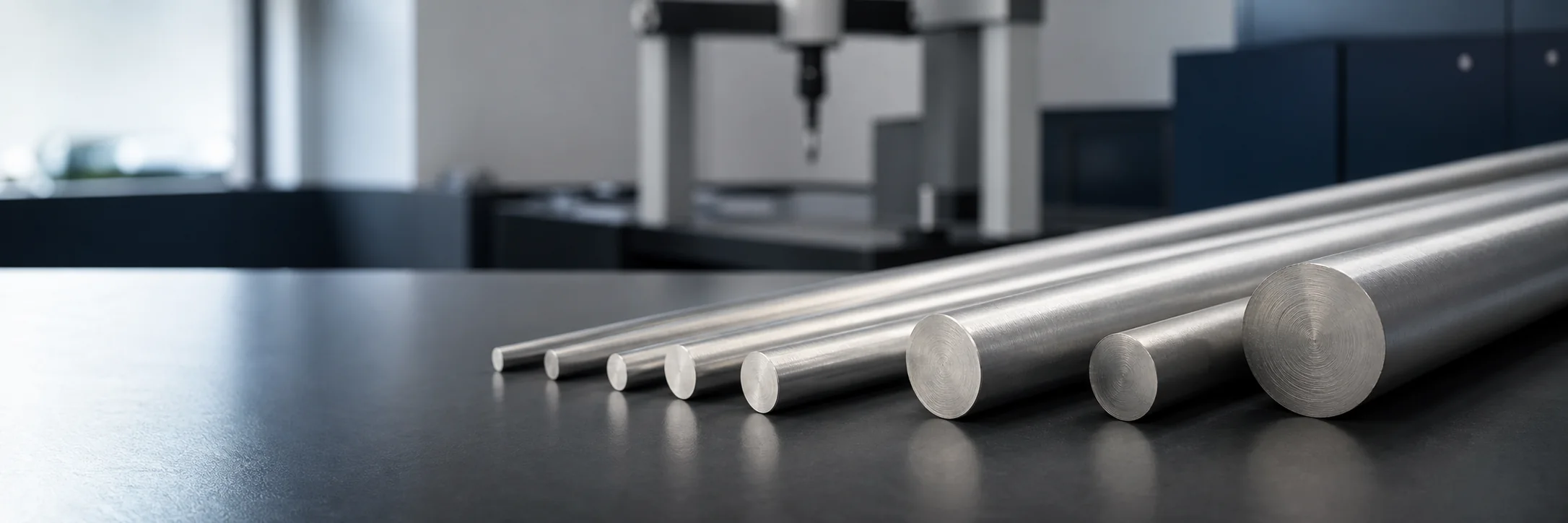
Featured-image note: The page uses a real titanium round-bar product-form photograph from the SAKY ALLOY media library. The photographed bars are not presented as a verified Grade 12 heat; grade must be confirmed from order and test documents.
Grade 12 vs Grade 2 Titanium Bar at a Glance
| Comparison point | Grade 12 titanium bar | Grade 2 titanium bar |
|---|---|---|
| Material identity | UNS R53400; commonly described as Ti-0.3Mo-0.8Ni | Commercially pure titanium; state Grade 2 and its UNS designation on the order |
| Alloying concept | Small molybdenum and nickel additions distinguish it from commercially pure grades | Commercially pure grade without the Grade 12 Mo-Ni addition |
| Strength comparison | Published annealed-material references show higher minimum tensile and yield strength than Grade 2 | Lower strength, with useful ductility and broad corrosion-service use; the ordered product specification controls |
| Corrosion-selection reason | Considered where improved crevice-corrosion resistance in selected hot brines or chloride conditions is important | Often evaluated for general corrosion resistance where Grade 12’s specific enhancement is not required |
| Primary US bar specification | ASTM B348/B348M, with Grade 12 / UNS R53400 stated explicitly | ASTM B348/B348M, with Grade 2 stated explicitly |
| Substitution rule | Neither grade is an automatic substitute for the other. Engineering and purchasing documents must approve any change. | |
What Is Grade 12 Titanium?
ASTM’s active B348/B348M-25 listing covers annealed titanium and titanium-alloy bars and billets. Its public scope identifies Grade 12 as UNS R53400 with 0.3% molybdenum and 0.8% nickel. The alloy is therefore different from Grade 2 even when both products have the same diameter and surface appearance.
The TIMET Grade 12 data sheet describes Grade 12 as a lean alloy that combines greater strength than Grade 2 with enhanced resistance to crevice corrosion in hot brines. This public material data is useful for screening; it is not a supplied-lot certificate, a design allowable or permission to ignore the ordered standard.
Is Grade 12 Titanium Stronger Than Grade 2?
In comparable published annealed-material references, Grade 12 has higher minimum tensile and yield strength than Grade 2. For example, the Grade 12 reference used on our product page lists minimum ultimate tensile strength of 483 MPa and minimum 0.2% yield strength of 345 MPa. These values should not be copied into a purchase order without checking the invoked standard, product form, section size, condition and edition.
Strength alone is not a complete selection method. A buyer should also review corrosion medium, concentration, aeration, contaminants, operating temperature, crevice geometry, cyclic loading, welding, machining and finished-component inspection.
Why Is Grade 12 Considered for Chloride and Hot-Brine Service?
Grade 12’s molybdenum and nickel additions are used to improve resistance to localized attack, particularly crevice corrosion, in selected aggressive environments. This can make the alloy relevant to chemical-processing equipment, heat-transfer components, hydrometallurgical equipment, seawater systems and other industrial parts where Grade 2 needs additional technical review.
That description is not a universal service guarantee. Temperature, pH, chloride level, oxidizing or reducing conditions, contamination, deposits and joint geometry can change performance. Use application-specific corrosion data and approval from the responsible engineer before selecting a bar grade for a finished component.
ASTM B348 Grade 12 Bar: What the Standard Reference Must Define
A quotation that says only “Grade 12 titanium” is incomplete. Bar, plate, tube, pipe and fittings have different product specifications, manufacturing routes, dimensions and test requirements. For a bar enquiry, identify the product as ASTM B348/B348M Grade 12 titanium bar, UNS R53400, then state the exact edition required by the project.
Buyers using Chinese or other national specifications may cite GB/T 2965-2023 Titanium and titanium alloy bars, TA10, or project-specific EN, DIN, JIS, ISO or GOST terminology. These keywords do not establish automatic equivalence to ASTM Grade 12. Send the full standard number, edition, grade, dimensions and acceptance criteria so chemistry, properties, tolerances and tests can be reviewed against the actual order.
What Affects Grade 12 Titanium Price per Kilogram?
Searchers often ask for a single Grade 12 titanium price or titanium bar price per kg, but a technically comparable quotation needs more information. The main commercial drivers include:
- Diameter and length: section size, cut length, end trim and machining allowance affect billable weight and usable yield.
- Condition and surface: forged, hot-rolled, annealed, peeled, pickled or ground supply routes do not have the same processing scope.
- Quantity: total weight, number of pieces and cut schedule influence processing and packing.
- Tolerance and straightness: tighter requirements can require additional processing and inspection.
- Testing and documentation: state required examinations, acceptance criteria, traceability and certificate scope before comparing prices.
- Delivery basis: packing, freight terms and destination must be compared on the same basis.
Do not treat a search-result price as a confirmed offer or stock statement. Request a quotation against one controlled schedule so suppliers price the same technical scope.
Grade 12 Titanium Bar RFQ Checklist
- Material: Grade 12 / UNS R53400 and any approved project designation.
- Specification: ASTM B348/B348M or the exact national/project standard and revision.
- Geometry: diameter or section, length, quantity, straightness, end condition and machining allowance.
- Supply condition: annealed condition and required surface or processing route.
- Inspection: dimensions, surface, chemistry, mechanical properties and any agreed supplementary examination.
- Documents: heat or lot traceability and the required inspection record. Product test certificates can be provided.
- Service information: medium, concentration, temperature, pressure or load, fabrication route and finished-part use.
Review the full Grade 12 titanium bar product page for material identity, ordering fields and inspection boundaries. For wider grade and dimensional enquiries, compare the ASTM B348 titanium bar overview.
Frequently Asked Questions
What is the chemical composition of Grade 12 titanium?
Grade 12 is identified as UNS R53400 and is commonly described as Ti-0.3Mo-0.8Ni. Full chemistry limits, including residual elements, must be verified against the ordered specification and supplied-lot test document.
Is Grade 12 titanium better than Grade 2?
Not in every application. Grade 12 offers higher strength and improved crevice-corrosion resistance in selected conditions, while Grade 2 may be appropriate where its commercially pure chemistry, formability and corrosion performance meet the design. Select by service and specification, not by grade number alone.
What is Grade 12 titanium used for?
It is considered for chemical-processing, heat-transfer, marine, hydrometallurgical and industrial components where its strength and localized-corrosion performance fit the reviewed environment. The finished component still requires application-specific design approval.
Can Grade 12 bar be ordered to GB/T, EN, DIN, JIS, ISO or GOST requirements?
International enquiries can be reviewed when the exact standard, edition, grade and acceptance criteria are supplied. Do not assume a designation is fully equivalent to ASTM Grade 12 without a clause-by-clause technical review.
What should I send for a Grade 12 titanium bar quotation?
Send the standard and edition, Grade 12 / UNS R53400, diameter, length, quantity, condition, surface, tolerances, inspection, certificate requirements, service information and delivery destination.
Request Grade 12 Titanium Bar
Use the Grade 12 titanium bar page to review the product scope, then send your RFQ with the grade, standard, diameter, length, quantity and required inspection. Availability and final compliance are confirmed against the complete enquiry.
Sources checked 21 October 2026: ASTM B348/B348M-25 public standard listing, TIMET Grade 12 public data sheet and GB/T 2965-2023 public standard record. Binding requirements come from the licensed standard, project specification and purchase order.