

Grade 2 vs Grade 5 for Titanium Machined Parts
Grade 2 and Grade 5 solve different design problems. Grade 2 is commercially pure titanium; Grade 5 is Ti-6Al-4V. Selection must follow service environment, loading, temperature, source specification and finished-part requirements.
Comparison
| Item | Grade 2 | Grade 5 |
|---|---|---|
| Material family | Commercially pure titanium | Ti-6Al-4V alloy |
| Selection focus | Corrosion resistance and useful ductility | Higher strength-to-weight requirement |
| Source stock | Plate, bar, tube or forging to applicable order | Plate, bar or forging with controlled condition |
| Approval | Design, service and material specification control | |
Machining Is Part of the Process Plan
Cutting speed, tool condition, rigidity, heat control, coolant and chip management must suit the grade, geometry and machine setup. Material grade alone does not define a universal machining recipe.
Corrosion and Galling
Review the full medium, temperature, crevice geometry and mating materials. For sliding interfaces, also define clearance, finish, lubrication or coating and duty cycle.
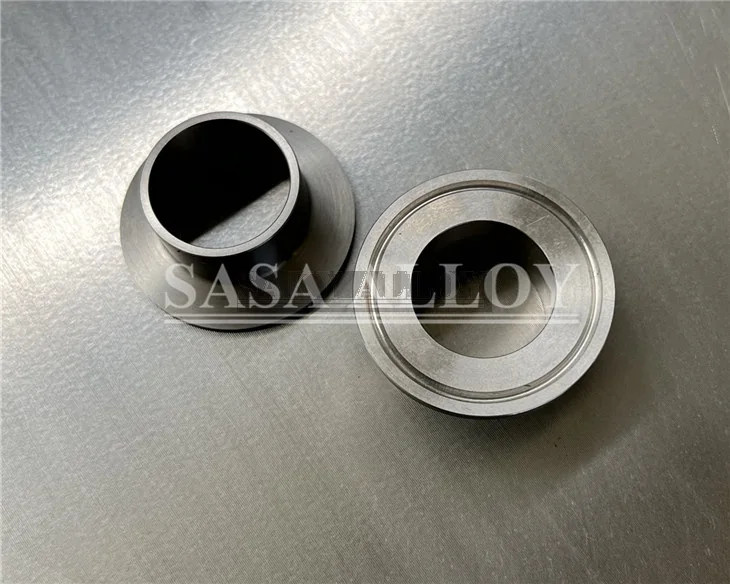
Compare custom CNC parts, precision bushings and machined discs.
Related Reading
CNC Machining RFQ Guide · Tolerance and Inspection Guide · Machined Component Applications
Frequently Asked Questions
Is Grade 5 always better than Grade 2 for machined titanium parts?
No. Grade 5 offers higher strength, while Grade 2 may be selected for corrosion resistance, ductility and fabrication needs. The finished part’s load, environment, geometry, standard and inspection determine the suitable grade.
Which grade is easier to machine?
Machinability depends on grade and condition, toolpath, rigidity, tooling, coolant and tolerances. Grade 2 and Grade 5 require different parameter planning; neither should be chosen solely from a generic machinability statement.
What should a machined titanium part RFQ include?
Provide the drawing and revision, grade and material specification, starting stock, quantity, dimensional and geometric tolerances, surface finish, threads, inspection, special processes, cleanliness, documentation and delivery requirements.
Direct Answer: Grade 2 or Grade 5 for a Machined Titanium Part?
Choose Grade 2 when corrosion resistance, ductility, weldability and moderate strength drive the design. Choose Grade 5 Ti-6Al-4V when substantially higher strength and strength-to-weight performance are required. Neither grade is universally better: service chemistry, load, temperature, fatigue, geometry, joining, inspection and the exact material specification control the decision.
Grade 2 vs Grade 5 Machining Matrix
| Decision factor | Grade 2 / UNS R50400 | Grade 5 / UNS R56400 |
|---|---|---|
| Material family | Commercially pure titanium | Alpha-beta Ti-6Al-4V alloy |
| Primary selection | Corrosion resistance, ductility and weldability | Higher strength and strength-to-weight ratio |
| Typical feedstock | ASTM B348 bar, B265 plate or B381 forging as applicable | ASTM/AMS bar, plate or forging specification expressly stated |
| Machining focus | Galling, heat control, burrs, surface and dimensional stability | Tool load, heat, stock allowance, surface integrity and fatigue-critical features |
| Selection warning | Grade name alone does not establish corrosion suitability | Ti-6Al-4V name alone does not establish condition or aerospace documentation |
Information Needed Before Quotation
Provide a revision-controlled drawing and 3D model when available, finished dimensions and tolerances, datum scheme, threads and sealing faces, annual and batch quantity, material standard and condition, source-product preference, surface finish, deburring and cleaning, prohibited processes, inspection plan and required records. State whether first-article, CMM, pressure/leak, PT, UT, PMI or material traceability is required.
For chemical and marine equipment, send the actual medium, concentration, temperature, contaminants, crevice and galvanic conditions. For aerospace or fatigue-sensitive components, identify grain direction, test orientation, alpha-case or thermal-cut restrictions and fatigue-critical surfaces. These inputs often matter more than nominal alloy name.
FAQ
Is Grade 5 always harder to machine?
Grade 5 generally imposes higher cutting loads and requires disciplined heat and tool control, but machinability also depends on condition, geometry, stock route, setup and finish requirements.
Can Grade 5 replace Grade 2 in corrosive service?
Not automatically. Higher strength does not mean better corrosion performance in every environment. Review service chemistry and design requirements.
What should be sent for a machining quote?
Send grade and standard, drawing/model, quantity, tolerances, finish, source-material requirements, application, inspection and documentation.
Grade 5 Titanium Machining Parts | Grade 2 Titanium Bar | Grade 5 Titanium Round Bar | Request a quote