

Titanium Manifolds and Sputtering Targets: Precision Machining Guide
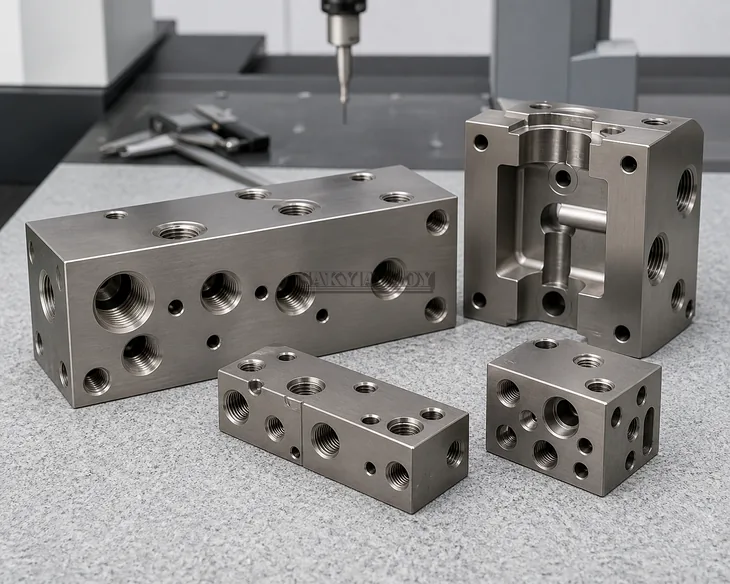
Titanium manifolds and sputtering targets are both precision-machined products, but their critical quality characteristics are very different. One controls fluids through sealed passages; the other supplies material to a vacuum-deposition process.
Quality Priority Matrix
| Product | Primary risks | Key evidence |
|---|---|---|
| Fluid manifold | Leakage, thin passage wall, burrs, contamination and incorrect ports | Drawing report, gauging, passage verification, cleaning and leak/pressure tests |
| Sputtering target | Composition, surface defects, flatness, cathode mismatch and bond voids | Composition report, dimensions, surface, flatness and bond inspection |
Machining Controls
For manifolds, tool paths and cross drilling must preserve pressure wall and enable complete deburring. For targets, machining must preserve flatness, clean surface condition and the precise cathode interface without contaminating high-purity material.
Packaging and Traceability
Manifolds require capped clean ports and protection of sealing faces. Targets may require clean wrapping or vacuum packaging and separation from incompatible metals. Both need material and lot identity maintained through machining.
Use Product-Specific Inspection
Explore Titanium Manifolds, Titanium Sputtering Targets, Custom Titanium CNC Parts and Titanium Machining Parts.
RFQ Checklist
- Function and approved drawing
- Material grade or purity limits
- Critical geometry and surface
- Application-specific tests
- Cleaning, packaging and traceability
Related Reading
How to Specify Titanium Fluid Manifolds · Titanium Sputtering Targets: Planar vs Bonded
Frequently Asked Questions
Why do titanium manifolds require process-specific cleanliness controls?
Internal passages, sealing surfaces and dead legs may retain chips, coolant or contamination. The drawing and service should define deburring, flushing, cleanliness, inspection and packaging.
Can a sputtering target be machined from any titanium plate?
No. Purity, composition, microstructure, dimensions, flatness, surface, backing/bonding design and application requirements must be specified for the target system.
What should a precision titanium machining RFQ include?
Provide drawing and revision, material grade or purity, starting stock, quantity, tolerances, passages or target geometry, surface, cleanliness, inspection, leak or bond testing, documentation and packaging.