
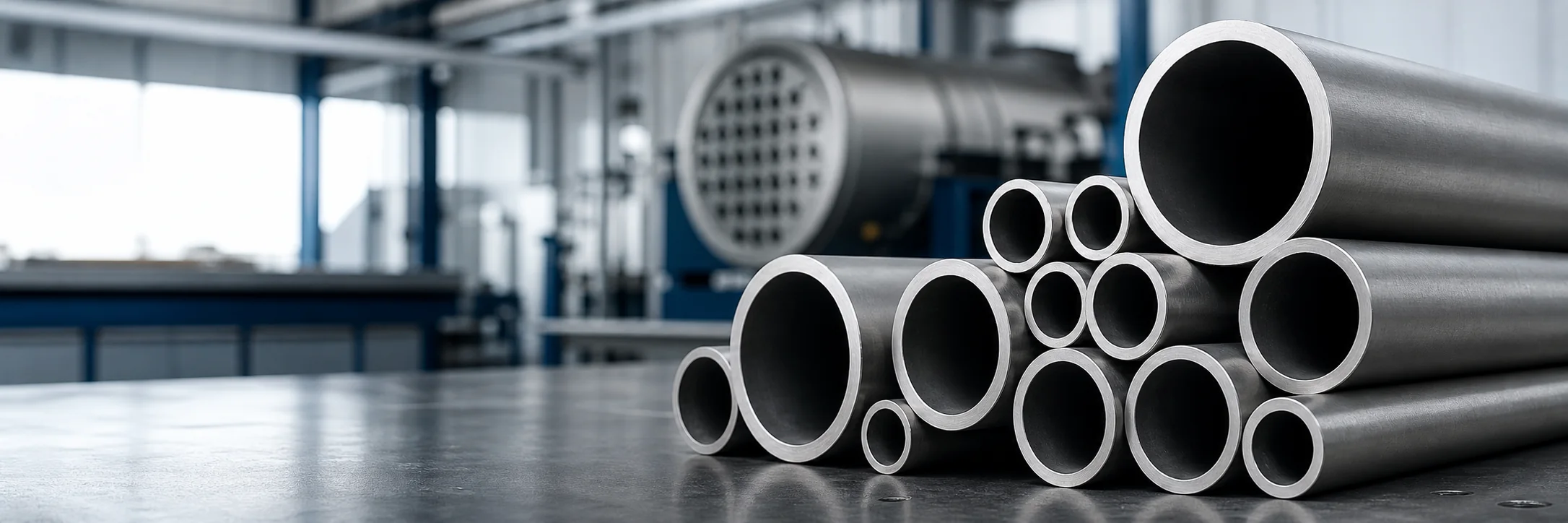
Titanium Tube for Heat Exchangers, Chemical and Seawater Service
Titanium heat exchanger tube should be selected from the complete operating environment and equipment design—not from corrosion resistance alone. Define process and cooling fluids, temperature, pressure, velocity, fouling, cleaning cycles, tube-sheet joining and inspection before choosing the grade and manufacturing route.
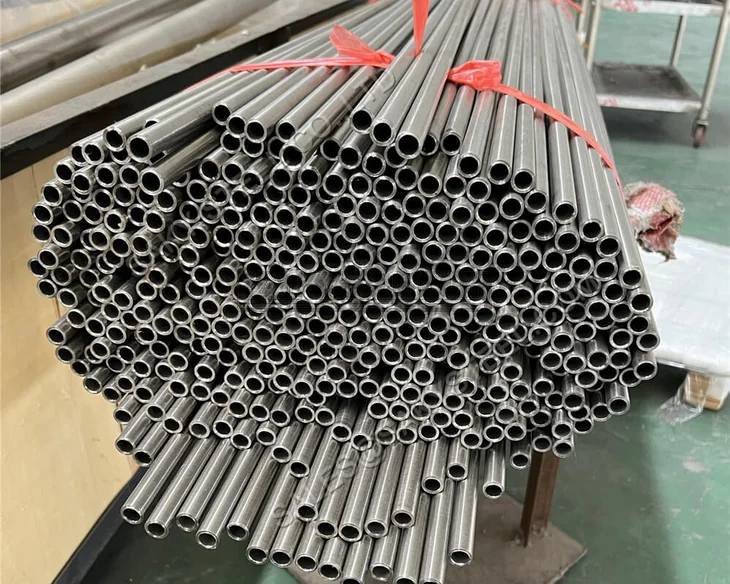
Application Selection Matrix
| Service | Critical review | Order information |
|---|---|---|
| Seawater cooling and condensers | Temperature, velocity, deposits, crevices, galvanic interfaces and tube-sheet design | Grade, ASTM B338, OD, wall, length, joining and NDE |
| Chemical processing | Medium, concentration, aeration, impurities, pressure and upset conditions | Corrosion-reviewed grade, construction, tests and cleaning |
| Desalination and evaporators | Brine chemistry, scaling, cleaning cycles and thermal duty | Dimensions, surface, ends, inspection and traceability |
Grade Selection
Grade 2 is commonly evaluated for seawater and many oxidizing environments because it combines corrosion resistance, formability and weldability. Grade 7 contains palladium and may be considered for selected reducing or crevice-corrosion conditions. Grade 12 may be evaluated where its alloying and elevated-temperature properties suit the design. No grade is universally suitable; corrosion review must include normal, cleaning, start-up and upset conditions.
Standard, Construction and Dimensions
ASTM B338 is commonly specified for seamless or welded titanium heat-exchanger and condenser tube. State the standard edition, grade, seamless or welded route, outside diameter, wall thickness, length, condition, tolerances, straightness, surface and end requirements. ASTM B861 and B862 address seamless and welded pipe rather than automatically replacing a B338 tube requirement.
Fabrication and System Design
Tube quality cannot correct an unsuitable tube-sheet material, poor crevice geometry, inadequate expansion, contaminated welding or galvanic mismatch. Define tube-to-tube-sheet expansion or welding, cleaning, iron-contamination control, bend requirements and compatible fabrication procedures. The equipment designer remains responsible for the complete system.
Inspection and Documentation
Depending on the specification and project, require chemistry and tensile results, dimensional and surface inspection, flattening or flaring, eddy-current or ultrasonic examination, and hydrostatic or pneumatic testing. State acceptance criteria, certificate type, heat or lot traceability and third-party witness points in the RFQ.
Review Tube Options
Grade 2 Seamless Tube, Grade 2 Welded Tube, Grade 7 Seamless Tube and the Titanium Pipe & Tube family.
RFQ Checklist
- Process and cooling fluids, concentrations and temperatures
- Pressure, velocity, fouling, cleaning and upset conditions
- Grade, standard, construction, OD, wall, length and quantity
- Tube-sheet material and joining method
- Inspection, testing, certification and delivery requirements
FAQ
Is Grade 2 suitable for every seawater heat exchanger?
No. Review temperature, deposits, crevices, flow, galvanic coupling and joining details.
Must heat-exchanger tube be seamless?
No. ASTM B338 can cover seamless or welded tube when ordered and accepted correctly. Follow the equipment specification.
Why specify tube ends?
End squareness, cleanliness and dimensional control affect insertion, expansion and welding at the tube sheet.
Related Reading
Condenser Tube Selection · Grade 2 vs Grade 7 · B338 vs B861 vs B862
ASTM B338 Heat Exchanger Tube
For condenser, seawater and chemical heat-transfer service, specify grade, OD, wall, length, tube condition and the required ASTM B338 tests.