
Titanium Pipe Spool vs Loose Pipe, Fittings and Flanges
Shop-fabricated titanium pipe spools provide controlled welding, inspection and dimensional records, while loose pipe, fittings and flanges provide more field adjustment. The best delivery split depends on drawing maturity, site access, transport limits, installation sequence, field-welding capability and total installed risk—not component price alone.
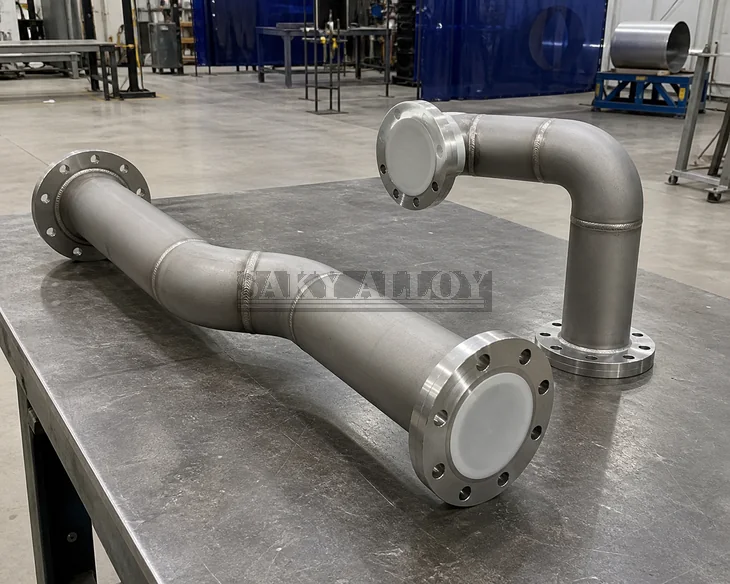
Shop Spool vs Loose Components
| Decision item | Shop-fabricated spool | Loose components |
|---|---|---|
| Welding environment | Controlled cleanliness, shielding, fixtures and supervision | Dependent on field access, weather, purge setup and site controls |
| Dimensional control | Measured against an approved isometric before shipment | More adjustment during installation, but field fit-up must be managed |
| Inspection records | Consolidated weld map, NDE and data book | Site inspection and turnover records require coordination |
| Transport and lifting | Large assemblies need support, lifting points and flange protection | Smaller pieces are easier to transport and handle |
| Schedule exposure | More work completed before site installation | More fabrication and quality activity remains at site |
When Shop Prefabrication Is Often Favored
Prefabrication is attractive when isometrics and line classes are mature, field titanium welding is difficult, cleanliness requirements are high, or a consolidated data book is valuable. It can reduce site weld count and allow controlled dimensional inspection. The advantage is lost if drawings continue changing or the completed assembly cannot be transported or installed safely.
When Loose Components May Be Better
Loose components can suit brownfield tie-ins, uncertain field dimensions, restricted access, transport constraints or installation sequences that demand adjustment. This route still requires qualified field welding, clean storage, purge and shielding controls, inspection, traceability and closure documentation. “Loose” does not mean uncontrolled.
Constructability and Spool Breaks
Before release, review maximum shipping envelope and weight, lifting points, flange protection, temporary supports, field joints, closure welds, installation sequence and allowable tolerances. Choose spool breaks where they support safe transport and practical fit-up rather than simply minimizing the number of pieces.
Compare Total Installed Scope
Compare like-for-like quotations: materials, fabrication, welding consumables, NDE, pressure or leak testing, data book, packaging, freight, site labor, field equipment and schedule risk. A lower component price can be offset by difficult site welding or rework; a large prefabricated spool can also create transport and alignment costs.
Review the Delivery Split
Compare Titanium Pipe Spools, Titanium Pipe & Tube, Titanium Buttweld Fittings and Titanium Flanges.
RFQ Checklist
- Approved isometrics, line class and BOM
- Proposed shop and field weld split
- Transport envelope, lifting and site access limits
- Welding, NDE, testing and documentation scope
- Packaging, preservation and installation sequence
FAQ
Does a prefabricated spool eliminate field welding?
Not necessarily. Tie-ins, closure welds and transport-driven spool breaks may remain.
Are loose components easier to install?
They offer flexibility, but shift fit-up, welding, inspection and documentation to the site.
Which option is cheaper?
Compare total installed cost and risk. The result depends on project location, access, labor, quality controls, transport and schedule.
Related Reading
How to Specify a Pipe Spool · Pipe Spool Applications · Buttweld Fittings Matrix