

How to Specify Titanium Threaded Fittings
A reliable titanium threaded-fitting order must define more than the alloy grade and nominal size. The product form, thread, dimensional standard, source material, pressure-design basis, service environment, surface condition and inspection must work together as one purchasing definition.
1. Identify the Exact Product Form
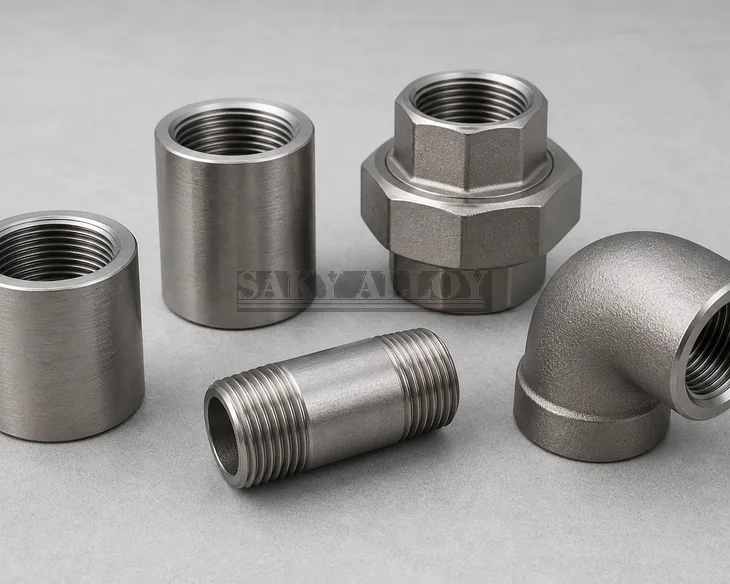
State whether the requirement is a threaded coupling, threaded union, pipe nipple, elbow, tee, plug or drawing-specific component. The name determines the flow path, end arrangement, assembly sequence and maintenance access.
2. State the Governing Standard and Revision
For covered forged titanium socket-welding and threaded fittings, ASME B16.52-2024 is the relevant titanium-specific reference. It addresses ratings, dimensions, tolerances, marking and material requirements. Special dimensions, threads or counterbores require agreement between purchaser and manufacturer. Do not assume that a fitting made from titanium automatically complies.
3. Define the Thread Completely
For inch pipe threads, state the ASME B1.20.1 designation such as NPT, together with size, internal or external end, required gaging and any project-specific allowance. If BSPT, BSPP, metric or another thread is required, identify the exact standard. Similar nominal sizes from different thread systems are not interchangeable.
4. Define Material and Traceability
Specify the exact titanium grade and UNS designation, source-material specification, condition and any project restrictions. Require an MTC and heat/lot identity that can be linked to the finished fitting. Grade equivalence must not be inferred from appearance or a trade name.
5. Provide Pressure and Service Information
A dimensional standard alone does not complete pressure design. Provide design pressure and temperature, medium, concentration, cleaning requirements, corrosion allowance if applicable, piping code and purchaser engineering requirements. The system designer remains responsible for joint suitability.
6. Control Assembly and Galling Risk
Titanium threaded joints can be sensitive to adhesive wear. Define surface condition, cleaning, compatible sealant or lubricant, mating material, tightening method and reuse policy. Any compound must also be compatible with the process medium, temperature and cleanliness requirements.
7. Specify Inspection
| Inspection item | Typical purchasing definition |
|---|---|
| Material | MTC, grade, heat/lot and source-material review |
| Dimensions | Size, wall, bore, length, across-flats and end geometry |
| Threads | Designation, internal/external ends and agreed plug/ring gaging |
| Surface | Visual condition, cleanliness, burrs and thread damage |
| Supplementary tests | PMI, PT, pressure test or third-party inspection when ordered |
Send a Complete RFQ
For quotation, provide product form, titanium grade, standard and revision, size, thread, dimensions, quantity, pressure and temperature, medium, surface or lubricant requirements, tests, documents and destination. See the Titanium Threaded Fittings product page.
Related Product Comparison
Read Titanium Threaded Coupling vs Union vs Pipe Nipple to choose the correct connection form before requesting a quotation.