

How to Specify Titanium Retaining Rings
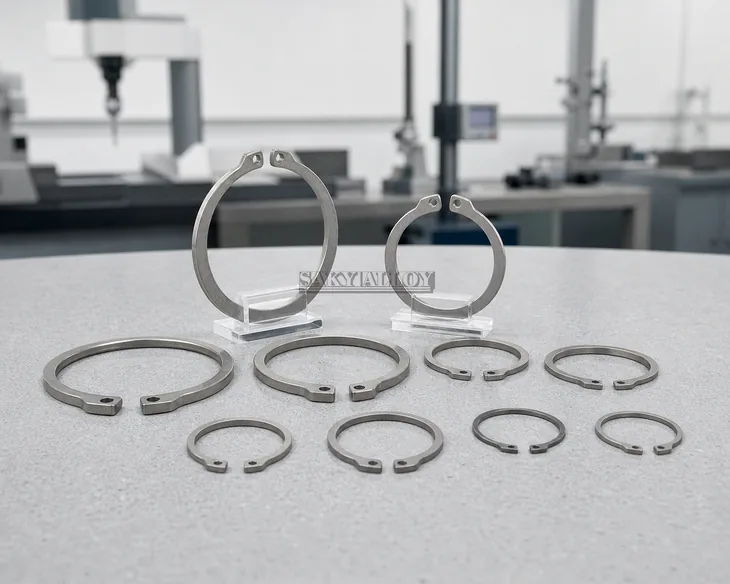
A titanium retaining ring inquiry must identify internal or external form, mating shaft or bore, groove dimensions, ring section, free geometry, load, installation and material condition. Copying a steel ring size without functional validation is unsafe.
Internal vs External Rings
| Ring type | Location | Installation action |
|---|---|---|
| External retaining ring | Groove on a shaft | Expanded over the shaft and released into the groove |
| Internal retaining ring | Groove inside a bore | Compressed for insertion and released into the groove |
Groove and Load Data
State shaft or bore diameter, groove diameter, groove width, corner radius, thrust face, mating component and available installation access. Define axial load, rotation, cycles, vibration, temperature and corrosion environment.
Why Titanium Requires Validation
Titanium differs from common spring steels in elastic modulus, strength, springback, wear and surface behavior. Section and condition must provide acceptable installation strain, permanent set and axial retention. A dimensional reference alone cannot prove functional capacity.
Send the Groove and Load Definition
Review Titanium Retaining Rings and provide the mating groove drawing, load, cycles, environment and inspection requirements.
FAQ
Do DIN 471 and DIN 472 automatically specify titanium?
No. They may be used as dimensional references when invoked, but titanium grade, condition, functional testing and deviations must be defined separately.
Can an installed ring be reused?
Reuse should not be assumed. It requires an approved maintenance procedure and confirmation that the ring has not exceeded deformation, wear or damage limits.
Related Reading
How to Specify Titanium Dowel Pins · Titanium Fastener Purchasing Matrix