

How to Specify a Titanium Tube Sheet for Heat Exchanger Fabrication
A titanium tube sheet is not simply a thick perforated plate. It is an engineered exchanger component whose raw material, hole layout, ligaments, faces, tube joint and inspection must match the approved equipment design.
Start With the Approved Equipment Drawing
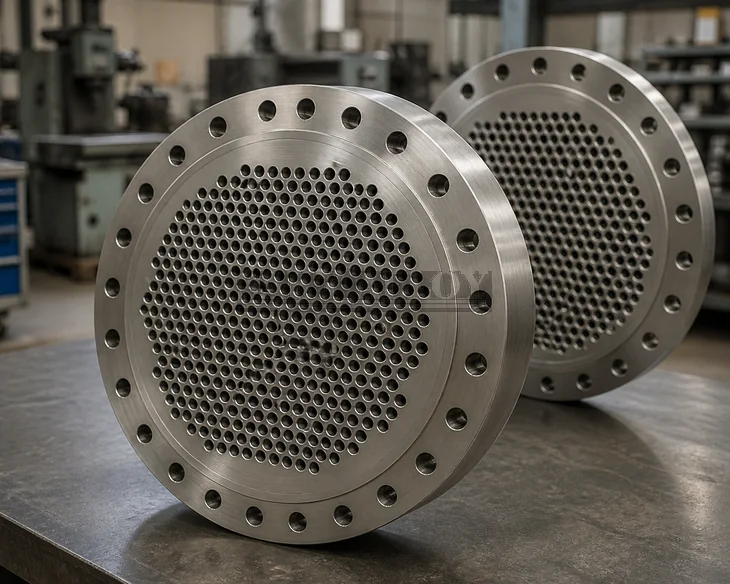
Provide overall diameter and thickness, steps, gasket and bolting faces, grooves, tube-hole layout, pitch, ligaments, tube projection and all drawing tolerances. A sketch without controlled dimensions is not enough for final quotation.
Define the Material Route
| Decision | Information to provide | Why it matters |
|---|---|---|
| Construction | Solid titanium, titanium clad or approved alternative | Controls design, machining and inspection route |
| Raw material | Grade and plate or forging specification | Controls properties, traceability and availability |
| Condition | Heat treatment and surface condition | Affects machining and equipment acceptance |
Control Tube Holes and the Joint
State hole diameter and tolerance, pitch, groove geometry, drilling depth, burr acceptance, surface finish and gauging. Identify whether tubes are expanded, welded or combined and provide the qualified tube-to-tubesheet procedure requirements.
Build the Inspection Plan Into the RFQ
Typical requirements may include raw-material certificates, PMI, dimensional mapping, plug gauges, coordinate measurement, face flatness and finish, visual inspection and project-specific NDE. Only requested and feasible tests should be included.
Coordinate the Tube Sheet With the Tube Supply
Review the titanium tube sheet, titanium heat exchanger tube and titanium condenser tube. Send the drawing, material specification, joint data, inspection plan and quantity for review.
RFQ Checklist
- Approved drawing and design code
- Titanium grade and raw-material route
- Solid or clad construction
- Hole pattern, pitch, ligaments and grooves
- Faces, flatness, finish and tube joint
- Quantity, NDE and documentation