

How to Specify a Titanium Spectacle Blind
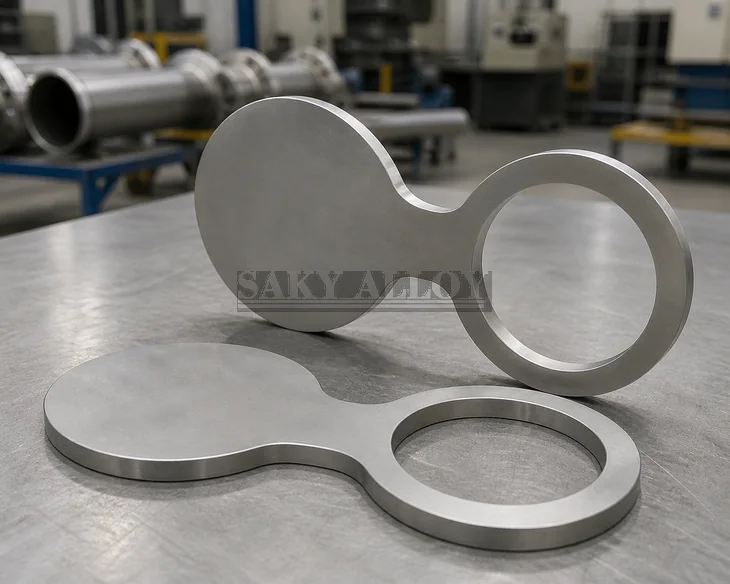
A quote-ready titanium spectacle-blind RFQ must define dimensional compatibility, material acceptance, service conditions and the operational isolation arrangement. Size and pressure class alone are not enough.
Specification Matrix
| Group | Required data |
|---|---|
| Design basis | ASME B16.48 revision or approved drawing |
| Connection | NPS/DN, class, facing, bore and mating flanges |
| Component | Thickness, OD, spacer opening, handle and marking |
| Material | Titanium grade, source standard and condition |
| Quality | Dimensions, PT/PMI if required, MTC and traceability |
Confirm Standard and Material Acceptance
ASME B16.48 provides requirements within its stated scope, but the governing piping code and project specification must accept the requested titanium material and pressure-temperature basis. Custom or out-of-scope geometry needs approved design documentation.
Operational Details
State handle direction, open/closed marking, lifting points, clearance, bolt length and gasket arrangement. Coordinate the component with depressurization, drainage, flange spreading and lockout procedure.
Product and Category
RFQ Checklist
- Standard/drawing revision, size and class
- Facing, bore, thickness and handle
- Grade, source material and service data
- Mating flanges, gaskets and bolting
- Inspection, marking, certificates and quantity
FAQ
Does ASME B16.48 automatically approve every titanium grade?
No. Confirm material acceptance in the governing code and project specification.
Should the open and closed positions be marked?
Yes, define durable position identification and plant tagging requirements.
Related Reading
Spectacle vs Paddle Set · Line Blank Applications · Plate vs Forged Flange