

Titanium Plate Flange vs Forged Flange
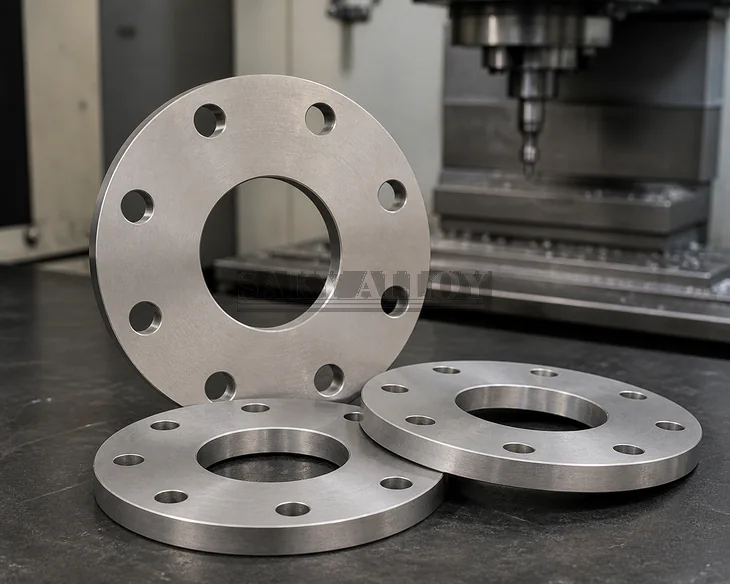
A titanium plate flange and forged flange may share a bolt pattern but are not automatically equivalent. Starting product, grain flow, geometry, material specification, design-code scope and approved pressure design must be reviewed separately.
Construction Comparison
| Item | Plate flange | Forged flange |
|---|---|---|
| Starting product | Rolled plate | Forging stock or billet |
| Geometry | Usually constant-thickness ring or blank | May include hub, neck or forged contour |
| Use basis | Approved project drawing/design | Invoked flange and forging standards |
| Acceptance | Plate records plus finished-part controls | Forging records plus flange controls |
Code Scope and Rating
A bolt circle and facing do not establish a pressure rating. Confirm whether the invoked flange standard permits the selected product form and geometry. A flat plate ring outside standard coverage needs an approved calculation or project design basis.
Manufacturing and Inspection
Define grade, source standard, cutting/forging route, heat treatment, machining allowance, grain-flow requirement if applicable, dimensions, facing, surface/NDE, MTC and heat traceability. Finished-part acceptance must match the approved drawing.
Choose the Approved Product Form
Compare Titanium Plate Flange with the broader Titanium Flange family.
RFQ Checklist
- Approved drawing, code and design basis
- Grade, source product and condition
- Size, facing, bore, thickness and bolt pattern
- Service, gasket, bolting and mating connection
- Inspection, NDE, MTC and traceability
FAQ
Can any flat ring be described as an ASME-rated flange?
No. Standard scope, material form, geometry and design approval must support the claim.
Is a forged flange always required?
Not universally; follow the applicable code and approved equipment design.
Related Reading
Line Blank Comparison · Specify a Spectacle Blind · Line Blank Applications
Direct Answer: Titanium Plate Flange or Forged Flange?
Use a forged flange when the piping code, pressure class, material specification or project requirements call for a qualified forging. Consider a plate-machined flange only where the design explicitly permits plate construction and the pressure, load, grain direction, thickness and inspection have been engineered. A plate flange is not automatically equivalent to an ASME pressure-rated forged flange.
| Factor | Plate flange | Forged flange |
|---|---|---|
| Source product | Certified titanium plate, commonly ASTM B265 when invoked | Titanium forging, commonly ASTM B381 when invoked |
| Typical use | Low-pressure, non-code or project-engineered connection | Code, class-rated or higher-integrity piping/equipment connection |
| Material direction | Rolled plate orientation remains relevant | Forging route and reduction can be controlled |
| Geometry | Flat plate-machined profile; hubs require separate design | Hubbed or standard flange types available by forging route |
| Approval | Requires explicit design acceptance | Must still match forging, dimensional and pressure-design documents |
Ordering and Verification
State grade, source-material specification and revision, flange type, NPS, class or design pressure, facing and finish, bore, thickness, bolt drilling, connected pipe or equipment geometry, quantity, service, design code, calculation or approved drawing, NDE and certificates. For plate flanges, include the required rolling direction, through-thickness review and edge or cut-surface acceptance. For forged flanges, define forging condition, hub and bore, test location and UT/PT requirements.
FAQ
Can ASTM B265 plate be machined into an ASME B16.5 flange?
Machining the dimensions does not automatically establish material or pressure-rating compliance. The design and governing code must expressly permit the source product and route.
Is every forged flange automatically code compliant?
No. Material grade, forging standard, dimensions, class, facing, tests and complete piping design must all be correct.
What should be sent for review?
Send design code, drawing, pressure/temperature, grade, flange type, sizes, facing, source route, quantity, NDE and documents.
Titanium Plate Flange | Grade 2 Titanium Forged Flange | Grade 5 Titanium Flange | Request a quote