

Titanium Flanges and Fittings for Seawater and Desalination Piping
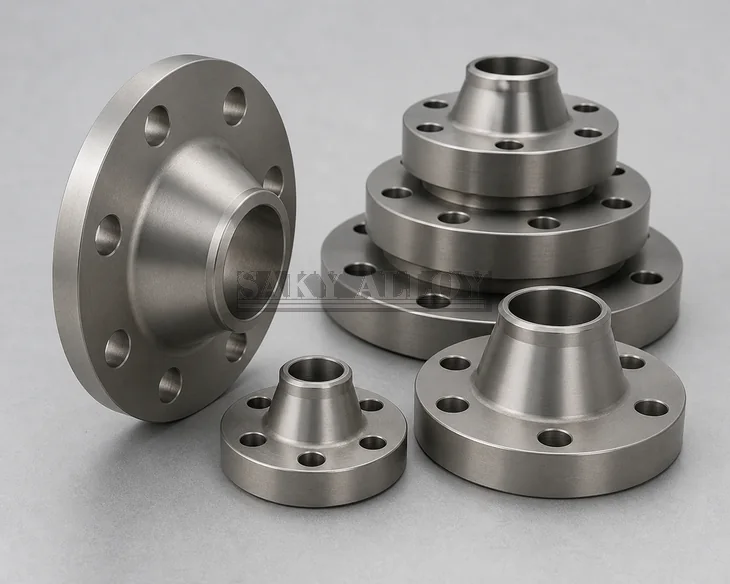
Titanium flanges and fittings can support corrosion-resistant seawater and desalination piping, but reliable service depends on the complete joint and piping system—not the component grade alone. Coordinate pipe dimensions, fitting geometry, flange class and facing, gasket, bolting, welding, galvanic interfaces, supports and inspection.
Connection Type Selection
| Component | Function | Important RFQ data |
|---|---|---|
| Weld neck flange | Butt-welded flanged joint with tapered hub | Grade, NPS, class, bore or schedule, facing and dimensional standard |
| Slip-on flange | Flange positioned over pipe and welded as designed | Pipe OD, class, facing, dimensions and welding detail |
| Elbow | Changes line direction | Angle, radius, NPS/OD, wall, ends and center-to-end |
| Tee | Creates or combines a branch | Run and branch sizes, wall, ends and dimensions |
| Reducer | Changes line size | Concentric/eccentric form, both end sizes, walls and length |
Seawater and Desalination Service Data
Provide water or brine chemistry, chlorides, temperature, pressure, velocity, aeration, solids, deposits, crevices, scaling, cleaning chemicals, start-up and shutdown conditions. Grade 2 is commonly evaluated for seawater service, while Grade 7 or Grade 12 may be considered for selected more demanding conditions. Final selection requires project-specific corrosion review.
Flanged Joint and Galvanic Review
State gasket type, flange facing, bolting material, required preload and assembly method. Review dissimilar-metal connections, electrically conductive supports and area ratios in the electrolyte. Titanium does not eliminate galvanic corrosion risk in adjacent less noble materials. Isolation details must also satisfy mechanical, electrical and safety requirements.
Standards, Dimensions and Drawings
Invoke both material/product and dimensional standards with revisions. ASTM B363 or ASME SB363 may apply to titanium welding fittings when within scope; flange material and dimensions require their applicable specifications. Special bores, facings, branches, wall transitions and compact layouts require approved drawings. Pipe schedule alone does not define all fitting or flange data.
Fabrication, Inspection and Preservation
Define clean handling, qualified welding and shielding, end preparation and acceptance of weld discoloration. Inspection may include MTC and heat/lot traceability, dimensions, wall, bevels, facing finish, visual and penetrant examination, other NDE, and pressure testing where applicable. Protect sealing surfaces and cap clean ends during shipment and site storage.
System-Level Checks
- Crevices, dead legs, deposits and cleaning cycles
- Gaskets, bolting and mating materials
- Supports, vibration, thermal movement and nozzle loads
- Field weld access and installation sequence
- Inspection and maintenance accessibility
Build a Complete Component List
Browse Titanium Flanges, Titanium Fittings and Titanium Pipe Spools. Send the line class, isometrics, quantities, service and inspection requirements.
RFQ Checklist
- Service data and governing piping code
- Component list, grade, standards and revisions
- Sizes, walls, classes, facings, ends and quantities
- Gasket, bolting, dissimilar-metal and isolation details
- Welding, NDE, testing, certification and preservation
FAQ
Can fittings and flanges be ordered from pipe schedule alone?
No. Schedule does not define grade, fitting geometry, flange class, facing, dimensions, testing or service requirements.
Should gasket and bolting be included in the review?
Yes. The complete joint determines sealing, preload and galvanic behavior.
Is Grade 2 always sufficient for seawater?
No. Review temperature, chemistry, deposits, crevices, flow, cleaning and connected materials.
Related Reading
Butt Weld Fittings Matrix · Fitting Grade Comparison · Titanium Pipe Spool Applications