

Grade 2 vs Grade 5 Titanium Hex Bolts and Nuts
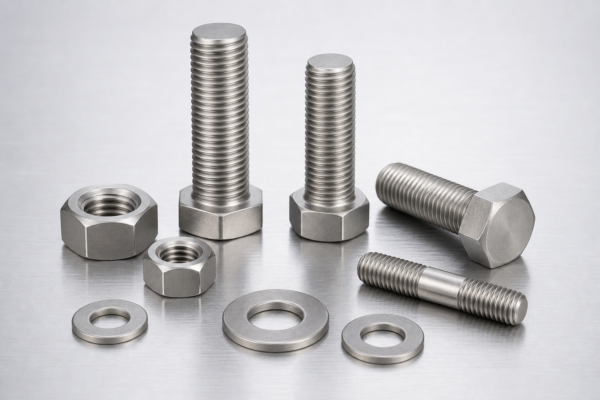
Grade 2 titanium hex fasteners emphasize commercially pure titanium corrosion resistance and ductility, while Grade 5 Ti-6Al-4V fasteners are selected for higher material strength. Finished-joint performance still depends on fastener geometry, threads, manufacture, mating parts, friction, preload and testing.
Grade 2 vs Grade 5 Hex Fasteners
| Item | Grade 2 | Grade 5 |
|---|---|---|
| UNS/family | R50400, commercially pure | R56400, Ti-6Al-4V |
| Selection emphasis | Corrosion-resistant joints with moderate strength demand | Higher-strength lightweight joints |
| Critical limitation | Lower strength may control size/preload | Higher strength does not guarantee better corrosion |
| Acceptance | Finished-fastener specification, dimensions, thread and tests—not bar data alone | |
Corrosion Is a Complete-Joint Question
Review bolt, nut, washer, clamped materials, electrolyte, temperature, crevices and galvanic area ratio. Grade 5 is not automatically more corrosion resistant. The nut and washer grade must also be intentionally selected rather than assumed.
Preload, Friction and Galling
Torque is only an indirect method of creating preload and is strongly affected by surface and lubrication. Define thread tolerance, approved lubricant/coating or clean condition, tightening sequence, speed and reuse policy. For critical joints, validate torque–tension behavior with the actual connection system.
Finished-Part Testing
Specify dimensional and thread gauging, surface inspection, mechanical tests and lot traceability according to the governing fastener specification or drawing. Confirm whether head markings, certificates, PMI or independent inspection are required.
Compare Product Options
Grade 2 Hex Bolts and Nuts, Grade 5 Hex Bolts and Nuts and Titanium Standard Parts.
RFQ Checklist
- Joint design, grade and finished-fastener standard
- Thread, tolerance, diameter, length, head and nut form
- Washer, clamped materials and service environment
- Lubrication/coating and installation procedure
- Mechanical tests, MTC, lot traceability and quantity
FAQ
Can Grade 5 replace Grade 2 because it is stronger?
No. Review corrosion, preload, fatigue, stiffness, mating materials and specification.
Should titanium fasteners be installed dry?
Do not assume. Specify and validate the intended surface and lubrication.
Can Grade 2 nuts be used with Grade 5 bolts?
Only after joint design review of thread strength, preload, corrosion and applicable standards.
Related Reading
Fastener Purchasing Matrix · Washer Selection · Galling Prevention