
How to Specify a Prefabricated Titanium Pipe Spool
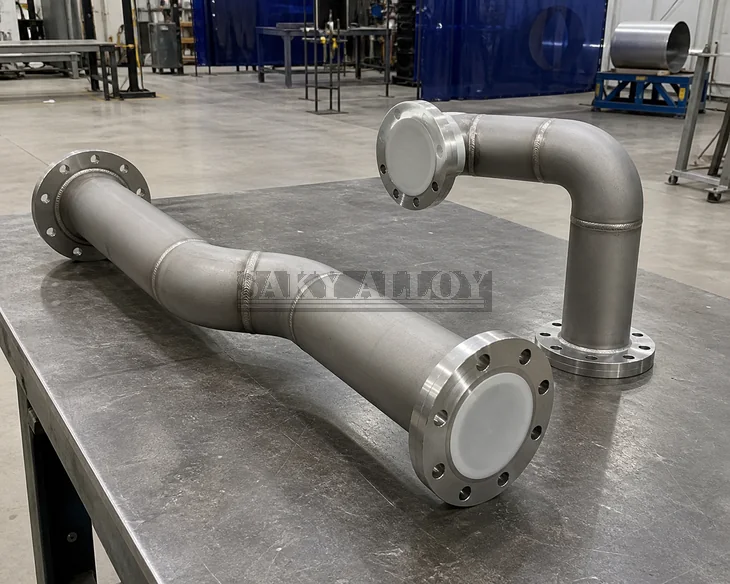
A prefabricated titanium pipe spool is a documented assembly of pipe, fittings and flanges—not a single ASTM product. A complete RFQ must control every component, the approved isometric, welding and shielding, dimensional tolerances, examination, pressure testing, cleaning, preservation and final data book.
Information Required Before Quotation
| Control area | RFQ information | Why it matters |
|---|---|---|
| Design basis | Piping code, line class, design pressure and temperature, fluid and corrosion allowance | Controls materials, fabrication and acceptance |
| Geometry | Approved isometric, dimensions, tolerances, flange orientation and support points | Prevents field-fit and alignment problems |
| Components | BOM with grade, standard, schedule or wall, rating, facing and ends | Maintains component-level compliance and traceability |
| Quality plan | WPS/PQR, welder qualification, NDE, testing, hold points and data book | Defines finished-assembly acceptance |
Component Standards Must Be Listed Separately
Seamless pipe may be supplied to ASTM B861 and welded pipe to ASTM B862. Butt-weld fittings, forged fittings and flanges use their applicable specifications and dimensional standards. Do not certify the whole spool to the pipe standard: the finished assembly requires fabrication, inspection and test records under the governing piping code and project quality plan.
Isometric and Dimensional Control
Provide a controlled drawing showing centerline dimensions, branch orientation, flange rotation, face-to-face dimensions, weld locations, vents, drains, supports and allowable tolerances. Identify field welds and shop welds. State whether trial assembly, templates or dimensional reports are required. Resolve drawing revisions before fabrication to avoid rework.
Welding and Shielding
Titanium welding requires qualified procedures, clean preparation and effective shielding of the molten and heated metal. Define base and filler materials, WPS/PQR, welder qualification, purge and trailing-shield requirements, interpass cleaning and acceptance of weld discoloration. Prevent contact with carbon-steel tools and contamination during handling.
Inspection, Testing and Data Book
Define visual, penetrant, radiographic or ultrasonic examination by weld category and acceptance criteria. Specify hydrostatic, pneumatic or leak testing only under an approved safe procedure. The data book may include material certificates, receiving traceability, weld map, qualifications, NDE reports, dimensional report, test certificate, cleaning record, nonconformance closure and release note.
Packaging for Site Installation
Protect flange faces, beveled ends and clean internal surfaces. Identify spool number, orientation, line number, weight and lifting points. Use supports that prevent distortion and packaging suitable for the shipping route and destination storage conditions.
Request a Fabrication Review
Send the isometric, line class and inspection requirements through the Titanium Pipe Spool page. Related components include Titanium Butt-Weld Fittings and Titanium Flanges.
RFQ Checklist
- Code, line class, service and approved isometric
- BOM with grade and component specifications
- Dimensions, flange details, tolerances and quantity
- Welding, shielding, NDE and acceptance criteria
- Pressure or leak test, cleaning, marking and preservation
- Data-book index, inspection points and delivery schedule
FAQ
Can a pipe spool be ordered from a hand sketch?
A preliminary quote may be possible, but fabrication should use an approved controlled isometric with complete dimensions and component data.
Does a material certificate cover the completed spool?
No. Component certificates establish material traceability; the completed assembly also needs fabrication, weld, inspection and test records.
Why is flange rotation important?
Bolt-hole orientation and face alignment affect installation. State orientation and tolerances on the drawing.
Related Reading
Spool vs Loose Components · Pipe Spool Applications · Butt-Weld Fittings Purchasing Matrix
Build the Pipe Spool Material Specification
Confirm the base pipe and fitting specifications before submitting the isometric drawing, weld map, inspection scope and delivery requirements.