

How to Specify Titanium Nuts for Marine and Chemical Assemblies
A titanium nut for marine or chemical equipment must be specified as part of a complete bolted joint. Alloy grade, thread system, nut geometry, mating bolt, surface condition, locking method, installation procedure and exposure environment all influence reliability. Selecting a nut only by nominal diameter leaves important procurement and engineering questions unanswered.
Start With the Joint, Not the Nut
The nut must develop and retain the preload required by the joint without stripping, galling, cracking or loosening. Its thread must match the bolt, but matching the nominal diameter is not enough. Pitch, thread class, engagement, nut height, bearing surface and material properties must also be compatible.
In corrosive service, the surrounding joint matters as much as the titanium hardware. A titanium nut may resist seawater well while a connected carbon-steel component corrodes rapidly because of an unfavorable galvanic area relationship. Drainage, isolation, coatings and inspection access should be reviewed at system level.
Grade 2 and Grade 5 Titanium Nuts
| Selection point | Grade 2 titanium | Grade 5 Ti-6Al-4V |
|---|---|---|
| General characteristic | Commercially pure titanium with strong corrosion-resistance value and moderate strength. | Higher-strength alpha-beta alloy with a high strength-to-weight ratio. |
| Typical evaluation | Marine and chemical assemblies where Grade 2 is compatible with the environment and design load. | Higher-load marine, offshore, aerospace and industrial assemblies. |
| Important caution | Do not assume corrosion resistance in every acid concentration or reducing condition. | Do not infer finished-nut proof load from raw material strength alone. |
The mating fastener grade and the nut specification should be reviewed together. Substituting a stronger or weaker nut without engineering approval can shift the joint’s failure mode.
Nut Styles and Their Procurement Meaning
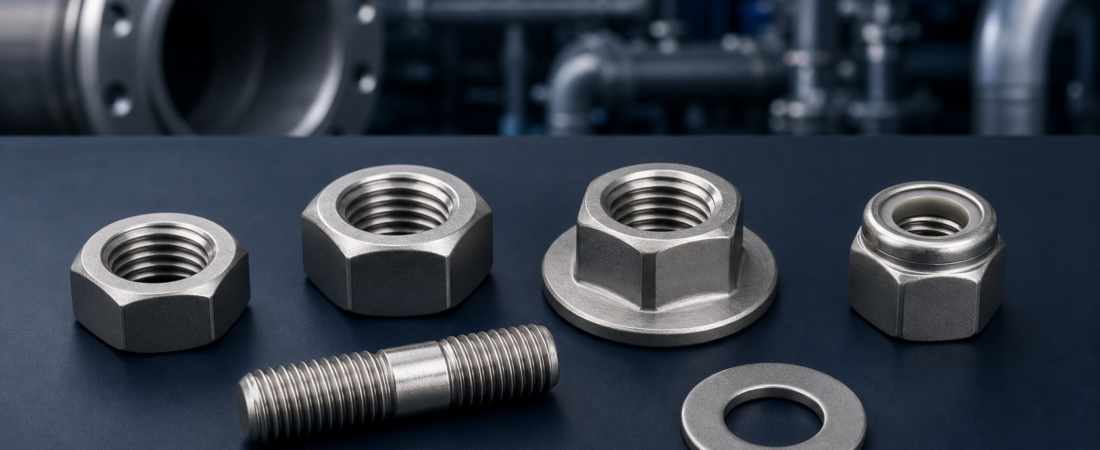
- Regular hex nut: the basic choice for accessible assemblies where the specified bearing area and engagement are adequate.
- Heavy or high nut: offers different across-flats or height geometry; it should be ordered to a specific standard or drawing.
- Thin nut: saves space but has reduced thread engagement and must not be treated as a regular nut.
- Flange nut: integrates a wider bearing surface; flange diameter, serrations and mating surface must be defined.
- Prevailing-torque nut: adds a locking feature, but temperature, reuse policy and prevailing torque must be qualified.
- Castle or slotted nut: works with a drilled bolt and pin where a positive retention system is required.
Applicable Standards and Drawings
ASTM F467-24(2026) covers commercial wrought nonferrous nuts for general-use applications and includes chemical composition and mechanical requirements within its scope. Its metric companion should be considered when SI requirements apply. The purchase order should identify the exact standard, edition, alloy and supplementary requirements.
ISO 4032:2023 defines metric regular hex-nut geometry for steel and stainless steel. If its geometry is used for a titanium nut, the order must separately define the titanium material and performance requirements. A customer drawing is preferable when flange dimensions, locking features, thread relief, special bearing faces or restricted clearances differ from standard products.
Marine Service Questions
For seawater, splash-zone or offshore exposure, provide the mating materials and the relative exposed areas. Titanium is relatively noble in seawater; a small carbon-steel component connected to a large titanium area can experience accelerated attack. Isolation sleeves, nonconductive washers, coatings and suitable sealants may be part of the solution, subject to the equipment design.
Also consider crevices, stagnant seawater, deposits, temperature, cathodic-protection potential, biofouling and inspection access. The phrase “marine grade” is not a complete material or joint specification.
Chemical-Processing Questions
State the chemical species, concentration, temperature, aeration, contaminants, flow condition and cleaning cycle. Titanium performance can change significantly between oxidizing and reducing environments, and small amounts of other ions may change corrosion behavior. Grade 7 or another palladium-bearing grade may be evaluated in some reducing-acid services, but material selection belongs to the equipment designer or corrosion specialist.
Bolted joints can trap liquid and create crevice conditions that differ from the bulk process stream. Gaskets, washers, deposits and thread roots should therefore be included in the corrosion review.
Prevent Galling During Assembly
Titanium-on-titanium threads are susceptible to adhesive wear and galling. Risk can increase with damaged or contaminated threads, high installation speed, excessive preload and repeated reuse. A qualified assembly procedure may include clean threads, controlled tightening speed, compatible lubricant or coating, appropriate thread tolerance and replacement criteria.
Lubrication changes friction and therefore changes the preload produced by a given torque. Do not reuse a dry-thread torque value after adding lubricant. Validate the torque–tension relationship for the actual bolt, nut, finish and installation method. See How to Prevent Galling in Titanium Bolts and Nuts for a detailed checklist.
Titanium Nut RFQ Checklist
- Grade, UNS designation, material condition and applicable ASTM or project specification.
- Nut style, dimensional reference or drawing, across-flats, height and bearing-face requirements.
- Metric or inch thread, pitch, class and mating bolt or stud specification.
- Quantity, manufacturing route, finish, cleanliness, coating or lubricant.
- Locking method, prevailing-torque requirement, reuse policy and installation procedure.
- MTC, heat/lot traceability, dimensional report, hardness or proof-load testing as required.
- Service medium, concentration, temperature, mating materials and galvanic-isolation plan.
Need Titanium Nuts for a Marine or Chemical Project?
Send the alloy, thread, nut form, mating fastener, quantity, documents and service conditions. SAKY ALLOY can review standard and drawing-specific titanium fastener requirements before quotation.
Send Your RFQ View Grade 5 Flange Nuts Grade 2 Bolts and Nuts
Frequently Asked Questions
Should a titanium nut always match the bolt grade?
The mating combination must satisfy the governing joint design and fastener specifications. Do not assume that mixing grades is acceptable without reviewing thread stripping, proof load, corrosion and galling.
Does a flange nut eliminate the need for a washer?
Not automatically. The bearing surface, joint material, hole size, isolation requirement and design standard determine whether an additional washer is needed.
Can titanium nuts be reused?
Reuse depends on the design, locking feature, thread condition, service history and approved maintenance procedure. Prevailing-torque and critical-service hardware may have restricted reuse.