

Titanium Countersunk Screws: Dimensions, Head Styles and Applications
Titanium countersunk screws are selected when a flush surface, low weight and corrosion resistance are required in the same assembly. Head geometry, recess type, thread, material grade and joint design must be specified together. A familiar dimensional designation alone does not establish the strength or suitability of a finished titanium screw.
What Is a Titanium Countersunk Screw?
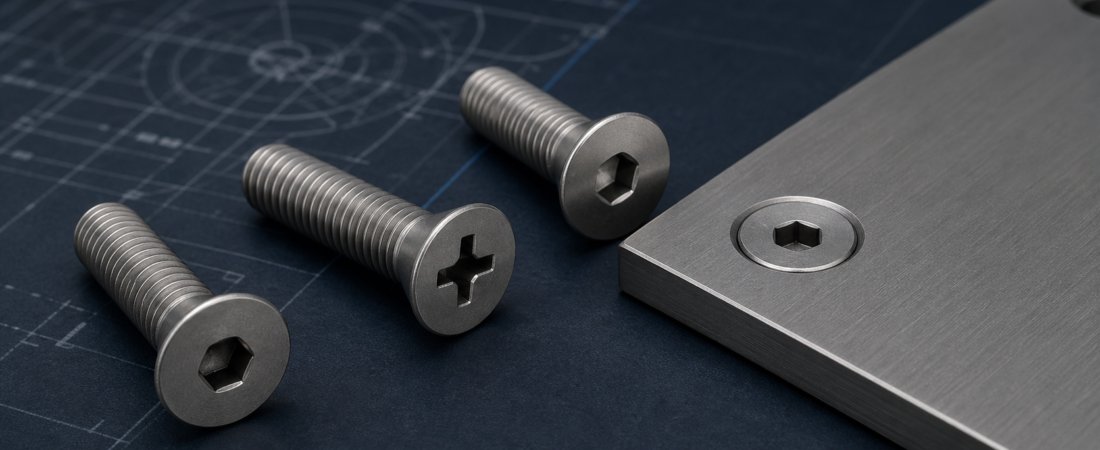
A countersunk screw has a conical bearing surface below the head. It seats in a matching countersink so that the top of the head can be flush with, or slightly below, the surrounding surface. This is useful where projecting hardware would interfere with a mating component, airflow, cleaning, movement or appearance.
Common drive options include an internal hexagon socket and a cross recess. Slotted, six-lobe and drawing-specific drives may also be requested. The drive system affects tooling, installation access and the amount of material remaining in the head, so it should never be treated as a cosmetic choice.
Dimensions Buyers Should Define
| RFQ item | Why it matters |
|---|---|
| Nominal thread and pitch | Defines the mating thread. State metric coarse/fine, UNC, UNF or the applicable drawing. |
| Overall length | Countersunk screw length is normally measured from the top of the head; confirm the invoked standard. |
| Head diameter and angle | Must match the prepared countersink to obtain uniform bearing contact. |
| Drive size and depth | Controls tool engagement and influences the remaining head section. |
| Thread length and point | Affects grip length, runout, engagement and assembly clearance. |
| Countersink in the joint | The hole angle, depth and concentricity must align with the selected head. |
How ISO and ASTM References Should Be Used
ISO 10642:2026 defines characteristics for metric hexagon-socket countersunk head screws and explicitly identifies reduced loadability arising from the head design. Its published scope is for steel and stainless steel screws. A purchaser considering its geometry for titanium should therefore state that dimensional reference together with the required titanium material, mechanical properties, manufacturing route and acceptance criteria.
ISO 7046-2:2011 covers cross-recessed countersunk flat head screws and includes non-ferrous metal screws within its scope. Material and property requirements still need to be checked against the purchase specification. For inch-series general-service nonferrous fasteners, the applicable edition of ASTM F468 may be considered where its product scope and requested configuration match the order.
Standards should not be mixed by copying selected dimensions from unrelated systems. If a customer drawing controls, the drawing should identify which dimensions are mandatory and which standard supplies any unspecified details.
Grade 2 or Grade 5 Titanium?
Grade 2 commercially pure titanium is often evaluated where corrosion resistance, formability and moderate strength are important. Grade 5 Ti-6Al-4V offers substantially higher strength and is commonly considered for weight-sensitive engineering assemblies. The correct choice depends on design load, environment, temperature, fatigue, mating material and the governing specification.
- Grade 2: commonly considered for chemical-processing and marine environments where commercially pure titanium is suitable.
- Grade 5: commonly considered for aerospace, marine, motorsport and precision equipment requiring a higher strength-to-weight ratio.
- Grade 23: may be specified for particular medical or aerospace requirements, subject to the governing material and fastener specification.
Reduced Head Loadability and Joint Design
A countersunk head contains less material around the drive recess than many protruding head styles. The head may therefore govern the fastener’s capacity before the threaded section reaches its full tensile capability. The countersink also needs accurate alignment: uneven contact can concentrate stress on one side of the head.
Designers should verify tensile and shear loading, edge distance, plate thickness, fatigue, countersink depth and installation torque. A countersunk screw should not automatically replace a socket head cap screw of the same thread size without a joint review.
Galling, Surface Condition and Installation
Titanium mating threads can gall when friction and local adhesion rise during tightening. Clean threads, compatible mating hardware, controlled installation speed and a qualified lubricant or coating may reduce risk. Any lubricant changes the torque–tension relationship, so torque values must come from validated assembly data rather than a generic internet chart.
Where titanium contacts a dissimilar metal in a conductive marine or chemical environment, the complete galvanic couple should be reviewed. Electrical isolation, washers, coatings and drainage can be more important than changing the screw alone. Related guidance is available in How to Prevent Galling in Titanium Bolts and Nuts.
Applications
Titanium countersunk screws may be evaluated for aircraft interiors and fixtures, marine deck hardware, chemical-equipment covers, robotics, optical instruments, motorsport components and premium bicycle assemblies. Suitability must be confirmed for the actual load case and environment; this article does not provide a universal design rating.
Countersunk Screw RFQ Checklist
- Titanium grade, UNS designation and required material condition.
- Head style, drive type and dimensional standard or controlled drawing.
- Thread diameter, pitch, length, thread coverage and quantity.
- Countersink angle, head diameter and flushness requirement.
- Surface finish, cleanliness, lubricant or coating requirements.
- MTC, heat/lot traceability, dimensional report and any mechanical testing.
- Application, mating material, temperature and relevant load information.
Planning a Titanium Countersunk Screw RFQ?
SAKY ALLOY can review Grade 5 and other titanium fastener requirements against a drawing or specified dimensional reference. Send the thread, length, head geometry, quantity, documentation and application details for a manufacturing review.
Frequently Asked Questions
Why can a countersunk screw have reduced loadability?
The head and drive recess leave a smaller effective section than many protruding head designs. The head can therefore become the limiting part of the fastener.
Can ISO 10642 dimensions be requested for a titanium screw?
They may be used as an agreed dimensional reference, but ISO 10642:2026 itself specifies steel and stainless steel screws. Titanium material, properties and acceptance requirements must be separately defined.
Is screw length measured under the head?
For countersunk screws, length is normally measured from the top of the head. The invoked standard or drawing should always control the order.