

Titanium Woven Mesh vs Expanded Metal vs Perforated Sheet
Titanium woven wire mesh, expanded metal and perforated sheet all provide controlled open area, but their manufacturing routes and mechanical behavior are different. Choosing by appearance alone can lead to the wrong opening, stiffness, edge or fabrication result.
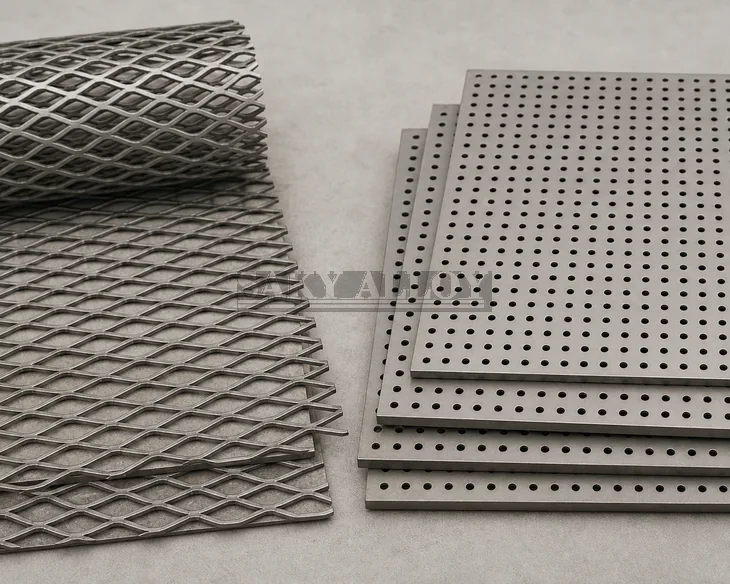
Open-Area Product Comparison
| Product | How it is made | Primary ordering dimensions |
|---|---|---|
| Woven wire mesh | Warp and weft wires interlaced | Weave, wire diameter, mesh count or clear opening |
| Expanded metal | Sheet slit and stretched without punched-out holes | Base thickness, strand, SWD, LWD, raised/flattened |
| Perforated sheet | Holes punched or otherwise produced in sheet | Sheet thickness, hole shape/size, pitch, pattern and margins |
Opening Size Does Not Fully Define the Product
Two products with similar open area can differ in stiffness, flow direction, strand or ligament strength, flatness and edge condition. State the support method and functional requirement together with the nominal opening.
Edges and Cut Size Affect Installation
Define trimmed or untrimmed edges, safe handling, burr direction, margins, orientation of the diamond or weave, width, length, roll or sheet form and flatness. These details affect frames, welding and sealing.
Choose Grade From the Environment
Grade 1 and Grade 2 are common commercially pure titanium options, but the service medium, electrochemical duty, temperature, mechanical load and fabrication determine the suitable grade and section dimensions.
Match the Product Form to the Function
Compare titanium woven wire mesh, titanium expanded metal mesh and titanium perforated sheet. Send grade, geometry, dimensions, cut size, edges, quantity and inspection requirements.
RFQ Checklist
- Titanium grade
- Woven, expanded or perforated form
- Opening and wire/strand/sheet dimensions
- Open area where controlled
- Width, length, orientation, edges and flatness
- Quantity, tests and certificates
Frequently Asked Questions
Do woven mesh, expanded metal and perforated sheet have the same open area at the same opening size?
No. Wire diameter, weave, strand and bond geometry, hole shape, pitch and pattern all affect open-area percentage and flow. Specify both the opening geometry and the required open area.
Which titanium mesh form is strongest?
Strength cannot be ranked from the product name alone. Compare grade, thickness or wire diameter, pattern, direction, cut size, edge condition, support span and applied load using the finished assembly design.
What information is needed for a titanium mesh or perforated sheet RFQ?
Provide product form, titanium grade, opening or hole geometry, wire/strand/sheet thickness, pitch or mesh count, open area, width, length, edge condition, surface, quantity, flatness and documentation.