
Titanium Pipe Retrofit Planning for Chemical Processing
This engineering guide explains the information that should be reviewed before replacing carbon steel, stainless steel or another piping material with titanium. It is a planning reference, not a report of a specific completed SAKY ALLOY customer project. Final material selection must be confirmed against the actual chemical composition, concentration, contaminants, temperature, pressure, flow, crevice conditions, fabrication route and governing code.
When Should Titanium Be Evaluated for a Pipe Retrofit?
Titanium may be evaluated where corrosion, maintenance frequency, contamination control or lifecycle cost makes the existing piping material unsuitable. It performs well in many oxidizing chloride and seawater environments, but the word “acid” alone is not enough to confirm compatibility. Reducing acids, dry chlorine, low-oxygen crevices, fluoride contamination and mixed chemicals require specific corrosion review.
Separate the Product Standard from the Application
| Product form | Common reference | Procurement use |
|---|---|---|
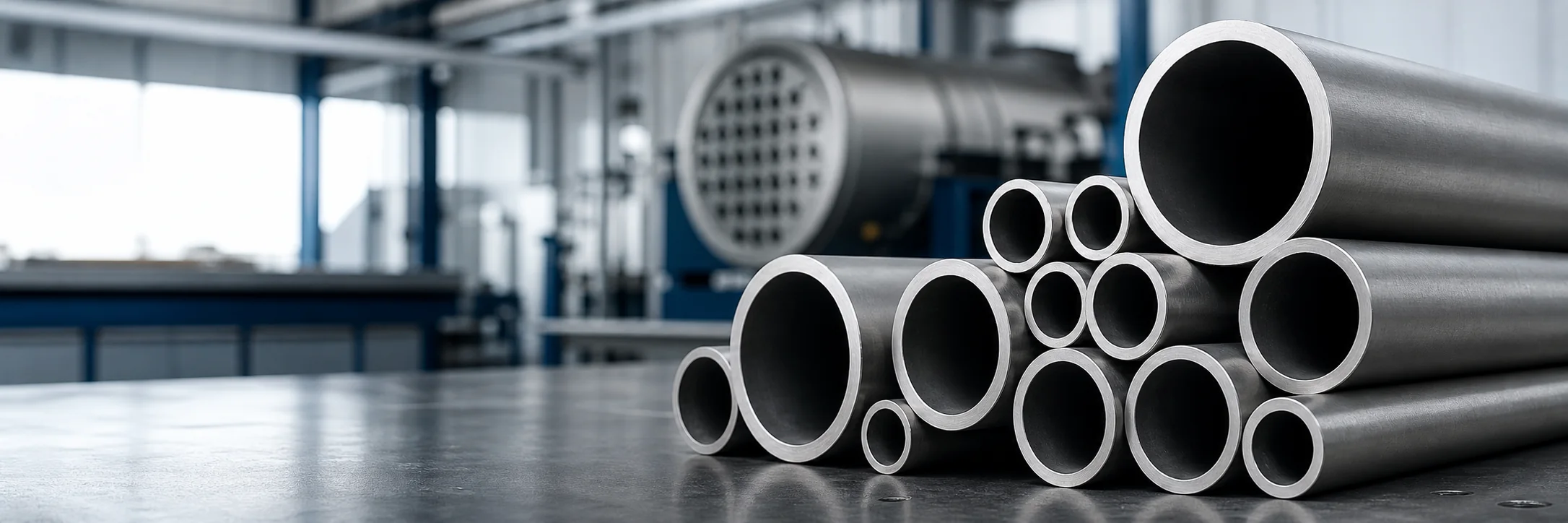
| Heat-exchanger or condenser tube | ASTM B338 / ASME SB-338 | Specify seamless or welded tube, OD, wall, length, test method and surface condition. |
| Seamless process pipe | ASTM B861 / ASME SB-861 | Specify grade, NPS or OD, schedule or minimum wall, length, ends and inspection. |
| Welded process pipe | ASTM B862 / ASME SB-862 | Specify grade, dimensions, weld route, examination and joint requirements. |
| Butt-weld fittings | ASTM B363 with the applicable dimensional standard | Confirm elbow, tee, reducer or cap type, schedule, ends and matching pipe material. |
A B338 tube certificate should not be used to describe B861 seamless pipe, and a material specification does not replace the piping design code or project drawing.
Grade Selection Questions
Grade 2 commercially pure titanium is a common starting point for seawater, chloride and many oxidizing chemical services because it combines corrosion resistance, weldability and practical availability. Grade 7, Grade 11 or Grade 12 may be considered only after the service environment and specification have been reviewed. The selected grade must not be based on a broad industry label alone.
Retrofit Data Required Before Quotation
- Existing piping material, failure mode and inspection findings
- Complete fluid composition, concentration, contaminants and cleaning chemicals
- Normal, design and upset temperature and pressure
- Pipe or tube standard, grade, OD or NPS, wall or schedule and required length
- Seamless or welded construction and applicable piping code
- Fittings, flanges, gasket arrangement, supports and dissimilar-metal isolation
- Welding procedure, shielding, cleanliness and acceptance requirements
- Quantity or total weight, MTC, NDT, dimensional inspection and destination
Cost Review Without Unsupported Service-Life Claims
A lifecycle comparison should include material cost, fabrication, welding, supports, inspection, shutdown exposure, maintenance access and expected replacement frequency. Titanium may reduce maintenance in a qualified environment, but service life and payback cannot be guaranteed without project-specific design, operating history and corrosion data.
Common Retrofit Risks
- Wrong product standard: pipe, heat-exchanger tube and fittings are ordered to different specifications.
- Incomplete chemistry: trace contaminants or reducing conditions can change corrosion behavior.
- Fabrication contamination: iron pickup, inadequate shielding and poor cleaning can impair the finished system.
- Galvanic design: contact with dissimilar metals and the surrounding electrolyte must be assessed.
- Unapproved substitution: grade or construction changes require engineering and purchaser approval.
FAQ
Is Grade 2 titanium suitable for every acid line?
No. Suitability depends on the exact acid, concentration, temperature, aeration, contaminants and crevice conditions. Obtain a corrosion assessment before specification.
Can ASTM B338 tube replace ASTM B861 pipe?
Not automatically. They cover different product scopes and may have different dimensional, testing and purchasing requirements.
What should be sent for a bulk titanium pipe quote?
Send the grade, standard and revision, seamless or welded construction, dimensions, quantity or total weight, service conditions, tests, documentation, packing and destination.
Continue From Technical Review to Product Specification
Browse the Titanium Pipe & Tube category and ASTM B338 Titanium Tube. Compare ASTM B338 vs B861 vs B862 and the Grade 1 vs Grade 5 vs Grade 12 guide before specifying material.
For quotation: provide grade, standard and revision, seamless or welded construction, OD, wall, length, tolerance, quantity, service conditions, inspection documents and destination.