

How to Specify Titanium Eye Bolts for Attachment and Lifting Applications
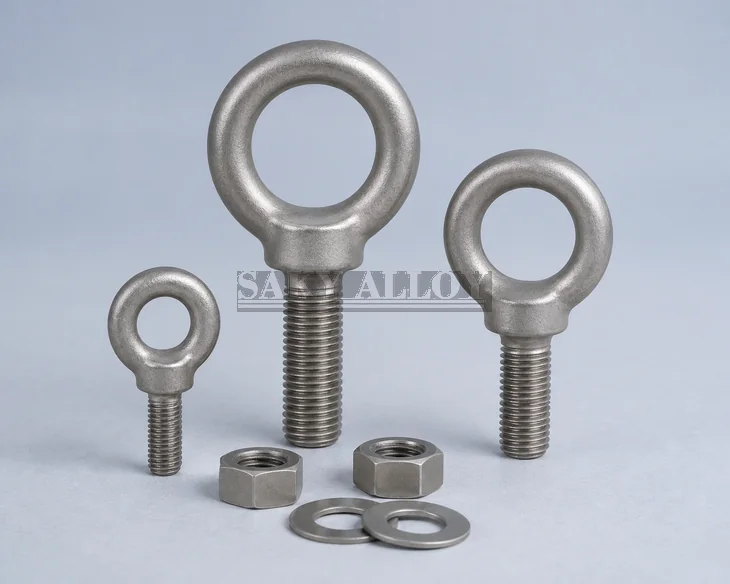
Titanium eye bolts are selected where corrosion resistance and low mass are important, but an eye-shaped fastener must never be chosen by material grade or appearance alone. A general attachment eye and a rated lifting eye can look similar while having very different design, manufacturing, inspection and marking requirements.
Start With the Intended Duty
State whether the component is a tie point, equipment attachment, handling aid or lifting component. For lifting, define the working load, load direction, loading angle, duty cycle, shock or dynamic factors and applicable safety requirements. The approved design—not the words “Grade 2” or “Grade 5”—establishes the permitted load.
Define Material and Product Geometry Separately
Grade 2 titanium is commercially pure and is often selected for corrosion resistance and ductility. Grade 5 Ti-6Al-4V provides higher source-material strength. Neither grade automatically creates a rated lifting device. The RFQ should define eye inside diameter, eye-section diameter, shoulder form, shank diameter, thread, engagement length, seating face and dimensional tolerances.
Standards, Testing and Traceability
DIN 580, ASME B30.26 or a customer specification may be reviewed when expressly applicable. A steel eye-bolt load table should not be transferred directly to titanium without engineering validation. Required controls may include material test certificates, heat/lot traceability, dimensional inspection, thread gauging, surface examination, nondestructive testing and proof testing. Marking and periodic inspection requirements should also be defined for lifting service.
Information to Include in an RFQ
- Intended attachment or lifting duty
- Applicable standard and drawing revision
- Titanium grade and material condition
- Eye, shoulder, shank and thread dimensions
- Load magnitude, direction and duty cycle
- Quantity, proof test, NDT, marking and certificates
Need an Eye Bolt Specification Review?
Compare Grade 2 titanium eye bolts and Grade 5 titanium eye bolts, then send the drawing, duty, load direction, quantity and required tests for review.
Frequently Asked Questions
Can titanium eye bolts be used for angled lifting?
Only when the specific design and governing requirements permit the stated loading angle. Side loading can substantially change stress distribution and must not be assumed acceptable.
Is Grade 5 always the preferred eye-bolt material?
No. Selection depends on the complete corrosion, strength, fabrication, inspection and regulatory requirements. Grade 5 source-material strength alone is not a finished eye-bolt rating.
What proves the supplied grade?
Material identification should rely on certificates, heat/lot traceability and agreed verification—not visual appearance.