

Cost and Performance Comparison: Titanium Grade 11 vs Nickel Alloys
Quick answer: is Grade 11 cheaper than a nickel alloy?
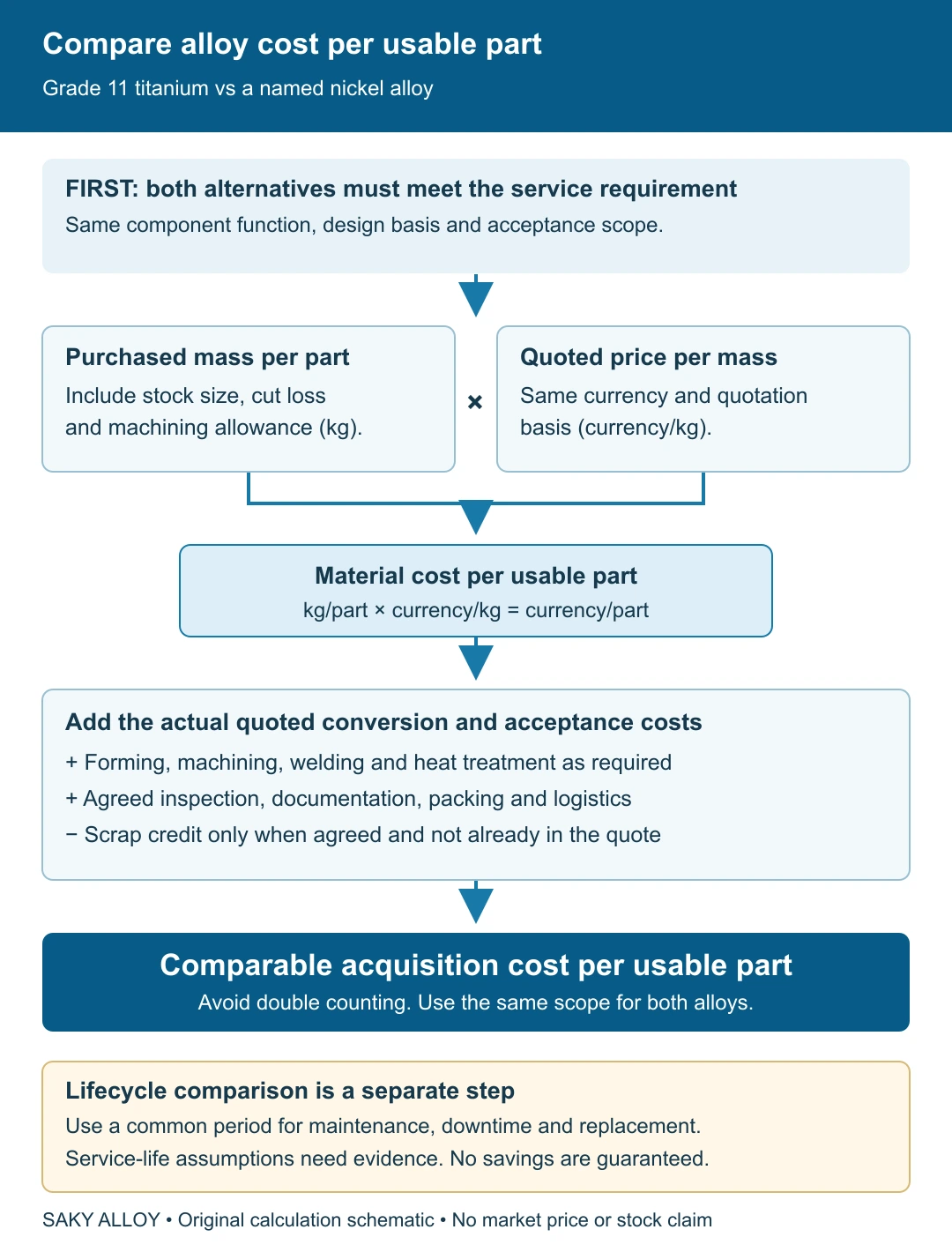
There is no universal price order. First identify materials suitable for the actual corrosion, temperature and design requirements. Then compare quotations for the same usable component, including machining yield, fabrication, inspection, maintenance and downtime. Price per kilogram alone is not a finished-component cost comparison.
Evidence and product route
The ATI Grade 11 reference identifies UNS R52250, 0.12–0.25% palladium, 0.18% maximum oxygen and 0.20% maximum iron. These are published references, not supplied-lot results. Compare a named nickel grade with its own datasheet, for example the Haynes C-276 corrosion data; do not apply one chemistry or service rating to all nickel alloys.
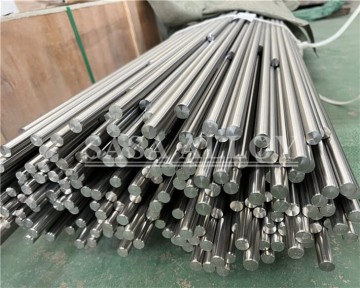
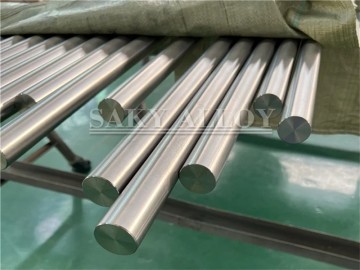
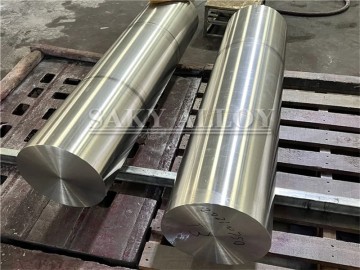
For bar enquiries, review Grade 11 titanium bar and the RFQ checklist. Product test certificates can be provided. The ordered product standard, revision, condition and dimensions control acceptance.
In modern industry, selecting the right materials for high-performance applications is critical. Corrosion resistance, strength, durability, and cost are key factors that influence material selection. Among the many options available for chemical processing, marine, and high-temperature environments, Titanium Grade 11 and various nickel alloys are widely considered. Both materials offer exceptional corrosion resistance, but they differ significantly in performance characteristics and overall cost. Understanding these differences is essential for engineers, procurement specialists, and project managers aiming to optimize both operational efficiency and budget.
This article provides a detailed comparison of Titanium Grade 11 and nickel alloys, analyzing their chemical composition, mechanical properties, corrosion resistance, cost-effectiveness, and typical industrial applications. Suppliers such as sakyalloy provide high-quality titanium solutions, supporting industries that require reliable, corrosion-resistant materials for critical systems.
1. Introduction to Titanium Grade 11 and Nickel Alloys
1.1 Titanium Grade 11 Overview
Titanium Grade 11 is a commercially pure titanium alloy with a small addition of palladium (0.12–0.25%). The palladium enhances corrosion resistance, particularly in reducing acids and chloride-rich environments. Grade 11 is well-suited for industries where corrosion resistance and material longevity are critical, such as:
-
Chemical processing
-
Desalination plants
-
Offshore marine equipment
-
Power generation systems
The alloy maintains excellent ductility and formability, allowing for fabrication of complex structures without compromising corrosion protection.
1.2 Nickel Alloys Overview
Nickel-based alloys, including Inconel, Hastelloy, and Monel, are known for their high corrosion resistance and superior mechanical performance in aggressive environments. They are widely used in:
-
High-temperature applications
-
Reducing and oxidizing chemical environments
-
High-pressure systems
-
Marine and offshore components
Nickel alloys differ substantially in grade, condition and density. Obtain current quotations and calculate finished mass for each technically acceptable option rather than assuming a universal cost ranking.
2. Chemical Composition Comparison
2.1 Titanium Grade 11
-
Titanium: balance
-
Palladium: 0.12–0.25%
-
Oxygen: 0.18% maximum in the cited ATI Grade 11 material reference. The ordered product specification and revision control acceptance.
-
Iron: 0.20% maximum in the cited ATI Grade 11 reference.
-
Trace elements: minimal
2.2 Nickel Alloys (General)
-
Nickel: identify the exact alloy and its specified composition range. There is no single nickel range for all nickel-alloy families.
-
Chromium: grade-specific; do not apply one generic range to INCONEL, HASTELLOY and MONEL families.
-
Molybdenum: grade-specific; consult the named alloy datasheet and ordered specification.
-
Iron: grade-specific; a generic family range cannot serve as a purchase limit.
-
Trace elements: cobalt, copper, or tungsten depending on alloy type
While both materials resist corrosion, titanium Grade 11 relies on its passive oxide layer and palladium enhancement, whereas nickel alloys rely on high nickel content and complex alloying for corrosion protection.
3. Mechanical Properties Comparison
3.1 Titanium Grade 11
-
Tensile strength: use the minimum for the ordered Grade 11 product form and condition. ATI publishes a 240 MPa minimum material reference, not a supplied-lot result.
-
Yield strength: use the ordered specification, condition and section requirements. A single approximate value is not a universal Grade 11 acceptance limit.
-
Elongation: ~24%
-
Density: 4.51 g/cm³
-
Fatigue resistance: evaluate load spectrum, surface finish, geometry, welds and the actual material condition.
-
Formability: High
3.2 Nickel Alloys
-
Nickel-alloy tensile strength: compare the named grade, heat treatment, product form, section size and test temperature.
-
Nickel-alloy yield strength: use the grade- and condition-specific specification or design-code value.
-
Nickel-alloy elongation: compare the specified gauge length, product form and condition.
-
Nickel-alloy density: use the named alloy value when calculating purchased and finished mass.
-
Fatigue resistance: verify grade- and condition-specific data for the component duty.
-
Formability: Moderate
Lower density alone does not establish a higher strength-to-weight ratio. Compare specified strength divided by density at the relevant temperature and verify the section needed for stiffness, corrosion allowance and the governing design code.
4. Corrosion Resistance Comparison
4.1 Titanium Grade 11
-
Palladium additions can improve titanium performance in selected reducing-acid conditions. Confirm concentration, temperature, impurities, aeration and crevice geometry against relevant corrosion data before selecting Grade 11.
-
Strong chloride and seawater resistance
-
Self-healing passive oxide layer
-
Excellent crevice and pitting corrosion resistance
4.2 Nickel Alloys
-
Outstanding corrosion resistance in oxidizing and reducing media
-
Excellent performance in high-temperature acidic environments
-
Nickel-alloy resistance to seawater, chlorine and chemical service is grade- and condition-specific. Distinguish wet from dry chlorine and verify the actual process environment.
-
Performance depends heavily on specific alloy selection
Neither Grade 11 nor the nickel-alloy family is a universal winner. Compare the specified titanium grade with a named nickel alloy using the actual medium, concentration, temperature, contaminants and acceptable corrosion rate.
5. Cost Considerations
5.1 Titanium Grade 11 Cost
-
Higher initial cost than commercially pure titanium
-
No universal price advantage over nickel alloys is assumed. Request like-for-like quotations for technically acceptable alternatives.
-
Potential maintenance or replacement savings require service evidence and a lifecycle-cost model; they are not guaranteed by the grade designation.
-
Lower density can reduce equal-volume mass. Required wall or section thickness must still satisfy strength, stiffness, corrosion and code requirements.
5.2 Nickel Alloys Cost
-
Nickel-alloy purchase cost depends on the exact grade, form, condition, dimensions, quantity, usable yield and inspection scope.
-
Heavy density may increase structural costs
-
Estimate forming, machining, welding, heat treatment and inspection costs for the specified nickel alloy and fabrication route.
-
Lifecycle value depends on actual service life, maintenance, downtime and replacement costs, not whether the service is described as extreme.
Choose among technically acceptable materials using quoted usable-part cost and a documented lifecycle model. This article does not establish a current market price or a guaranteed cost advantage for Grade 11.
6. Fabrication and Formability
6.1 Titanium Grade 11
-
High ductility and formability allow complex shapes and assemblies
-
Use a qualified welding procedure appropriate to Grade 11, the product form, joint and application.
-
Weld cleanliness, shielding, procedure and acceptance requirements must be controlled; low post-weld corrosion risk is not assumed.
6.2 Nickel Alloys
-
Moderate formability; requires specialized tools and techniques
-
Welding is more complex and often requires filler metals
-
Post-weld heat treatment may be necessary to maintain corrosion resistance
Fabrication difficulty and cost require a process-specific comparison. Do not assume Grade 11 is always easier or cheaper to fabricate than every nickel alloy.
7. Industrial Applications
7.1 Titanium Grade 11
-
Heat exchangers for chemical processing
-
Seawater piping and desalination equipment
-
Offshore oil and gas systems
-
Pressure vessels in reducing acid environments
-
Lightweight structural components
7.2 Nickel Alloys
-
High-temperature chemical reactors
-
Steam and gas turbine components
-
Sulfuric acid concentration systems
-
Aerospace components requiring extreme strength and oxidation resistance
-
Chlorine production and electrochemical plants
8. Advantages and Limitations
8.1 Titanium Grade 11 Advantages
-
Lower density than many nickel alloys can reduce equal-volume component mass.
-
Excellent corrosion resistance in moderate temperature aggressive media
-
Easy fabrication and welding
-
Lower density reduces structural weight
-
Long-term reliability in chloride and reducing acid conditions
Grade 11 is not selected from a single generic maximum-temperature claim. Verify allowable stress, corrosion, oxidation, exposure duration and design-code requirements for the actual service.
8.2 Nickel Alloys Advantages
-
Exceptional high-temperature strength
-
Excellent corrosion resistance across wide chemical conditions
-
Durable and wear-resistant
-
Suitable for extreme pressure and thermal applications
Limitations: Higher cost, higher density, more difficult fabrication, and specialized welding requirements.
9. Total Lifecycle Cost Analysis
Calculate total lifecycle cost only after identifying technically acceptable alternatives. Use purchase and fabrication quotations, maintenance intervals, downtime, replacement and disposal assumptions; Grade 11 is not automatically the lower-cost option.
-
Reduced replacement frequency
-
Lower maintenance requirements
-
Easier fabrication and installation
-
Reduced structural weight
In many cases, titanium Grade 11 balances upfront material costs with long-term savings, making it a practical choice for offshore, marine, and chemical systems.
10. Market Trends and Supplier Insights
Use current project requirements and comparable quotations rather than an unsupported market-growth claim. The purchasing comparison should identify grade, form, dimensions, condition, inspection and usable yield.
SAKY ALLOY can review Grade 11 bar enquiries against the specified product standard and revision. Product test certificates can be provided. State dimensions, condition, quantity and required inspection results.
Meanwhile, nickel alloys continue to dominate extreme high-temperature and highly aggressive chemical systems. Engineers often evaluate the application environment to determine whether the additional cost and weight of nickel alloys are justified compared to titanium Grade 11.
11. Key Considerations for Material Selection
When deciding between Titanium Grade 11 and nickel alloys, consider:
-
Operating environment: Temperature, acidity, chloride content, and exposure to oxidizing or reducing chemicals
-
Mechanical requirements: Tensile and yield strength, fatigue resistance, ductility
-
Weight limitations: Titanium Grade 11 offers significant weight reduction
-
Fabrication complexity: Ease of welding, forming, and assembly
-
Long-term cost: Initial material cost versus maintenance and replacement
Selecting the right material requires balancing these factors for optimal performance and cost efficiency.
12. Conclusion
Grade 11 and named nickel alloys must be compared for the actual service. Do not infer acid compatibility, fabrication savings or cost superiority from a family-level comparison.
For an actionable enquiry, identify the alloy designation, product form, governing specification and revision, dimensions, condition, quantity, service environment and documentation requirements. Product test certificates can be provided.
Select Grade 11 only when its verified service performance and quoted whole-life cost meet the project requirements. A named nickel alloy may be the appropriate alternative; neither family is universally preferred.
Continue From Material Knowledge to Selection
Use the Grade 2, Grade 5, Grade 7 and Grade 23 selection guide, then review the Titanium Product Categories. When a material requirement is defined, follow the Titanium RFQ Checklist or contact SAKY ALLOY.
Material suitability must be confirmed from the actual environment, load, temperature, fabrication route, applicable standard and responsible engineering approval.
Grade 11 Titanium vs Nickel Alloy Decision Matrix
“Nickel alloy” describes a broad material family, so the exact nickel grade and service environment must be identified before making a cost or performance comparison.
| Decision factor | Titanium Grade 11 | Nickel alloy family |
|---|---|---|
| Material basis | Commercially pure titanium with controlled palladium addition | Multiple nickel-based compositions designed for different corrosion and temperature ranges |
| Primary selection driver | Corrosion resistance with low density in suitable chemical environments | Grade-specific resistance to heat, stress, oxidation or aggressive media |
| Strength and temperature | Lower-strength titanium family; verify design limits at temperature | Some grades retain substantially higher strength at elevated temperature |
| Cost comparison | Evaluate product availability, fabrication and lifecycle corrosion performance | Evaluate the exact alloy, fabrication route, machining and lifecycle performance |
| Substitution rule | Do not substitute by generic material name. Compare the specified nickel grade, service chemistry, temperature, stress, fabrication and code requirements. | |
Frequently Asked Questions
Can Titanium Grade 11 replace any nickel alloy?
No. Nickel alloys cover many compositions and service conditions. Grade 11 may be attractive in selected corrosive environments, but it is not a universal replacement for high-temperature or grade-specific nickel alloy duties.
Which material is cheaper?
There is no reliable answer without a defined product form, size, quantity, nickel grade, fabrication route and inspection scope. Buyers should compare delivered component cost and expected service life rather than raw material price alone.
What data is needed for a material review?
Provide the candidate nickel grade, process medium and concentration, operating and upset temperatures, pressure or stress basis, product form, dimensions, fabrication method, standard, inspection and service-life expectations.