

How to Specify Titanium Shoulder Bolts: Diameter, Length, Tolerance and Fit
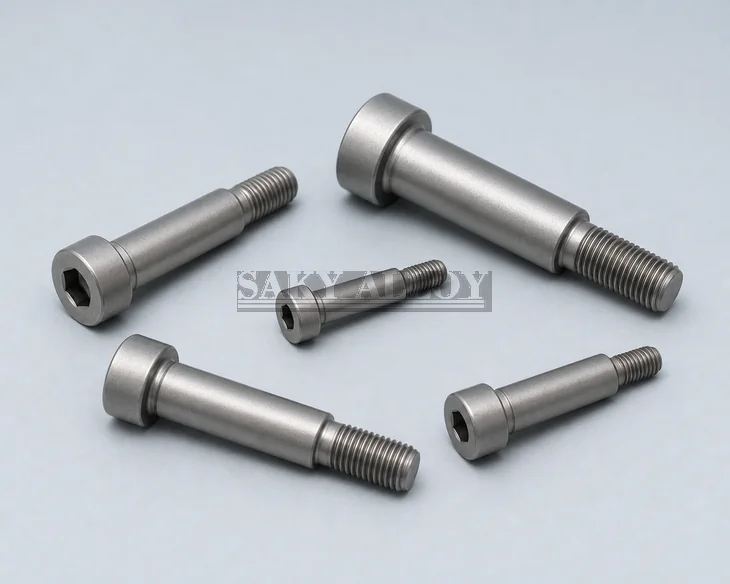
Titanium shoulder bolts combine a precision unthreaded shoulder with a smaller threaded end. They are used as pivots, guides, axles, stops and locating elements where corrosion resistance and controlled motion are important. A useful RFQ must define the shoulder as a precision feature rather than treating the part as an ordinary threaded fastener.
Start With the Shoulder and Mating Bore
State the nominal shoulder diameter, tolerance, usable shoulder length, surface finish and mating-bore dimensions. These values establish clearance or transition fit and affect rotation, alignment and wear. Also define straightness and runout when the shoulder guides a bearing or moving component.
Control the Head-to-Shoulder Transition
The head fillet, shoulder relief and thread runout can prevent a mating component from seating against the intended face. A drawing should show the usable shoulder length and any permitted undercut. Head diameter, head height and socket size must also be defined where space or tool access is limited.
Define Thread Engagement and Joint Loading
Specify metric or inch thread, tolerance class, threaded length, engagement, mating material and installation method. The joint should be engineered so the intended transverse load is carried by the precision shoulder rather than by an uncontrolled thread-to-hole interface. Bending, fatigue, tightening load and safety factors require application review.
Material and Inspection Requirements
Grade 2 / UNS R50400 is commercially pure titanium commonly selected for corrosion resistance and ductility. Grade 5 / Ti-6Al-4V / UNS R56400 offers higher source-material strength. The finished-part order should separately define material condition, dimensional report, thread gauging, surface inspection, heat or lot traceability and any agreed mechanical or functional tests.
RFQ Checklist
- Titanium grade and material condition
- Shoulder diameter, tolerance and surface finish
- Usable shoulder length, straightness and runout
- Head, socket, transition and relief geometry
- Thread, engagement and mating material
- Quantity, load, inspection and certificates
Need a Shoulder Bolt Drawing Review?
Compare Grade 2 titanium shoulder bolts and Grade 5 titanium shoulder bolts. Send the drawing, fit, quantity, service environment and required inspection for quotation.
Frequently Asked Questions
Does ISO 7379 fully define a titanium shoulder bolt?
No. It can provide a geometry reference when expressly invoked, but titanium grade, condition, precision tolerances, mechanical acceptance, finish and documentation must be defined separately.
Which shoulder tolerance should be selected?
The tolerance must be chosen with the mating bore, required clearance, temperature, lubrication, motion and inspection capability. It should not be copied without reviewing the complete assembly.
Can a shoulder bolt be used as a bearing surface?
It can function as a bearing or pivot surface when the fit, surface finish, hardness relationship, lubrication, load and wear conditions have been engineered for that duty.
Titanium Shoulder Bolt RFQ Dimension Matrix
| RFQ item | What to define | Why it matters |
|---|---|---|
| Shoulder diameter | Nominal diameter, tolerance and measuring convention | Controls fit with the mating bore and the bearing or guiding function |
| Shoulder length | Length under the head to the shoulder/thread transition | Controls clamped clearance, component stack and axial location |
| Thread | System, nominal size, pitch, class, handedness and thread length | Determines mating compatibility and engagement |
| Head | Head style, diameter, height and drive | Affects tool access, seating area and envelope |
| Transition and relief | Fillet radius, undercut or relief requirements | Prevents interference and influences stress concentration |
| Material and finish | Titanium grade, governing specification, surface and lubrication/coating limits | Defines material performance, traceability and assembly behavior |
| Inspection | Dimensional report, thread gauging, material certificate and special tests | Aligns acceptance criteria before production |