
Titanium Threaded Inserts
Titanium threaded inserts supplied by internal and external thread, body style, length, locking feature, installation method, parent material and inspection requirements.
- Material
- Titanium Grade 2 or Grade 5 as specified
- Forms
- Solid, thin-wall or key-locking by drawing
- Threads
- Internal and external thread fully defined
- Documents
- MTC, thread inspection and lot traceability
Product Detail
Product Introduction
Titanium threaded inserts provide a replaceable or strengthened female thread in corrosion-resistant, lightweight or repaired assemblies. Selection must define parent material and wall, internal and external threads, body diameter and length, flange or key-locking feature, installation torque or depth, locking method, service load, removability and inspection.
Selection Priorities
Solid threaded insert
Provides internal and external machine threads and requires an accurately prepared parent hole.
Key-locking insert
Mechanical keys resist rotation when the parent geometry, installation and edge distance are suitable.
Thin-wall or special insert
Used where radial space is limited; wall strength, installation tooling and pull-out capacity require validation.
Product Specifications
| Product | Titanium Threaded Inserts | Grade | Titanium Grade 2 or Grade 5 |
|---|---|---|---|
| Standard | Insert geometry may follow an expressly invoked MS/NAS, ISO, DIN or customer drawing, but published standards can specify non-titanium materials and proprietary installation systems. The order must separately confirm titanium grade, thread classes, locking feature, installation process and performance tests. | Size & Form | Internal/external threads, body diameter and length, wall, flange or keys, drive and installation depth by drawing |
| Tolerance | Drawing-defined thread classes, concentricity, length, key/flange geometry and installed position | Supply Condition | CNC machined, thread inspected, deburred, cleaned and lot identified; installation tools by agreement |
| Inspection | Available controls include MTC review, internal and external thread gauging, body diameter, length, concentricity, flange or key geometry, visual condition, sample installation, torque or pull-out testing where agreed and lot traceability. | Documents | MTC, heat/lot traceability and agreed inspection reports |
Send the complete material RFQ
Include grade, specification revision, dimensions, tolerance, quantity, condition, tests and destination.
Chemical Composition
Weight percent; maximum unless a range is shown. Titanium is the balance. The ordered specification and grade control.
| Grade / UNS | Principal Alloying Elements | Fe max | O max | C max | N max | H max | Ti |
|---|---|---|---|---|---|---|---|
| Grade 2 / R50400 | — | 0.30 | 0.25 | 0.08 | 0.03 | 0.015 | Balance |
| Grade 5 / R56400 | Al 5.50–6.75; V 3.50–4.50 | 0.40 | 0.20 | 0.08 | 0.05 | 0.015 | Balance |
Mechanical Properties – Annealed Material Reference
| Grade | Ultimate Tensile Strength min | 0.2% Yield Strength min | Elongation min |
|---|---|---|---|
| Grade 2 | 345 MPa | 275 MPa | 20% |
| Grade 5 | 895 MPa | 828 MPa | 10% |
Representative minima only. Product form, section size, heat treatment and the invoked specification determine the certified acceptance values.
Typical Physical Properties
| Grade | Density | Elastic Modulus | Thermal Expansion |
|---|---|---|---|
| Grade 2 | 4.51 g/cm³ | Approx. 105 GPa | Approx. 8.6 µm/m·K |
| Grade 5 | 4.43 g/cm³ | Approx. 114 GPa | Approx. 8.6 µm/m·K |
Typical engineering references, not inspection acceptance limits.
Certificates & Inspection Records
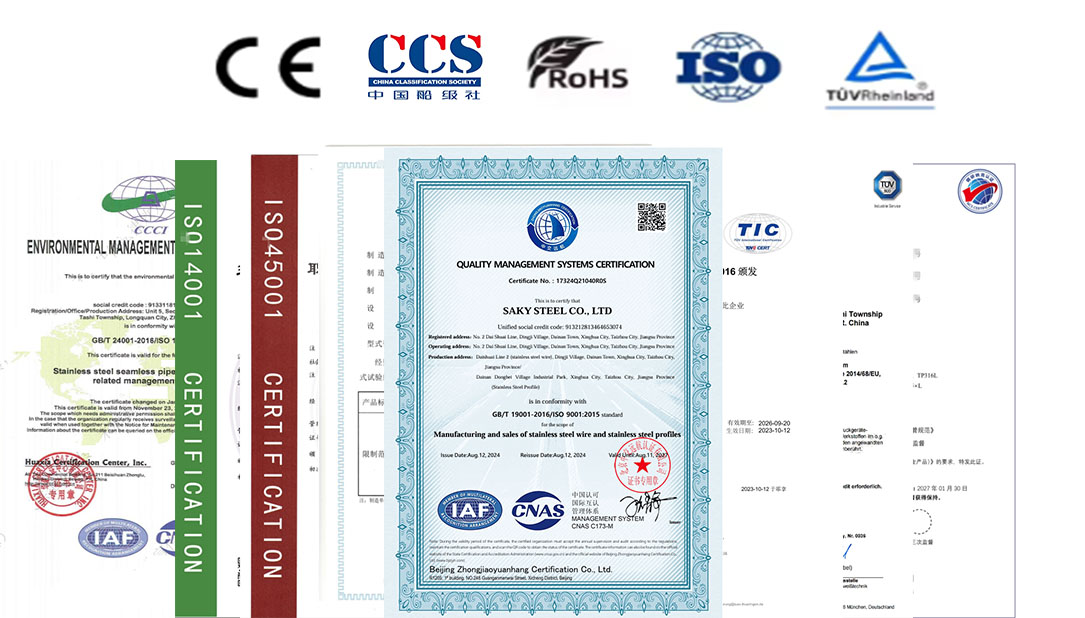
Services We Can Provide
Product Packaging
Products are separated by grade and heat, protected against surface and dimensional damage, and packed with traceability labels according to form, size, quantity and shipping method.
Application Scenarios

Marine equipment and corrosion-resistant enclosures
Material grade, dimensions, condition and inspection must be matched to the application requirements.

Aerospace fixtures, panels and serviceable lightweight assemblies
Material grade, dimensions, condition and inspection must be matched to the application requirements.

Chemical-process equipment, instruments and repair locations
Material grade, dimensions, condition and inspection must be matched to the application requirements.
FAQ
When is an insert preferred to a directly tapped hole?
An insert can provide a replaceable thread, repair a damaged hole or support repeated assembly, but edge distance, wall, parent material and load must be reviewed.
Are installation tools included?
Only when the RFQ identifies the insert system and required installation or removal tooling.
What thread data is required?
Provide internal and external designations, pitch, class, hand, engagement, surface requirement and gauging standard.
Leave Your Message




Related Technical Guides
Titanium Solid Rivets vs Blind Rivets
Compare access, installation, head style, grip range and inspection.
Read technical guideHow to Specify Titanium Dowel Pins
Define diameter, fit, length, ends, surface and inspection.
Read technical guideRivets and Dowel Pins Application Guide
Review joint function, material compatibility and purchasing data.
Read technical guideTitanium Clevis Pins vs Dowel Pins
Compare retention, alignment, fit, cross-hole and ordering data.
Read technical guideHow to Specify Titanium Retaining Rings
Define internal or external type, groove, section, load and installation.
Read technical guidePins and Retaining Rings Application Guide
Review material compatibility, joint function and inspection.
Read technical guideTitanium Cotter Pins vs Spring Pins
Compare removable retention with interference-fit location and retention.
Read technical guideHow to Specify Titanium Spring Pins
Define pin form, hole limits, interference, insertion force and validation.
Read technical guideTitanium Pin Retention Systems Guide
Select clevis, cotter, spring pin and retaining-ring systems by joint function.
Read technical guideTitanium Threaded Inserts vs Tapped Holes
Compare repair, thread durability, wall section, locking and serviceability.
Read technical guideHow to Specify Titanium Spacers and Standoffs
Define body form, threads, length, fits, loads and inspection.
Read technical guideTitanium Inserts, Spacers and Standoffs Guide
Review assembly function, interfaces, galvanic exposure and purchasing data.
Read technical guide