

How to Choose Titanium Grade 2, Grade 5, Grade 7 and Grade 23
Titanium Grade Selection Guide
Choose Grade 2 for general corrosion resistance and fabrication, Grade 5 for high strength-to-weight performance, Grade 7 for demanding corrosion service, and Grade 23 when ELI chemistry and damage tolerance are specified.
Selecting between Titanium Grade 2, Grade 5, Grade 7 and Grade 23 is not a matter of ranking them from “basic” to “premium.” Each grade solves a different engineering problem. The correct choice depends on the service environment, required strength, product form, fabrication route, governing specification and certification package.
This guide compares the four grades in a practical purchasing format. It is intended for engineers, buyers and fabricators sourcing titanium bar, plate, sheet, pipe, tube, forgings or machined components.
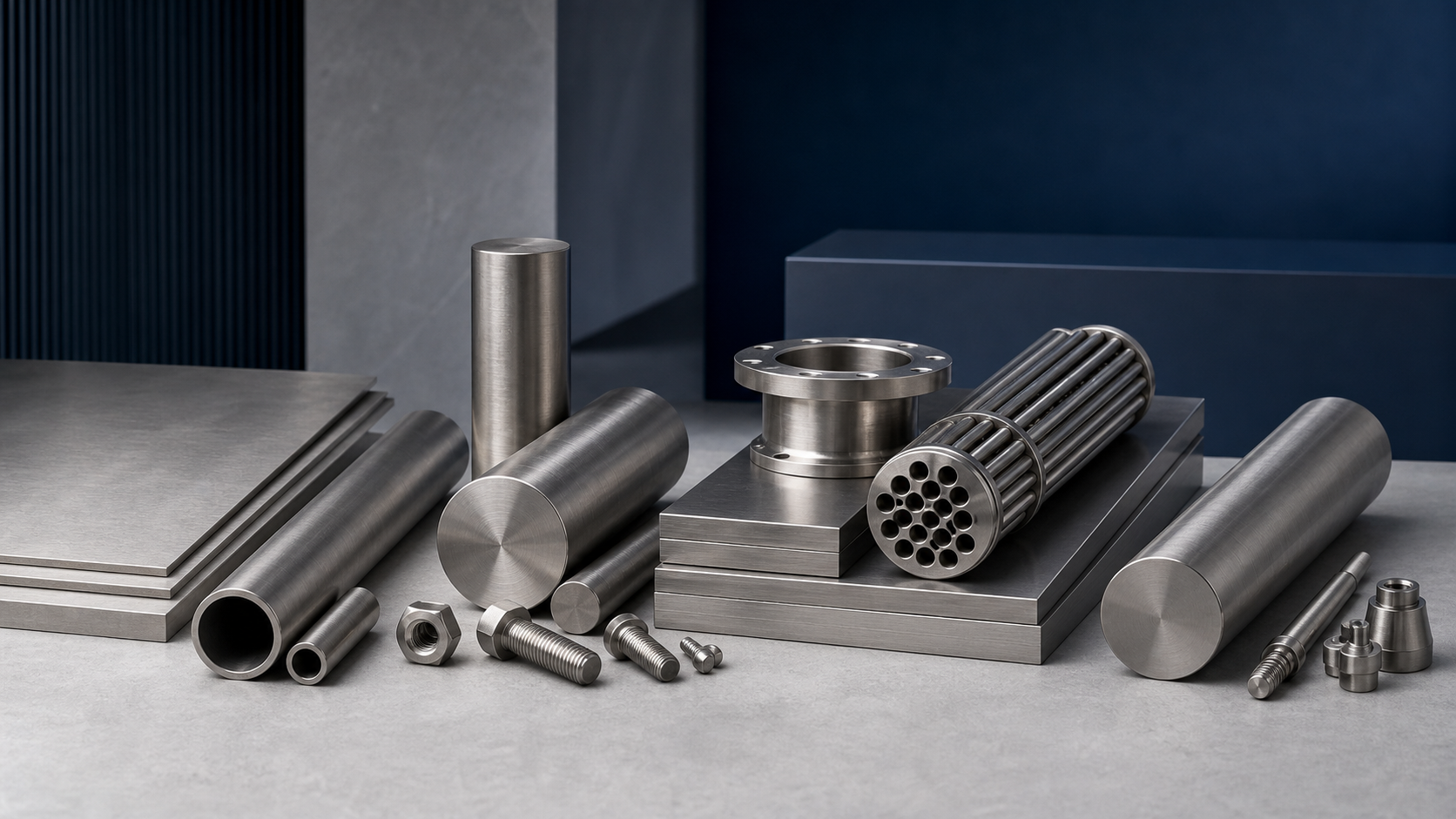
Titanium Grade 2 vs Grade 5 vs Grade 7 vs Grade 23
| Grade | UNS / Material | Primary Advantage | Typical Selection | Main Trade-Off |
|---|---|---|---|---|
| Grade 2 | UNS R50400 Commercially pure titanium |
Excellent corrosion resistance, ductility, forming and weldability | Chemical equipment, heat exchangers, marine systems and general industrial fabrication | Lower strength than Ti-6Al-4V alloys |
| Grade 5 | UNS R56400 Ti-6Al-4V |
High strength-to-weight ratio and broad availability | Aerospace structures, fasteners, rotating parts, motorsport and high-load components | Less formable than Grade 2; machining and welding need disciplined process control |
| Grade 7 | UNS R52400 Commercially pure titanium + 0.12–0.25% Pd |
Enhanced resistance to reducing acids and crevice corrosion | Aggressive chemical processing, pickling, brine and chloride-bearing process equipment | Palladium content and lower availability increase cost |
| Grade 23 | UNS R56407 Ti-6Al-4V ELI |
Lower interstitial limits, improved damage tolerance and cryogenic performance | Medical devices, fracture-critical parts, cryogenic equipment and specification-driven aerospace work | ELI chemistry and added documentation can increase price and lead time |
Fast answer: If your design does not require high strength, a palladium-enhanced corrosion grade or ELI chemistry, Grade 2 is often the most practical starting point. Confirm the final selection against the actual environment and governing specification.
When to Choose Titanium Grade 2
Grade 2 is the workhorse commercially pure titanium grade. It combines useful strength with strong ductility, corrosion resistance and fabrication performance. It is widely selected when equipment must resist seawater, wet chlorine, oxidizing media or many neutral chloride solutions without the higher strength of an alpha-beta alloy.
Choose Grade 2 when:
- Corrosion resistance, formability and weldability matter more than maximum strength.
- The project involves heat-exchanger shells, condenser tubing, piping, tanks, anodes or fabricated chemical equipment.
- You need a broadly available titanium grade across plate, sheet, bar, tube and pipe forms.
- The service environment does not justify the palladium addition in Grade 7.
Grade 2 should not be dismissed as an “entry-level” material. In many corrosion-control projects, its balance of clean fabrication, availability and lifecycle cost is more important than the higher tensile capability of Grade 5.
When to Choose Titanium Grade 5
Grade 5, also called Ti-6Al-4V, is the most widely used high-strength titanium alloy. Its strength-to-weight ratio, fatigue performance and established supply base make it a common choice for aerospace, energy, motorsport and high-performance mechanical components.
Choose Grade 5 when:
- Reducing mass while carrying high structural loads is a primary design objective.
- The component is a fastener, shaft, structural fitting, forged part, pressure component or machined aerospace part.
- The drawing or specification explicitly calls for Ti-6Al-4V or UNS R56400.
- The selected heat treatment, microstructure and testing route support the required properties.
Grade 5 is not automatically the best choice for corrosive process equipment. If a design is stiffness-limited rather than strength-limited, its higher tensile strength may not reduce section size as much as expected because the elastic modulus remains far below that of steel.
When to Choose Titanium Grade 7
Grade 7 is mechanically similar to Grade 2 but contains a controlled palladium addition. Palladium stabilizes the passive surface film in conditions where commercially pure titanium may become vulnerable, particularly certain reducing acids and tight crevices in hot chloride-bearing service.
Choose Grade 7 when:
- A corrosion study, process licensor or project specification requires palladium-alloyed titanium.
- Crevice corrosion at gasketed joints, deposits or narrow process gaps is a credible design concern.
- The equipment handles selected reducing-acid or aggressive chloride conditions beyond the recommended envelope for Grade 2.
- The lifecycle cost of avoiding corrosion-related shutdowns justifies the higher material price.
Grade 7 is a corrosion upgrade, not a high-strength upgrade. Its suitability should be confirmed using actual concentration, temperature, contaminants, aeration, pH, flow and crevice geometry rather than a generic chemical name alone.
When to Choose Titanium Grade 23
Grade 23 is the extra-low-interstitial version of Ti-6Al-4V. Compared with Grade 5, its specification imposes lower limits on oxygen, iron and selected interstitial elements. The result is improved fracture toughness, fatigue-crack-growth behavior and cryogenic performance rather than a simple increase in tensile strength.
Choose Grade 23 when:
- The governing medical, aerospace or cryogenic specification explicitly requires Ti-6Al-4V ELI.
- Damage tolerance, fracture-critical performance or low-temperature toughness drives material selection.
- The application involves implantable components under an applicable medical-material standard.
- You can maintain ELI traceability through the required melting, conversion, testing and documentation route.
Do not substitute Grade 23 for Grade 5—or Grade 5 for Grade 23—without engineering approval. Chemistry limits, minimum properties and required quality controls depend on the product and application specification.
A Four-Step Titanium Grade Selection Process
01 — Define the environment
List temperature, pressure, chemicals, concentration, pH, chlorides, oxygen level, velocity and crevice conditions.
02 — Set mechanical needs
Confirm tensile, yield, fatigue, fracture, impact, stiffness, temperature and weight requirements.
03 — Fix the product standard
Specify the exact product form, standard, edition, condition, dimensions, tolerances and surface finish.
04 — Define quality evidence
State MTC, EN 10204 3.1, heat traceability, NDT, third-party inspection and application approvals.
Decision shortcut
- If the specification requires ELI, medical-grade or fracture-critical Ti-6Al-4V, evaluate Grade 23.
- If high structural strength and low mass dominate, evaluate Grade 5.
- If Grade 2 corrosion limits may be exceeded, obtain a corrosion review and evaluate Grade 7.
- For general corrosion-resistant fabrication without those drivers, start with Grade 2.
Match the Grade to the Product Standard
A grade number alone is not a complete purchase specification. Mechanical requirements and quality controls vary by product form. Common ASTM routes include:
| Product Form | Common Specification Direction | Buyer Should Confirm |
|---|---|---|
| Sheet, strip and plate | ASTM B265 | Thickness, width, condition, flatness, surface and tolerances |
| Bar and billet | ASTM B348/B348M | Diameter, condition, finish, straightness, UT and machining allowance |
| Condenser and heat-exchanger tube | ASTM B338 | Seamless or welded route, OD, wall, length and required tube testing |
| Forgings | ASTM B381 | Forging grade designation, heat treatment, test location and NDT |
| Seamless or welded pipe | ASTM B861 or ASTM B862 | Manufacturing route, schedule, pressure testing and end preparation |
| Surgical implant material | Application-specific standards such as ASTM F136 for Ti-6Al-4V ELI | Exact application standard, melt route, cleanliness and regulatory documentation |
Important: Always state the required standard edition and do not combine values from different standards or product forms. “Grade 5” plate and “Grade 5” bar may share a UNS designation while carrying different dimensional, sampling and acceptance requirements.
Fabrication, Machining and Welding Considerations
Forming
Grade 2 and Grade 7 generally provide better room-temperature ductility and forming response than Grade 5 and Grade 23. Bend radius, sheet orientation, surface condition and forming temperature still need to be controlled by the applicable specification and process qualification.
Machining
All titanium grades benefit from rigid setups, sharp tools, positive geometry, controlled cutting speed and abundant non-chlorinated coolant. Grade 5 and Grade 23 often demand closer attention to heat generation, tool pressure and chip control during heavy machining.
Welding
Titanium weld zones must be protected from oxygen, nitrogen and hydrogen while hot. Clean joint preparation, inert-gas shielding, trailing shields and purging are essential. Filler-metal grade, heat input and post-weld requirements must follow the qualified procedure and design code.
Cost and Availability: What Buyers Should Expect
- Grade 2 is commonly the most economical of these four grades in standard industrial forms.
- Grade 5 has a broad global supply base, but price varies significantly with product form, melt route, heat treatment and aerospace-quality requirements.
- Grade 7 carries a palladium-related premium and may require longer sourcing lead times.
- Grade 23 can cost more than Grade 5 because of ELI chemistry control, selected melt routes, traceability and application-specific testing.
Compare quotations on the same basis: grade, UNS, product standard, dimensions, condition, tolerance, testing, certificate, quantity, packing and Incoterm. Price per kilogram alone does not establish equivalence.
Common Selection Mistakes
- Choosing Grade 5 only because it is stronger, without checking corrosion, forming or stiffness requirements.
- Treating Grade 7 as a high-strength alloy instead of a palladium-enhanced corrosion grade.
- Assuming Grade 23 is universally “better” than Grade 5 rather than an ELI grade for specific performance and standards.
- Specifying only a grade number and omitting the product standard, condition, dimensions and inspection scope.
- Using generic corrosion tables without accounting for temperature, concentration, contaminants, aeration and crevice geometry.
Titanium RFQ Checklist
- Grade and UNS designation
- Product form and applicable standard
- Required standard edition
- Dimensions, tolerances and quantity
- Heat-treatment or supply condition
- Surface finish and machining allowance
- Melt route and application approvals
- MTC or EN 10204 3.1 certificate
- UT, PT, EC, hydrostatic or other NDT
- Third-party inspection requirements
- Heat-number marking and traceability
- Destination, packing, Incoterm and schedule
Related Titanium Products and Guides
- Titanium Grade 2 sheet and plate
- Titanium Grade 5 sheet and plate
- Titanium Grade 7 sheet and plate
- Grade 23 Ti-6Al-4V ELI titanium bar
- ASTM B348 titanium bar
- Titanium alloy grade cross-reference guide
Frequently Asked Questions
Which titanium grade is best for general corrosion resistance?
Grade 2 is a common first choice for general corrosion-resistant industrial equipment because it combines corrosion resistance, fabrication performance and availability. The service environment must still be reviewed.
Is Titanium Grade 5 stronger than Grade 2?
Yes. Grade 5 is a high-strength Ti-6Al-4V alloy, while Grade 2 is commercially pure titanium with lower strength and better general formability. Strength alone should not determine the selection.
What is the difference between Titanium Grade 2 and Grade 7?
Grade 7 is based on commercially pure titanium but includes 0.12–0.25% palladium. It retains Grade 2-like fabrication characteristics while improving resistance in selected reducing-acid and crevice-corrosion conditions.
What is the difference between Titanium Grade 5 and Grade 23?
Both are Ti-6Al-4V alloys. Grade 23 is the ELI version with tighter limits on oxygen, iron and selected interstitial elements, supporting improved damage tolerance and cryogenic performance.
Is Grade 23 always better than Grade 5?
No. Grade 23 is appropriate when ELI chemistry or its related performance is required. Grade 5 is often the more practical and economical choice for general high-strength applications.
Can Grade 5 be substituted for Grade 23?
Not without approval from the responsible engineer or specification authority. The grades have different chemistry limits and may be controlled by different application standards.
What information should be included in a titanium quotation request?
Include the grade, UNS designation, product standard and edition, dimensions, tolerances, quantity, condition, surface, inspection, certificates, traceability, packing, destination and required delivery date.
Technical References
Material selection should use the current project specification and qualified engineering review. Helpful primary references include:
- ASTM B348/B348M — Titanium and Titanium Alloy Bars and Billets
- ATI — Corrosion-Resistant Titanium Alloys technical data
- Carpenter Technology — Ti-6Al-4V ELI technical data
Request a Grade-Specific Titanium Quote
Send SAKY ALLOY your grade, product form, standard, dimensions, quantity, condition and certification requirements. Our team can review availability for Grade 2, Grade 5, Grade 7 and Grade 23 titanium products.
Submit Your Titanium RFQ