
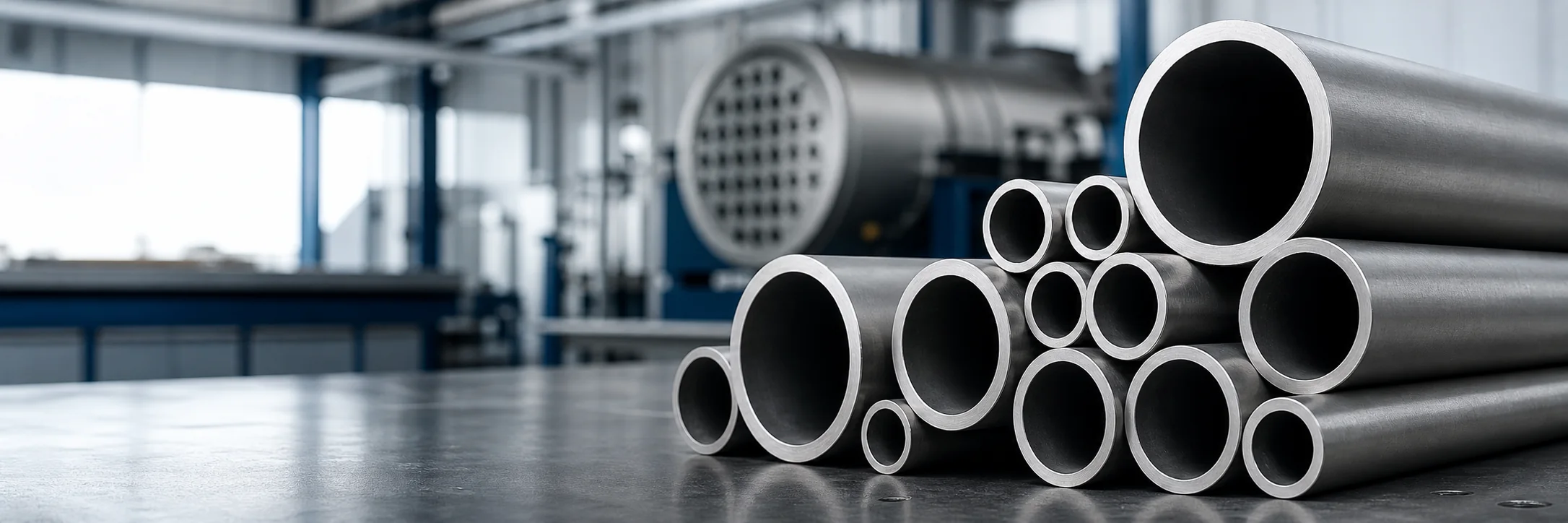
Titanium Tube for Condensers, Power Plants and Seawater Cooling
Titanium condenser tube is selected for seawater and chloride-bearing cooling service because the complete tube system must resist corrosion while transferring heat reliably. A purchasing specification should define the alloy grade, governing tube standard, dimensions, manufacturing route, tests and joining conditions instead of relying on the word titanium alone.
Where Titanium Condenser Tube Is Used
- Steam-surface condensers in coastal power plants
- Desalination evaporators and heat-recovery equipment
- Seawater-cooled heat exchangers and condensers
- Offshore, chemical and marine cooling systems
Grade Selection for Seawater Service
| Grade | Typical selection basis | Purchasing note |
|---|---|---|
| Grade 2 | Common commercially pure titanium option with corrosion resistance, formability and weldability | Confirm water chemistry, temperature, velocity, fouling and galvanic interfaces |
| Grade 7 | Palladium-enhanced grade considered for more demanding reducing or crevice-corrosion conditions | Use only after the service environment and governing design rules support the selection |
| Grade 12 | Alloy option considered where elevated-temperature strength and corrosion performance are required | Confirm availability, specification and fabrication procedure before ordering |
Standards, Dimensions and Tube Condition
ASTM B338 and corresponding ASME requirements are commonly referenced for seamless and welded titanium heat-exchanger and condenser tube. State the applicable revision, grade, seamless or welded construction, outside diameter, wall thickness, length, tolerances, end condition and surface requirements. Tube-sheet expansion, welding and cleaning procedures must suit the selected tube and mating materials.
Inspection and Testing
The order may require chemistry and tensile results, dimensional and surface inspection, flattening or flaring tests, eddy-current or ultrasonic examination, and hydrostatic or pneumatic testing as required by the governing specification. Define acceptance criteria and certificate format in the RFQ.
Specify the Complete Condenser Tube Requirement
Review Grade 2 Titanium Pipe and Tube, Grade 7 Titanium Pipe and Tube and the Titanium Pipe and Tube product family.
RFQ Checklist
- Application, cooling medium and water chemistry
- Grade, ASTM or ASME standard and revision
- Seamless or welded construction
- Outside diameter, wall thickness, length and quantity
- Tube-sheet joining and end requirements
- Nondestructive tests, pressure tests and documentation
- Packaging, destination and required delivery schedule
FAQ
Is Grade 2 titanium suitable for every seawater condenser?
No. Grade selection must consider temperature, flow velocity, deposits, crevices, water chemistry, galvanic coupling, joining details and the governing equipment design.
Should seamless or welded tube be specified?
Both forms can be supplied under applicable standards. Select the construction from the equipment specification, service risk, dimensional range, fabrication route and inspection requirements.
Why must tube ends be specified?
End squareness, cleanliness, burr condition and dimensional control affect tube-sheet insertion, expansion or welding and therefore influence joint quality.
Related Reading
Titanium Heat Exchanger Tube vs Condenser Tube · Titanium Piping for Seawater and Desalination