
6 Things to Know About Titanium Tube.
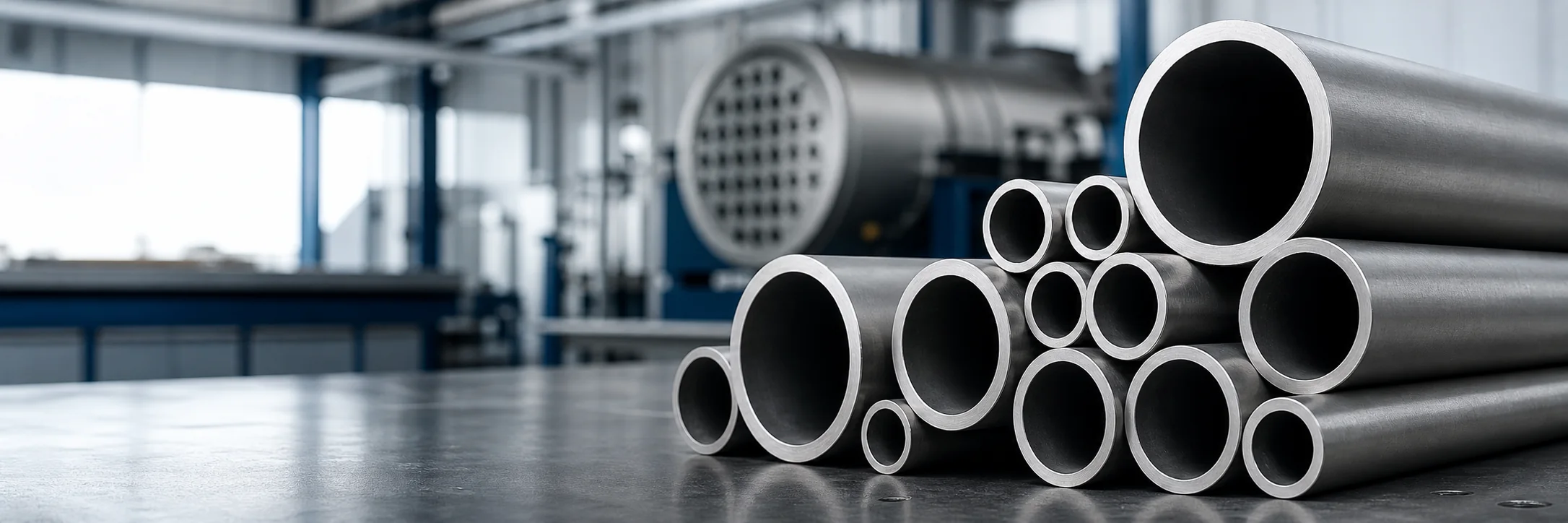
Titanium tube is purchased by grade, product standard, construction, outside diameter, wall thickness and test requirement—not by material name alone. Its corrosion resistance and low density can be valuable, but the correct tube depends on the actual fluid, temperature, pressure, fabrication route and governing equipment code.
Six Procurement Facts About Titanium Tube
- Tube and pipe use different size conventions. Heat-exchanger tube is commonly defined by OD and wall thickness; pipe is often ordered by NPS and schedule.
- Grade controls more than strength. Commercially pure and alloy grades differ in formability, strength and corrosion behaviour.
- Construction must be stated. Seamless and welded tube can have different availability, tolerances and inspection routes.
- Corrosion resistance is environment-specific. Chloride concentration, pH, temperature, crevices, oxidizing conditions and galvanic couples matter.
- Fabrication cleanliness is critical. Iron contamination and inadequate inert shielding can damage surface condition and weld integrity.
- Testing belongs on the RFQ. Eddy-current, hydrostatic or pneumatic testing, dimensional inspection and documentation must be agreed before production.
| Decision point | What to specify or verify |
|---|---|
| Material | Grade, UNS designation and product specification |
| Dimensions | OD, wall, length and tolerances |
| Manufacture | Seamless or welded; supplied condition and surface |
| Quality | Test method, acceptance criteria, MTR and traceability |
| Commercial | Quantity, destination, packaging and required delivery |
FAQ
Does ASTM B338 cover every titanium pipe or tube requirement?
No. ASTM B338 is widely used for seamless and welded titanium tube for condenser and heat-exchanger service. Other specifications apply to other forms and applications; name the required standard and edition.
Can Grade 2 and Grade 5 tube be substituted?
Not automatically. Strength, formability, weld procedure, corrosion environment and code allowables differ. Substitution requires engineering approval.
Continue to Titanium Tube Specification
Browse Titanium Pipe & Tube and ASTM B338 Titanium Tube, then use the Titanium RFQ Checklist.