
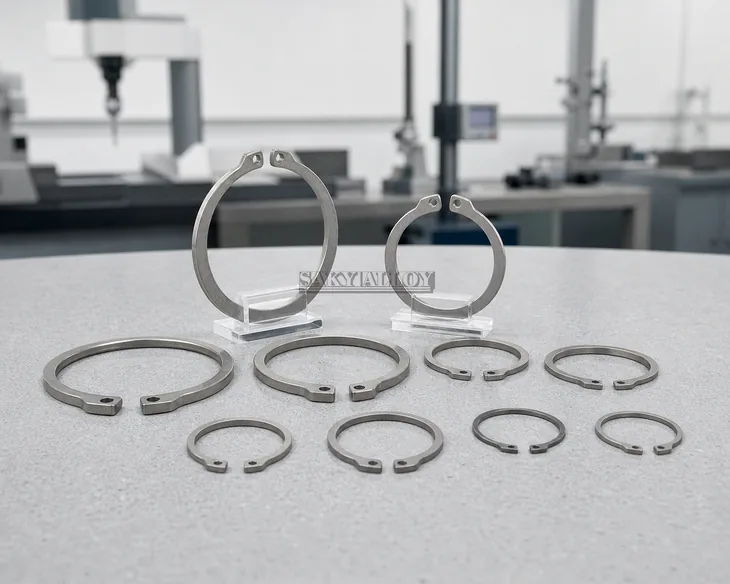
Titanium Retaining Rings
Titanium internal and external retaining rings supplied by grade, shaft or bore size, groove geometry, section, free diameter, load and inspection requirements.
- Material
- Titanium grade and condition by engineering review
- Types
- External shaft rings or internal bore rings
- Definition
- Ring section, free diameter and mating groove
- Documents
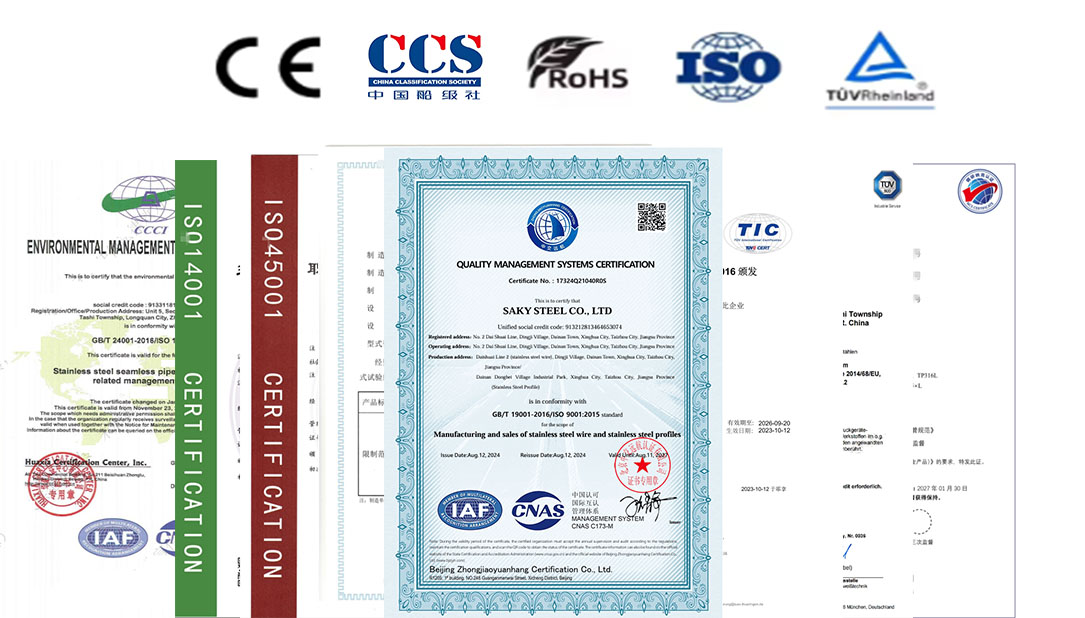
- MTC, dimensions and lot traceability
Product Detail
Product Introduction
Titanium retaining rings provide axial retention in a shaft groove or bore groove. Because spring behavior depends on elastic modulus, strength, section, heat treatment and installation strain, titanium rings must be engineered and validated rather than substituted directly for steel rings of the same appearance.
Product Specifications
| Product | Titanium Retaining Rings | Grade | Titanium grade and condition by approved design |
|---|---|---|---|
| Standard | DIN 471 and DIN 472 may be used as dimensional references for external and internal retaining-ring forms when expressly invoked. Standard steel spring properties do not automatically transfer to titanium. The approved order or drawing must define titanium grade, condition, functional load, installation and testing. | Size & Form | Internal or external ring; mating shaft/bore, groove diameter and width, section, free diameter, lug and tool-hole geometry |
| Tolerance | Drawing-defined section, free diameter, flatness, lug geometry and functional groove fit | Supply Condition | Stamped, cut or machined and condition-controlled as approved; deburred, cleaned and lot identified |
| Inspection | Available controls include MTC review, section thickness and width, free diameter, lug and hole geometry, flatness, groove-fit inspection, functional expansion or compression checks and lot traceability. | Documents | MTC, heat/lot traceability and agreed inspection reports |
Send the complete material RFQ
Include grade, specification revision, dimensions, tolerance, quantity, condition, tests and destination.
Chemical Composition
Weight percent; maximum unless a range is shown. Titanium is the balance. The ordered specification and grade control.
| Grade / UNS | Principal Alloying Elements | Fe max | O max | C max | N max | H max | Ti |
|---|---|---|---|---|---|---|---|
| Grade 2 / R50400 | — | 0.30 | 0.25 | 0.08 | 0.03 | 0.015 | Balance |
| Grade 5 / R56400 | Al 5.50–6.75; V 3.50–4.50 | 0.40 | 0.20 | 0.08 | 0.05 | 0.015 | Balance |
Mechanical Properties – Annealed Material Reference
| Grade | Ultimate Tensile Strength min | 0.2% Yield Strength min | Elongation min |
|---|---|---|---|
| Grade 2 | 345 MPa | 275 MPa | 20% |
| Grade 5 | 895 MPa | 828 MPa | 10% |
Representative minima only. Product form, section size, heat treatment and the invoked specification determine the certified acceptance values.
Typical Physical Properties
| Grade | Density | Elastic Modulus | Thermal Expansion |
|---|---|---|---|
| Grade 2 | 4.51 g/cm³ | Approx. 105 GPa | Approx. 8.6 µm/m·K |
| Grade 5 | 4.43 g/cm³ | Approx. 114 GPa | Approx. 8.6 µm/m·K |
Typical engineering references, not inspection acceptance limits.
Certificates & Inspection Records
Services We Can Provide
Product Packaging
Products are separated by grade and heat, protected against surface and dimensional damage, and packed with traceability labels according to form, size, quantity and shipping method.
Application Scenarios

Marine shafts, instruments and corrosion-resistant mechanisms
Material grade, dimensions, condition and inspection must be matched to the application requirements.

Aerospace lightweight assemblies and serviceable mechanisms
Material grade, dimensions, condition and inspection must be matched to the application requirements.

Chemical-process pumps, valves and equipment retainers
Material grade, dimensions, condition and inspection must be matched to the application requirements.
FAQ
Can a titanium ring directly replace a steel retaining ring?
Not without engineering validation. Titanium has different elastic modulus, strength, springback and wear behavior, so groove fit, installation strain and axial capacity must be reviewed.
What is the difference between internal and external retaining rings?
External rings retain components on shafts; internal rings retain components within bores. Their free geometry, installation direction and grooves differ.
What data is required for quotation?
Provide ring type, shaft or bore and groove dimensions, section, grade and condition, axial load, rotation, cycles, environment, installation and tests.
Leave Your Message



Related Technical Guides
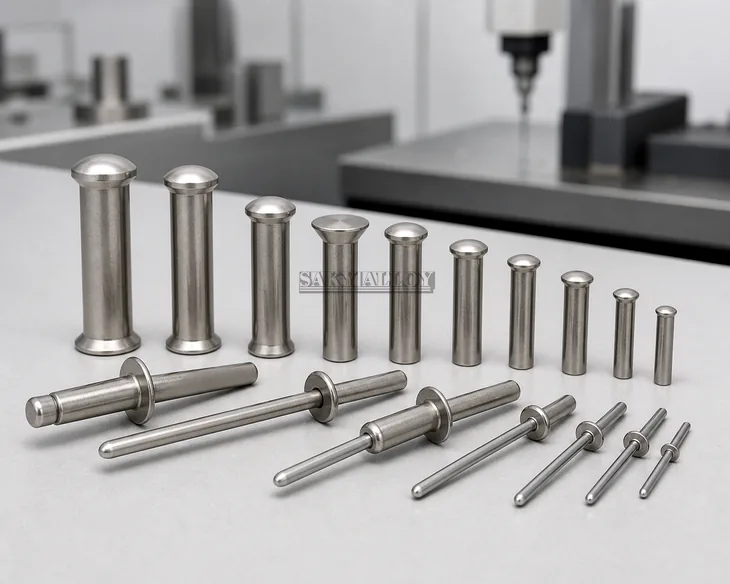
Titanium Solid Rivets vs Blind Rivets
Compare access, installation, head style, grip range and inspection.
Read technical guideHow to Specify Titanium Dowel Pins
Define diameter, fit, length, ends, surface and inspection.
Read technical guideRivets and Dowel Pins Application Guide
Review joint function, material compatibility and purchasing data.
Read technical guideTitanium Clevis Pins vs Dowel Pins
Compare retention, alignment, fit, cross-hole and ordering data.
Read technical guideHow to Specify Titanium Retaining Rings
Define internal or external type, groove, section, load and installation.
Read technical guidePins and Retaining Rings Application Guide
Review material compatibility, joint function and inspection.
Read technical guide