
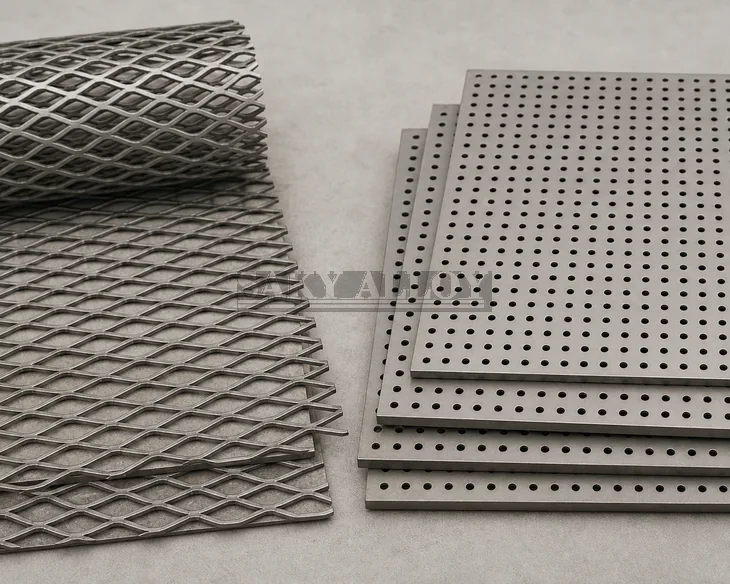
Titanium Perforated Sheet
Titanium Perforated Sheet supplied by grade, perforated sheet geometry, opening, thickness or wire diameter, width, length, edge, surface and inspection requirements.
- Material
- Grade 1, Grade 2 or specified titanium
- Form
- Perforated Sheet
- Dimensions
- Opening geometry and section size by RFQ
- Documents
- MTC and dimensional inspection
Product Detail
Product Introduction
Titanium perforated sheet is solid titanium sheet in which holes are punched, drilled, laser cut or otherwise produced to a controlled pattern. Unlike expanded metal, it retains continuous ligaments and may include solid margins around the perforated field. Hole shape and size, pitch, staggered or straight pattern, percent open area, sheet thickness, margins, burr direction and post-perforation flatness define the product.
Selection Priorities
Hole and pattern
State round, square, slot or drawing-specific holes, finished hole size, pitch and whether rows are straight, staggered or directionally oriented.
Ligament and open area
Confirm minimum ligament, percent open area and solid margins because these govern flow, stiffness, forming and available punching geometry.
Manufacturing and finish
Choose punching, drilling or laser processing from thickness, hole size, quantity and edge-quality needs; state burr direction, deburring, flatness and surface requirements.
Product Specifications
| Product | Titanium Perforated Sheet | Grade | Titanium Grade 1, Grade 2 or specified alloy |
|---|---|---|---|
| Standard | The titanium sheet may be ordered to ASTM B265 / ASME SB265 or another expressly invoked raw-material specification. Finished perforation is controlled by the approved drawing or perforation schedule, including hole geometry, pitch, pattern, margins, open area, burr direction, flatness and inspection. | Size & Form | Perforated sheet in sheets, cut panels or rolls as feasible; exact opening, section dimensions, width and length by RFQ |
| Tolerance | Drawing or order-defined opening, wire/strand/sheet size, pitch, open area, cut size, edge and flatness requirements | Supply Condition | Clean mill-finish sheets, panels or rolls with edge protection, interleaving and export packing |
| Inspection | Raw-sheet MTC and traceability, sheet thickness, hole size and shape, pitch and pattern, perforated-field location, solid margins, open area when specified, burr direction, panel dimensions, flatness and surface condition. | Documents | MTC, heat/lot traceability and agreed inspection reports |
Send the complete material RFQ
Include grade, specification revision, dimensions, tolerance, quantity, condition, tests and destination.
Chemical Composition
Weight percent; maximum unless a range is shown. Titanium is the balance. The ordered specification and grade control.
| Grade / UNS | Principal Alloying Elements | Fe max | O max | C max | N max | H max | Ti |
|---|---|---|---|---|---|---|---|
| Grade 1 / R50250 | — | 0.20 | 0.18 | 0.08 | 0.03 | 0.015 | Balance |
| Grade 2 / R50400 | — | 0.30 | 0.25 | 0.08 | 0.03 | 0.015 | Balance |
Mechanical Properties – Annealed Material Reference
| Grade | Ultimate Tensile Strength min | 0.2% Yield Strength min | Elongation min |
|---|---|---|---|
| Grade 1 | 240 MPa | 170 MPa | 24% |
| Grade 2 | 345 MPa | 275 MPa | 20% |
Representative minima only. Product form, section size, heat treatment and the invoked specification determine the certified acceptance values.
Typical Physical Properties
| Grade | Density | Elastic Modulus | Thermal Expansion |
|---|---|---|---|
| Grade 1 | 4.51 g/cm³ | Approx. 103 GPa | Approx. 8.6 µm/m·K |
| Grade 2 | 4.51 g/cm³ | Approx. 105 GPa | Approx. 8.6 µm/m·K |
Typical engineering references, not inspection acceptance limits.
Certificates & Inspection Records
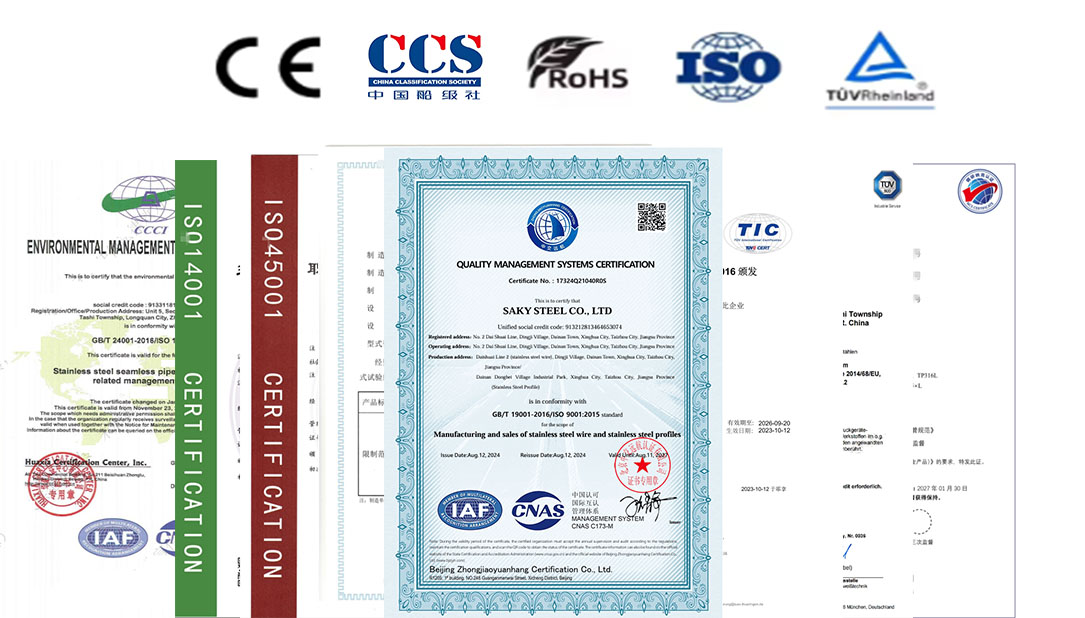
Services We Can Provide
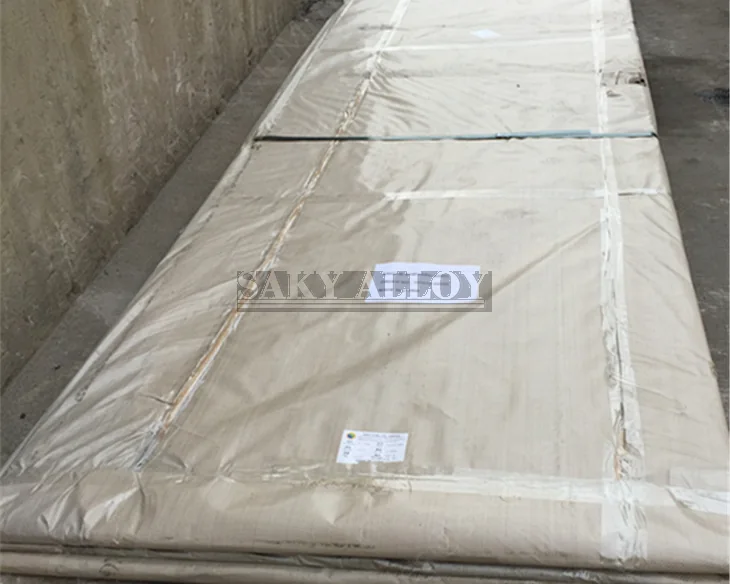
Product Packaging
Sheet and plate surfaces are interleaved or wrapped as required, protected at edges and secured on pallets or in export cases with grade, heat and dimensional identification. Typical export packaging for the same physical product form is shown below; final packing is confirmed for each order.
Application Scenarios

Chemical filtration and separation
Material grade, dimensions, condition and inspection must be matched to the application requirements.

Electrochemical electrodes and current collectors
Material grade, dimensions, condition and inspection must be matched to the application requirements.

Marine, aerospace and industrial screening or guards
Material grade, dimensions, condition and inspection must be matched to the application requirements.
FAQ
How is titanium perforated sheet different from expanded metal?
Perforated sheet removes material to create holes and retains solid ligaments and optional margins. Expanded metal slits and stretches sheet into strands and bonds without punching out holes.
Why must the burr direction be stated?
Punching can leave a directional edge. Its orientation may affect handling, flow, filtration, forming and contact with adjoining components.
Which data controls percent open area?
Hole shape and size, pitch and pattern determine theoretical open area. Solid margins and unperforated zones must also be defined for the finished panel.
Leave Your Message
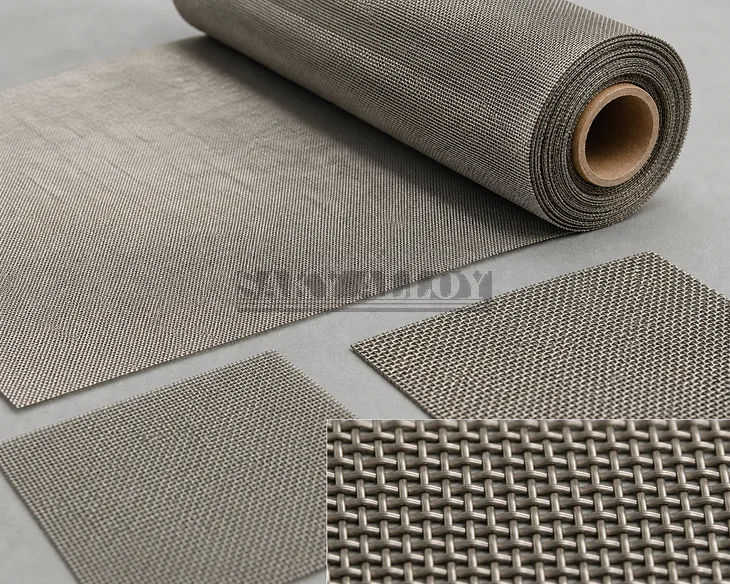
Related Technical Guides
Titanium Mesh Application Guide
Compare mesh forms for filtration, electrochemical and marine equipment.
Read technical guideTitanium Woven Mesh vs Expanded Metal vs Perforated Sheet
Compare opening geometry, strength and ordering data.
Read technical guideTitanium RFQ Checklist
Prepare dimensions, tolerances, tests and documents.
Read technical guideComplete Titanium Product Guide
Compare titanium product forms.
Read technical guide