
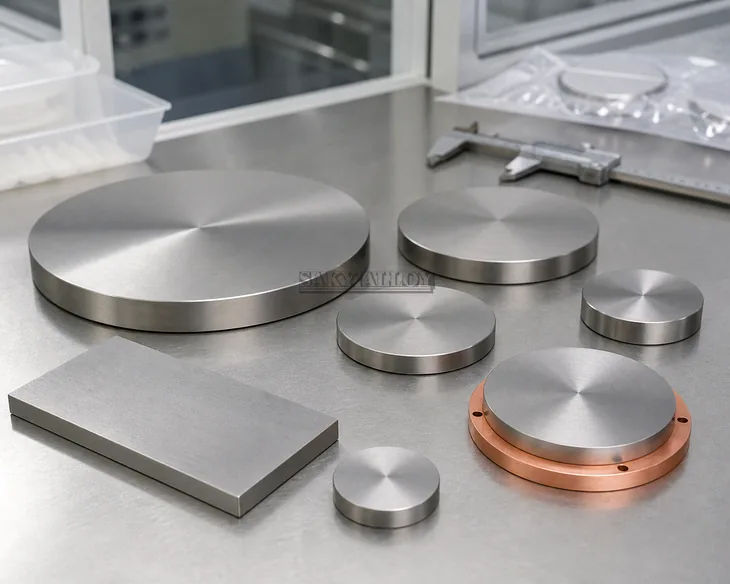
Titanium Sputtering Targets
High-purity titanium sputtering targets supplied as circular or rectangular planar targets, monolithic or bonded, with controlled purity, density, dimensions, surface and backing assembly.
- Material
- High-purity titanium; purity and impurity limits by RFQ
- Forms
- Circular disc, rectangular planar or drawing-specific target
- Assembly
- Monolithic or bonded to approved backing plate
- Documents
- Composition, dimensions, surface and bonding records
Product Detail
Product Introduction
Titanium sputtering targets are vacuum-deposition source materials used to produce titanium or titanium-containing thin films. Purchasing requirements differ from structural titanium: purity, individual impurity limits, density, grain structure, magnetic or process-specific limits, target dimensions, surface finish, backing-plate compatibility, bonding coverage and vacuum packaging can directly affect deposition stability.
Product Specifications
| Product | Titanium Sputtering Targets | Grade | High-purity titanium to order-specific composition limits |
|---|---|---|---|
| Standard | Purity should be stated as a minimum percentage together with maximum limits for critical metallic and interstitial impurities. ASTM structural-grade designations alone are not a substitute for a sputtering-target composition specification. Finished targets are drawing- and process-controlled, including backing material, bonding, surface and packaging. | Size & Form | Circular or rectangular planar target; diameter/length/width, thickness, edge/groove, cathode interface and backing assembly by drawing |
| Tolerance | Order-defined dimensions, flatness, parallelism, surface finish, edge condition and bonded-assembly acceptance | Supply Condition | Machined and cleaned target; monolithic or bonded to approved backing plate; individually protected or vacuum packed |
| Inspection | Available controls include supplier composition report or agreed analytical testing, dimensions and flatness, surface finish, visual condition, density or ultrasonic review, bond-coverage and void inspection for bonded assemblies, backing-plate dimensions, cleaning, vacuum packaging and lot traceability. | Documents | MTC, heat/lot traceability and agreed inspection reports |
Send the complete material RFQ
Include grade, specification revision, dimensions, tolerance, quantity, condition, tests and destination.
Chemical Composition
Weight percent; maximum unless a range is shown. Titanium is the balance. The ordered specification and grade control.
| Grade / UNS | Principal Alloying Elements | Fe max | O max | C max | N max | H max | Ti |
|---|---|---|---|---|---|---|---|
| Grade 1 / R50250 | — | 0.20 | 0.18 | 0.08 | 0.03 | 0.015 | Balance |
| Grade 2 / R50400 | — | 0.30 | 0.25 | 0.08 | 0.03 | 0.015 | Balance |
Mechanical Properties – Annealed Material Reference
| Grade | Ultimate Tensile Strength min | 0.2% Yield Strength min | Elongation min |
|---|---|---|---|
| Grade 1 | 240 MPa | 170 MPa | 24% |
| Grade 2 | 345 MPa | 275 MPa | 20% |
Representative minima only. Product form, section size, heat treatment and the invoked specification determine the certified acceptance values.
Typical Physical Properties
| Grade | Density | Elastic Modulus | Thermal Expansion |
|---|---|---|---|
| Grade 1 | 4.51 g/cm³ | Approx. 103 GPa | Approx. 8.6 µm/m·K |
| Grade 2 | 4.51 g/cm³ | Approx. 105 GPa | Approx. 8.6 µm/m·K |
Typical engineering references, not inspection acceptance limits.
Certificates & Inspection Records
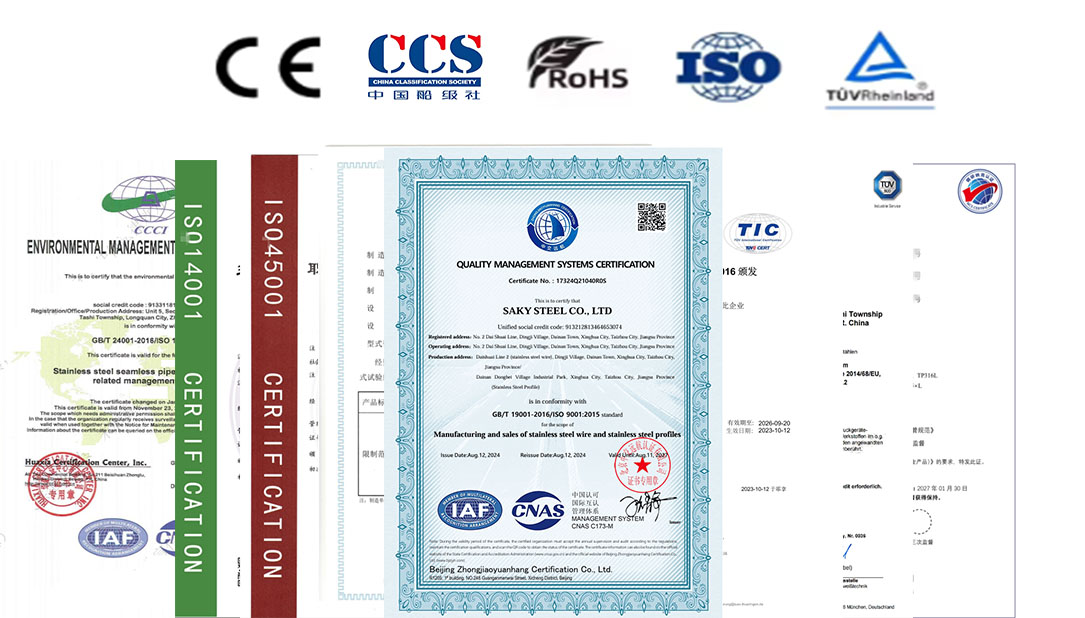
Services We Can Provide
Product Packaging
Products are separated by grade and heat, protected against surface and dimensional damage, and packed with traceability labels according to form, size, quantity and shipping method.
Application Scenarios

Semiconductor and microelectronic thin-film deposition
Material grade, dimensions, condition and inspection must be matched to the application requirements.

Architectural, optical and wear-resistant PVD coatings
Material grade, dimensions, condition and inspection must be matched to the application requirements.

Research, display and vacuum-coating systems
Material grade, dimensions, condition and inspection must be matched to the application requirements.
FAQ
Is Grade 2 titanium sufficient to specify a sputtering target?
Usually not. State minimum purity and maximum limits for critical impurities because deposition performance depends on composition beyond a structural grade name.
When is a bonded backing plate used?
Bonding may support cooling, stiffness and cathode compatibility. Backing material, bond method, coverage, void acceptance and service temperature must be defined.
What drawing data is essential?
Provide the exact cathode interface, target dimensions, thickness, edges or grooves, backing plate, surface finish, flatness and packaging requirements.
Leave Your Message

Related Technical Guides
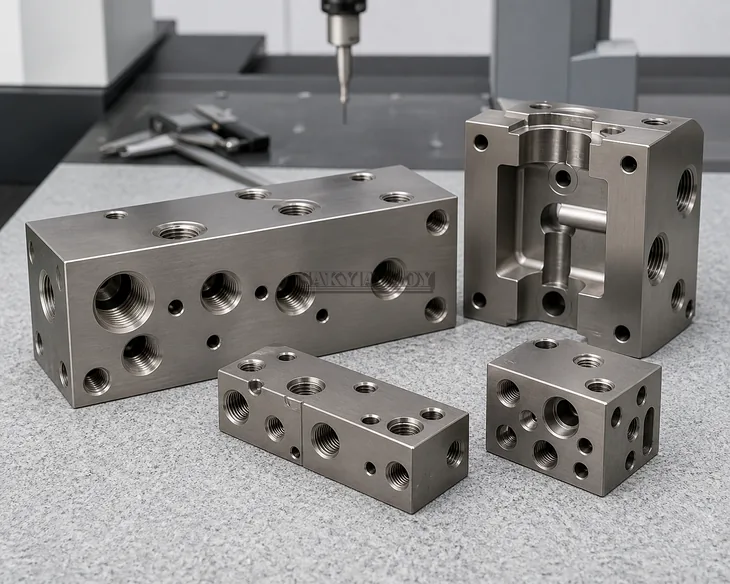
How to Specify Titanium Fluid Manifolds
Define media, pressure, ports, passages, sealing, cleaning and inspection.
Read technical guideTitanium Sputtering Targets: Planar vs Bonded
Compare monolithic targets, backing plates, purity, bonding and dimensional control.
Read technical guideTitanium Precision Machining Guide
Review different quality priorities for flow components and vacuum-coating materials.
Read technical guide