Titanium Button Head vs Low Head vs Socket Head Screws
Titanium button head, low head and standard socket head screws all provide internal-hex wrenching, but their head geometry changes clearance, drive engagement, bearing area and installation capability. The correct choice depends on the complete joint rather than appearance alone.
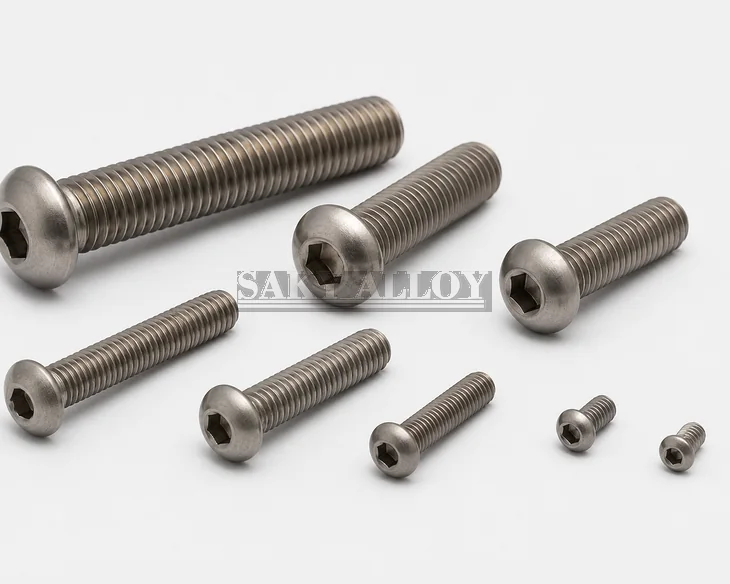
Head Geometry Comparison
| Head form | Typical design reason | Important check |
|---|---|---|
| Button head | Smooth rounded profile and broad bearing face | Shallow socket depth and permitted tightening torque |
| Low cylindrical head | Reduced vertical projection with a flat bearing face | Head capacity, socket engagement and counterbore clearance |
| Standard socket head | Deeper drive and conventional high-profile geometry | Available vertical clearance and bearing stress |
Button Head Socket Screws
A button head provides a low, rounded exterior and a relatively broad underside. It is useful where snag resistance or appearance matters, but the shallow head can limit drive depth. Installation torque and required clamp load must be validated.
Low Head Socket Cap Screws
A low cylindrical head reduces projection while retaining a flat bearing face. Compared with a standard socket head, the shallower geometry can reduce socket engagement and head capacity. DIN 7984, ISO 14580 or a customer drawing may define geometry when expressly invoked.
Standard Socket Head Cap Screws
A standard cylindrical socket head normally offers deeper wrench engagement and a taller head. It is often selected where vertical space is available and conventional socket-head geometry fits the joint. Titanium material, lubrication and preload still require separate definition.
Material Grade and Installation
Grade 2 titanium is commonly selected for corrosion resistance and useful ductility. Grade 5 Ti-6Al-4V provides higher source-material strength. Neither grade removes the need to define thread fit, engagement, mating material, bearing area, lubricant or coating, tightening method and finished-screw acceptance.
Select the Head Form From the Available Space and Clamp Requirement
Review Grade 2 button head screws, Grade 5 button head screws, Grade 2 low head screws, Grade 5 low head screws and Grade 5 standard socket head cap screws.
RFQ Checklist
- Head form and dimensional standard or drawing
- Titanium grade and condition
- Thread, length, grip and engagement
- Available head clearance and bearing surface
- Installation torque or preload method
- Quantity, inspection and certificates