

Titanium Strip Slit Edges: Burr Direction and Inspection Requirements
For titanium slit strip, specify the required edge condition, which face may carry a burr, and the agreed burr limit and inspection method. A width tolerance or the word “deburred” alone does not define the acceptable edge profile, measurement basis or orientation at your processing line.
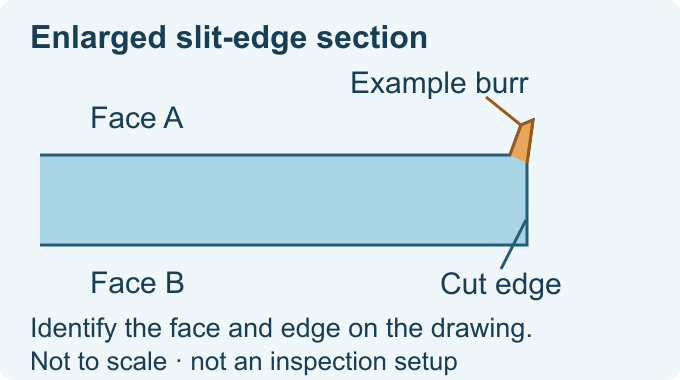
Slit, deburred and rounded describe different requirements
Slitting separates a wider coil into narrower widths by a shearing operation. The resulting edge can include a burr. If the edge matters to the component or process, define its delivered condition rather than assuming that a slit-width tolerance also controls burrs.
- Slit edge: identify the as-slit condition and any separately agreed burr and edge-defect limits.
- Deburred edge: define the required result after burr removal. This term alone does not prescribe a radius, chamfer or complete edge profile.
- Rounded or profiled edge: provide the drawing and acceptance features needed by the part. Confirm how the profile and finished strip width will be checked.
Do not transfer steel strip edge classes, another mill’s numerical capabilities or a generic percentage-of-thickness rule into a titanium order without an applicable specification and supplier agreement.
Identify the face, edge and delivery orientation
Use a drawing or marked example to name the two faces and the inspected edges. If “left” and “right” are used, state the viewing or feed direction. Also distinguish a face label from the inside or outside of a wound coil; the receiving team should be able to retain the agreed orientation when the material is unpacked or fed.
Where burr direction matters, state the permitted face or direction against those references. Ask how the proposed winding and package identification will preserve that relationship. Do not assume that “burr up” means the same thing to a slitter, a receiving inspector and a stamping operator.
Make the burr result reproducible
| Record | Agree before ordering |
|---|---|
| Inspected region | Which edges, faces, sample locations and quantity are covered |
| Feature and reference | Height or another required feature, its datum, direction and units |
| Material state | As received, after specified edge processing, or another agreed stage |
| Method | Suitable instrument or procedure, sample support and reporting basis |
| Acceptance | Actual limits, drawing revision, sampling and disposition process |
Burr height and the thickness at the burr base are different dimensions. A drawing should identify the feature being limited. Likewise, one local reading does not describe an entire edge unless it forms part of the agreed sampling and reporting method.
Agree whether sample preparation, support or contact with the edge could change the feature before it is recorded. An ordinary unscaled photograph can show a location or visible condition; it does not establish compliance with a numerical height limit by itself.
A useful RFQ instruction
“Quote the specified titanium strip with edge condition and permitted burr direction defined by our drawing. Confirm the proposed burr limit, measurement reference, method, inspected locations and sampling. Identify any edge-processing or winding changes needed before order confirmation, and tie the report to the supplied coil or lot.”
Add the actual grade, condition, thickness, width, tolerances, quantity and drawing revision. Request confirmation of the requirement rather than treating a suggested edge process as an established supply capability.
Resolve a receiving discrepancy before reworking the edge
Compare the reported locations, orientation, material state and measurement basis first. Keep the coil identity, inspection records and any affected samples connected. If the requirement has not been defined clearly, obtain a documented clarification instead of comparing results from different setups.
Where a claim or disposition is pending, agree any deburring, trimming or other rework before it changes the evidence. A material certificate confirms its stated material results; it does not by itself show that every delivered slit edge meets a separately ordered burr requirement.
For the other parts of a strip order, see coil dimensions and processing-line requirements. Keep edge inspection separate from camber and coil-set measurement.
Product route and technical references
Review the precision titanium strip product page against the required drawing and inspection scope.
Technical background: Ulbrich on slit-strip edges, Waelzholz on steel strip edge processing, and KEYENCE on burr dimensions and measurement. Their equipment capabilities and steel-specific requirements are not SAKY ALLOY titanium supply limits.
Review a slit-strip requirement
Send the grade, size, condition, quantity and edge drawing with your inspection requirements.