
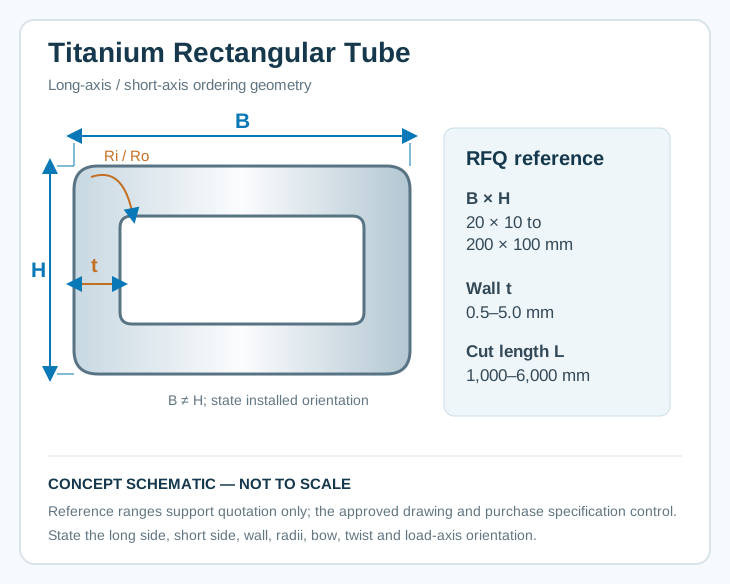
Concept engineering schematic, not to scale. RFQ reference ranges are not stock; the approved drawing controls.
Titanium Rectangular Tube
Titanium rectangular tube with unequal long and short sides for direction-dependent frame stiffness and compact equipment layouts. Typical RFQs reference 20 × 10 to 200 × 100 mm, 0.5–5.0 mm wall and 1,000–6,000 mm cut lengths; these are quotation guides, not stock.
- Grades
- Grade 2 / UNS R50400; Grade 5 / UNS R56400
- Width B × Height H
- 20 × 10 to 200 × 100 mm RFQ reference
- Wall t
- 0.5–5.0 mm RFQ reference
- Cut Length L
- 1,000–6,000 mm RFQ reference
Product Detail
Product Introduction
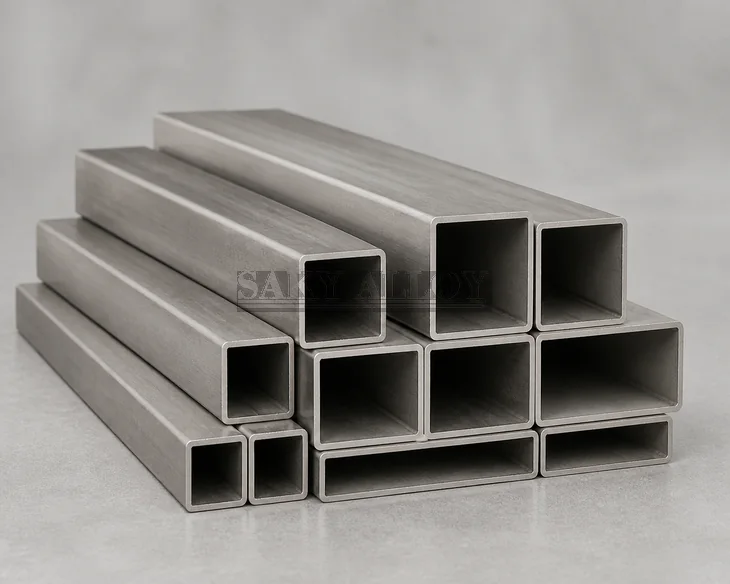
Titanium rectangular tube is defined by unequal outside width and height, wall thickness and the orientation of its long and short axes. It is selected where packaging space and bending stiffness differ by direction, so the drawing must identify installed orientation, side-specific dimensions, bow, twist and connection faces. A round-tube specification does not by itself define this non-round section.
Selection Priorities
Long and short axes
State outside width B, height H, wall t and corner radii separately; identify which face and axis are load-bearing in the assembly.
Directional straightness
Define bow on the long and short faces, twist over length, rectangularity and cut-end orientation because stiffness and fit-up differ by axis.
Manufacturing route
Confirm formed and welded or another approved route, seam location relative to the working face, surface condition and any post-forming heat-treatment requirement.
Product Specifications
| Product | Titanium Rectangular Tube | Grade | Titanium Grade 2, Grade 5 or specified alloy |
|---|---|---|---|
| Standard | Titanium rectangular tubing is commonly supplied to a customer drawing and agreed manufacturing/inspection specification. ASTM / ASME terms are the primary purchasing references. EN/W.-Nr. 3.7035 and 3.7165, JIS titanium grade terminology, and GB/T TA2 or TC4 keywords can also be reviewed when the exact product-form standard and revision are stated; they are not automatic equivalents. Do not cite a round heat-exchanger-tube standard as a substitute for non-round geometry and acceptance criteria. | Size & Form | Rectangular hollow section; 20 × 10 to 200 × 100 mm RFQ reference, 0.5–5.0 mm wall and 1,000–6,000 mm cut-length RFQ reference. These values are quotation guidance, not stock. |
| Tolerance | Drawing-defined long and short sides, wall, corner radii, rectangularity, face-specific bow, straightness, twist and cut-end orientation | Supply Condition | Straight cut lengths in agreed formed or welded condition with protected ends and bundle or case packing |
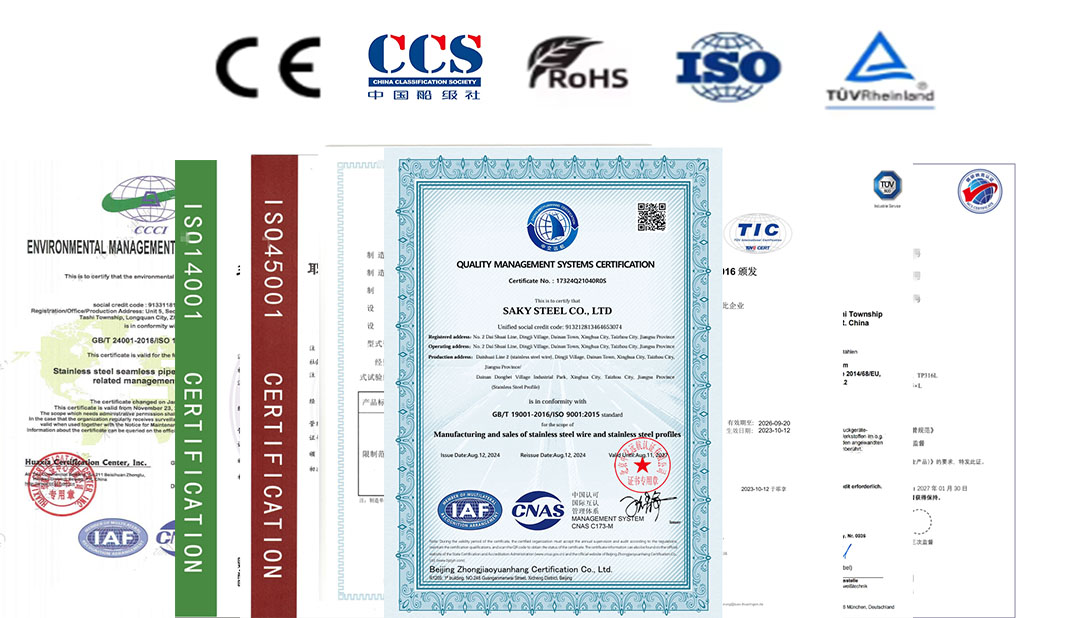
| Inspection | Long-side and short-side outside dimensions, wall, corner radii, rectangularity, face-specific bow, straightness, twist, cut-end orientation, surface and weld seam where applicable are reviewed against the order. Product test certificates can be provided. | Documents | Product test certificates can be provided. |
Additional Supply & Ordering Details
Useful, technically consistent information consolidated from earlier product pages.
| Section definition | Rectangular titanium tube has unequal outside width and height. Specify both outside dimensions, wall, corner radii, length, straightness, twist and rectangularity; width and height orientation must appear on the drawing. |
|---|---|
| Manufacturing-route boundary | Formed-and-welded, extruded, drawn or machined hollow routes can differ in corner radii, wall distribution and available aspect ratio. Confirm route, seam location and governing project requirements. |
| Orientation and loading data | Identify the major and minor axes, mating surfaces, seam orientation, cut or hole locations and whether bending, welding or finish machining follows. These inputs are more important than an equivalent round size. |
| Inspection focus | Measure width, height, diagonals, wall, corner radii, twist, bow and end squareness; inspect seam quality for welded construction and protect broad faces from transport damage. |
Send the complete material RFQ
Include grade, specification revision, dimensions, tolerance, quantity, condition, tests and destination.
Chemical Composition
Weight percent; maximum unless a range is shown. Titanium is the balance. The ordered specification and grade control.
| Grade / UNS | Principal Alloying Elements | Fe max | O max | C max | N max | H max | Ti |
|---|---|---|---|---|---|---|---|
| Grade 2 / R50400 | — | 0.30 | 0.25 | 0.08 | 0.03 | 0.015 | Balance |
| Grade 5 / R56400 | Al 5.50–6.75; V 3.50–4.50 | 0.40 | 0.20 | 0.08 | 0.05 | 0.015 | Balance |
Mechanical Properties – Annealed Material Reference
| Grade | Ultimate Tensile Strength min | 0.2% Yield Strength min | Elongation min |
|---|---|---|---|
| Grade 2 | 345 MPa | 275 MPa | 20% |
| Grade 5 | 895 MPa | 828 MPa | 10% |
Representative minima only. Product form, section size, heat treatment and the invoked specification determine the certified acceptance values.
Typical Physical Properties
| Grade | Density | Elastic Modulus | Thermal Expansion |
|---|---|---|---|
| Grade 2 | 4.51 g/cm³ | Approx. 105 GPa | Approx. 8.6 µm/m·K |
| Grade 5 | 4.43 g/cm³ | Approx. 114 GPa | Approx. 8.6 µm/m·K |
Typical engineering references, not inspection acceptance limits.
Certificates & Inspection Records
Services We Can Provide
Product Packaging
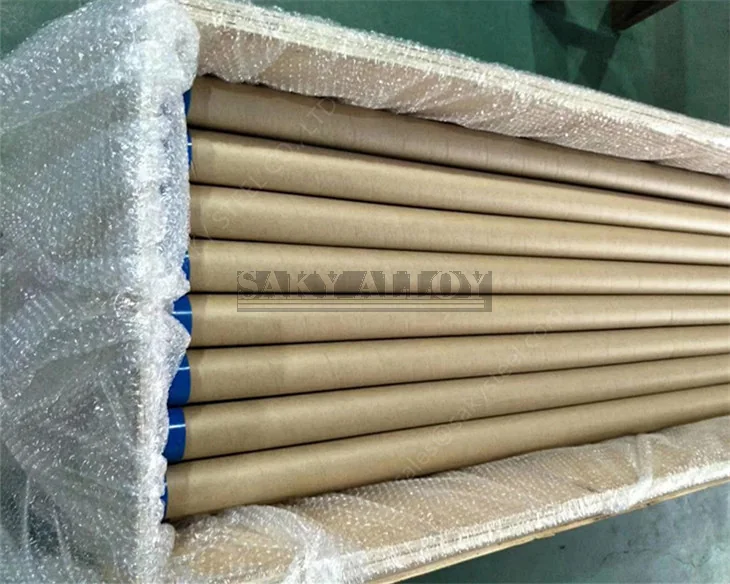
Pipe and tube ends are capped, surfaces are wrapped where required, and bundles or export cases are identified by grade, size, heat and quantity. Typical export packaging for the same physical product form is shown below; final packing is confirmed for each order.
Application Scenarios
Low-profile equipment frames and enclosures
Material grade, dimensions, condition and inspection must be matched to the application requirements.
Directionally loaded rails, beams and support members
Material grade, dimensions, condition and inspection must be matched to the application requirements.
Compact chemical and marine assemblies with unequal section depth and width
Material grade, dimensions, condition and inspection must be matched to the application requirements.
FAQ
Why must rectangular tube orientation be shown on the drawing?
Its long and short axes have different bending stiffness and different connection faces. The installed orientation affects fit-up and structural behavior.
Which measurements are needed for a rectangular section?
Provide long side B, short side H, wall, corner radii, face-specific bow, rectangularity, twist, length and cut-end orientation.
Is titanium rectangular tube covered by ASTM B338?
ASTM B338 primarily addresses seamless and welded tubes for condensers and heat exchangers. Non-round rectangular sections should be ordered to an explicit drawing and agreed manufacturing and inspection specification.
Can the weld seam be placed on any face?
Seam position and acceptance should be agreed during manufacturing review, especially when one face is visible, machined, bent, clamped or highly loaded.
Leave Your Message
Related Technical Guides
How to Specify Titanium Capillary, Square and Rectangular Tube
Define small-bore and hollow-section requirements.
Read technical guideTitanium RFQ Checklist
Prepare grade, dimensions, tests and documents.
Read technical guideComplete Titanium Product Guide
Compare product forms and sourcing.
Read technical guide