

Titanium Strip Camber vs Coil Set: Agree the Measurement Before Ordering
Camber is sideways curvature of a strip edge within its plane; coil set is lengthwise curl out of that plane. For a titanium strip order, specify them separately and agree the sample length, support, restraint and supply condition before comparing measurements or deciding acceptance.
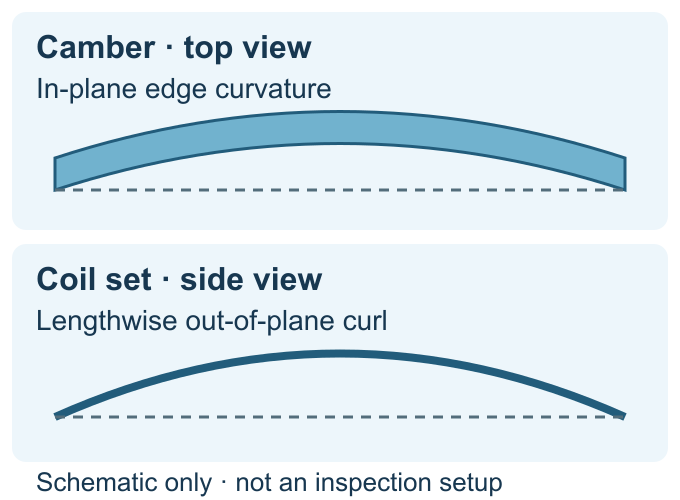
Two shape features, two different records
A strip can show both features. An acceptable camber result does not establish acceptable coil set, and a strip held flat does not necessarily have a straight edge. Crossbow across the width and local edge waves are separate shape issues.
| Feature | What to observe | What the report must define |
|---|---|---|
| Camber | An edge deviating sideways from a straight reference in top view | Reference edge, gauge length, datum and maximum lateral deviation |
| Coil set | A sample curling along its length in side view | Sample length, orientation, support points, restraint and the agreed result definition |
Agree the conditions before setting a limit
A number such as “maximum deviation” is incomplete without a reproducible method. Put the following decisions in the drawing, inspection instruction or agreed order attachment:
- Material state: as supplied, after a specified uncoiling procedure, or after agreed leveling. Keep incoming-material acceptance separate from a processing-line trial.
- Sample definition: cut length, gauge length, sampling position and frequency. Identify the coil and sample so the result can be traced back.
- Support and restraint: surface or support arrangement, which face is uppermost, and whether any load or clamping is permitted. Do not silently flatten or tension a sample during a free-state check.
- Datum and reading: the reference edge or line for camber; the reference plane, span and height or other agreed metric for coil set. Include units and measurement equipment.
- Acceptance and reporting: separate limits for each required feature, the governing method and revision, and any retest or disposition procedure.
Do not import a tolerance from a steel strip chart or another supplier’s capability statement into a titanium order. Confirm the applicable material specification, edition, product form and supplementary requirements; use the agreed method when a specific shape requirement needs further definition. A grade designation alone is not a shape acceptance instruction.
Suggested wording for an RFQ or inspection attachment
“Please review separate camber and coil-set requirements for the specified titanium strip. Confirm the sample and gauge lengths, sampling locations, supply condition, orientation, supports, permitted restraint, datums and reporting units against our inspection drawing. Identify any proposed method or limit changes before order confirmation. Report the coil identity, measured results and agreed method revision.”
This wording is a starting point, not a complete specification. Add the actual limits and method details needed by your application. For coil ID, OD, weight and slit-width data, see how to specify titanium coil geometry.
When receiving and supplier results disagree
Compare the methods before comparing the numbers. Check that both reports use the same length, orientation, material state and restraint. A photo without a scale, datum or sample identity can document an observation, but cannot by itself demonstrate compliance with a numerical limit.
Retain the coil label, sample identity and photographs showing the agreed setup. Record whether the material was already straightened, tensioned or otherwise processed. Obtain an authorized disposition before corrective processing if it could change the evidence needed for the claim. Successful feeding on one machine does not replace the purchase-order acceptance criteria.
Related material and technical references
Review the precision titanium strip product page and titanium coil and strip range alongside your drawing. Availability and any special shape controls require order-specific review.
Geometry references: Ulbrich’s rolled-strip camber guide and the WorldAutoSteel roll-forming shape discussion. The latter concerns steel; its numerical limits and processing guidance are not titanium acceptance requirements.
Review a titanium strip requirement
Send the grade, size, condition, quantity and drawing with your camber and coil-set measurement requirements.